A War With No Endgame
The United States and Israel have struck Iran, killing Supreme Leader Khamenei, destroying much of Iran's political leadership, and reportedly eliminating half of its ballistic missile launchers. Joseph Webster, a senior fellow at the Atlantic Council's Global Energy Center who also edits the independent China-Russia Report, published an early assessment of the conflict's implications for energy markets and the China-Russia relationship. His analysis is sober, data-rich, and notable for what it refuses to predict.
There is war in the Middle East again.
That spare opening sentence carries more weight than its five words suggest. Webster does not sensationalize. He acknowledges uncertainty repeatedly, and the restraint lends his claims credibility when he does stake out positions.
The Strait of Hormuz Problem
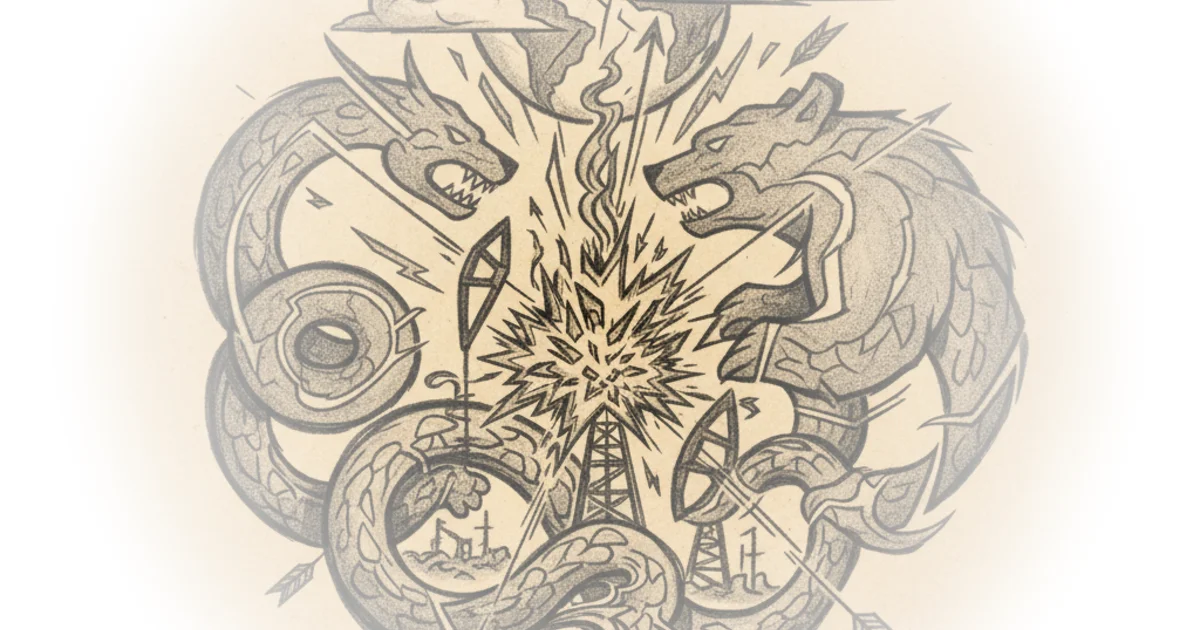
The heart of Webster's analysis concerns the Strait of Hormuz. He argues that the Iranian government, or what remains of it, retains the capacity to disrupt one of the world's most critical shipping lanes for weeks, months, or potentially years.
The Iranian government -- or whatever is left of it -- can very likely disrupt Strait of Hormuz shipping for weeks, months, or even years, if it is willing to endure the considerable costs.
Webster draws a parallel to Yemen's Houthi disruption of Red Sea shipping, where transit volumes fell 70 percent in four months despite limited Houthi capabilities and U.S. air dominance. The Strait of Hormuz, he notes, presents an even more favorable geography for disruption: its ship lanes are narrower, and Iran's military is more capable than the Houthis.
The analysis identifies three threat vectors beyond missiles. Naval mines may prove the most dangerous. A single mine can disable or sink a vessel, and the mere threat of mines can freeze shipping for months. Webster points to Ukraine's Black Sea de-mining effort, which neutralized about 50 mines in 2025 with the full operation expected to take decades. He also flags rocket-launched artillery and GNSS spoofing as tools Iran could deploy in combination.
U.S. mine countermeasure capabilities have atrophied, and de-mining operations would need to be conducted methodically, and potentially while under fire from Iran's onshore and naval forces.
One might push back on the Houthi analogy, however. The Red Sea disruption succeeded in part because Western powers chose restraint over escalation. Webster acknowledges this distinction but does not fully reckon with it. A full-scale war footing against Iran would look nothing like the measured response to Houthi attacks. The political calculus, force commitment, and rules of engagement would be fundamentally different. The comparison is instructive but risks overstating Iran's leverage in a scenario where the United States has already committed to regime-altering strikes.
Oil Prices and the Recession Scenario
Webster builds his most alarming case around energy markets. The Middle East accounts for 41 percent of all seaborne oil supply, and sustained outages across even a fraction of that volume could, in his estimation, drive prices to historic highs.
If large-scale, long-duration physical outages occur in the Middle East, oil prices, inflation, and interest rates could rise much higher than in June 2022, in a worst-case scenario. A comparable and sudden tightening of financial conditions for the capital-intensive U.S. artificial intelligence buildout would plunge the U.S. into a recession -- or far worse.
He grounds this in the 2022 precedent, when Russia's invasion of Ukraine pushed West Texas Intermediate crude to 115 dollars per barrel, U.S. inflation to 7.9 percent, and the Federal Funds rate from zero to above 5 percent. Crucially, that price spike occurred without large-scale physical supply disruptions. The current scenario could involve actual supply loss.
The political dimension is equally revealing. Webster highlights that no senior Trump officials appeared on Sunday news shows following the strikes, a striking absence. Vice President Vance and other reportedly skeptical officials were in the Situation Room in Washington rather than with the president in Florida.
Vance and others seem to be adopting a wait-and-see approach before fully supporting the strikes, suggesting some concern about the trajectory of the conflict.
That physical and symbolic distance between the vice president and the president during a major military operation is a detail worth lingering on. It suggests internal division at the highest levels of the administration over an operation already underway.
The China-Russia Fault Line
Webster's most distinctive contribution is his analysis of how the conflict exposes tensions between Beijing and Moscow. The structural logic is straightforward: China is the world's largest energy importer, while Russia is one of its largest energy exporters. A sustained disruption to Middle Eastern oil benefits Moscow and hurts Beijing.
China and Russia hold fundamentally different economic perspectives on the war and resulting energy outages, although that doesn't preclude joint action against the United States, given that both Beijing and Moscow prioritize regime interests, including in foreign policy, over their subjects' well-being.
Webster marshals several data points to support this thesis. Chinese Foreign Minister Wang Yi had publicly warned his Russian counterpart about their distinct interests before the crisis. The Chinese navy skipped joint exercises with Iran and Russia ahead of the conflict. And Wang Yi's first call on the day of the strikes was to Russian Foreign Minister Lavrov, warning that the Middle East situation could be "pushed into a dangerous abyss." Meanwhile, Kirill Dmitriev, chief executive of the Russian Direct Investment Fund, tweeted triumphantly about the prospect of 100-dollar-per-barrel oil.
Yet Webster resists the temptation to overstate the rift. He reminds readers that Xi Jinping backed Russia's invasion of Ukraine despite the direct economic costs to China from higher commodity prices and increased Western tensions. If Xi was willing to absorb those costs, he might similarly accept the risks of supporting Iran.
Xi may believe that direct support for Tehran -- perhaps via kill chain support -- is the quickest way to end the conflict, or may be necessary to prevent Iran from targeting non-military targets, especially regional energy infrastructure.
The "good cop, bad cop" framework Webster proposes, with Beijing tacitly encouraging Moscow to provide military assistance while maintaining its own deniability, is plausible but somewhat speculative. It assumes a level of coordination between Xi and Putin that their recent public friction might not support. It also underestimates the degree to which both leaders operate on parallel tracks rather than in genuine concert.
Loose Ends Worth Watching
Webster closes with two underreported stories that deserve wider attention. The first involves Iranian crude oil stored on vessels off the Malaysian coast, which was at record levels in January. With the United States effectively at war with Iran, the question of whether China will attempt to take ownership of that floating inventory creates a flashpoint with no obvious precedent.
The second concerns the Hong Kong-flagged tanker Sea Horse, a Chinese-owned vessel carrying Russian fuel that was reportedly bound for Cuba before diverting. Webster connects this to the Trump administration's sudden reversal on Cuban oil restrictions, asking whether pressure from Moscow and Beijing forced Washington's hand on Western Hemisphere policy.
Given that the Cuba story has a nexus to Iran -- not to mention the so-called "Donroe Doctrine" -- it would be great if reporters could uncover what's going on, and find if pressure from Moscow and Beijing is leading Washington to reverse course on Western Hemispheric policies.
These are exactly the kinds of questions that tend to get buried under the volume of breaking-news coverage during a military conflict. Webster is right to flag them.
Bottom Line
Webster's analysis stands out for its disciplined uncertainty. He does not pretend to know how the conflict will evolve, and he says so plainly. What he does is map the pressure points: a narrow strait vulnerable to asymmetric disruption, an energy market that could spike catastrophically, and a China-Russia partnership that wants the same geopolitical outcome but holds opposite economic interests in how it arrives. The piece is strongest on the specific mechanisms of Strait disruption, weakest on predicting Chinese behavior, and most valuable as a framework for watching what comes next. In a media environment racing to declare winners and losers within hours, the willingness to say "there is a huge amount of uncertainty" is itself a form of analysis.