Yascha Mounk cuts through the noise of political speculation to ask a question many are too afraid to voice: Is the current administration's leader actually capable of governing, or is the entire system running on autopilot? While the media cycle obsesses over gaffes, Mounk offers a chillingly clinical dissection of a presidency that appears to be fracturing under the weight of age, yet retains enough momentum to remain dangerous. This is not a hit piece on personality; it is an institutional risk assessment of a leader who may no longer be fully present in the room where it happens.
The Illusion of Vitality
Mounk begins by dismantling the comforting narrative that the executive branch is in imminent collapse. He observes that while the President is undeniably older, the decline is not as linear or total as Democrats might hope. "If, for long swathes of his term, Joe Biden made no public appearances at all, spoke only when reading from a teleprompter, and kept his appearances to short and scripted exchanges, Trump continues to interact with the press and to speak off the cuff," Mounk writes. This distinction is crucial. It suggests that the administration's functionality relies less on cognitive sharpness and more on a performative energy that can mask underlying deficits.
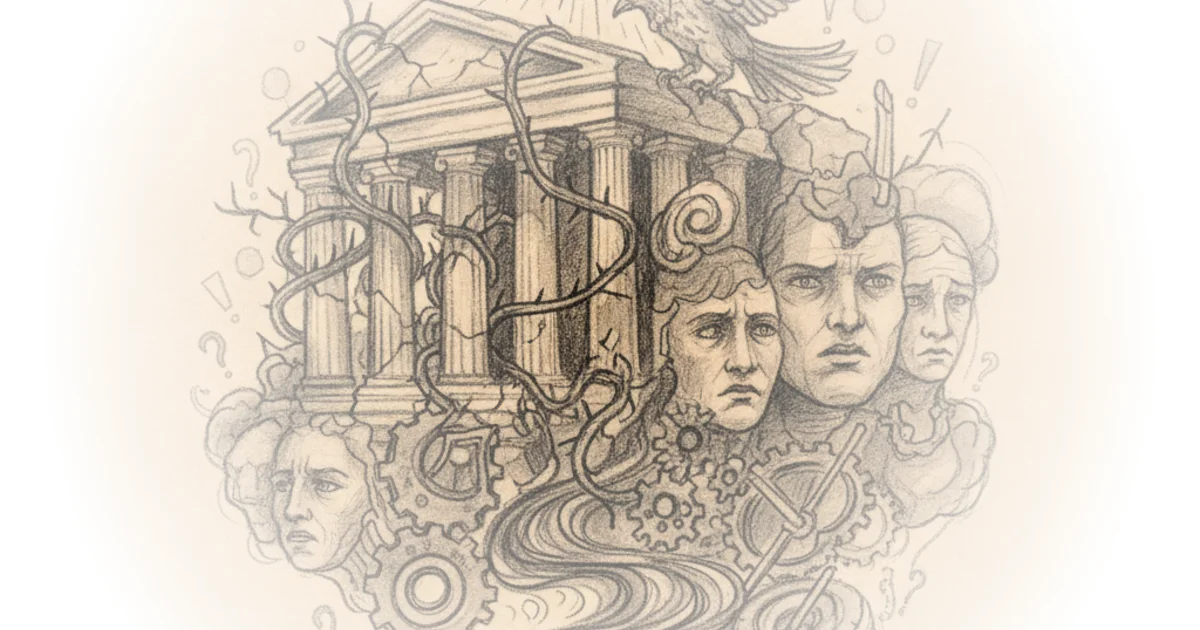
The author contrasts the current President's 2026 demeanor with his 2015 campaign, noting that while he has slowed, he remains "voluble and pugnacious." Mounk argues that critics expecting a sudden breakdown are likely to be disappointed because the President's baseline behavior—rambling, interrupting, and shouting—has always been a feature, not a bug. However, this framing risks underestimating the difference between a calculated "pugilistic" style and genuine cognitive drift. As Mounk notes, "The impression he gives is of barely being able to contain his energy and rage," but when that energy is paired with factual confusions, the line between strategy and senility blurs.
"Even with his voice weaker and his presence diminished, there's the same patter—the certainty of being at the center of attention, the litanies of enemies and grievances, the not-always-entirely plausible record of his own accomplishments, the firehose of falsehoods."
The Glitches in the System
The core of Mounk's analysis lies in the specific, disturbing incidents that suggest a neurological decline rather than mere political clumsiness. He points to the President's inability to distinguish between nations, noting that at a recent NATO summit, the leader "swaps the name of 'Iran' with 'Japan'" during a high-stakes discussion. Mounk finds the video of this exchange inconclusive regarding intent but damning regarding capability, suggesting the errors are "more attributable to his not knowing his blocking and being bored out of his mind" than simple carelessness.
More alarming are the reports of the President sleeping during cabinet meetings, a claim the Secretary of State, Marco Rubio, has vehemently denied under oath. Mounk writes, "It definitely looks like he's sleeping—no matter that Secretary of State Marco Rubio found himself swearing under oath to Congress that 'I've never seen him fall asleep, on the contrary the guy doesn't sleep.'" This contradiction highlights a growing opacity within the White House, where official denials clash with visual evidence. The author suggests that the administration is becoming a collection of "fiefdoms," with figures like Rubio and Stephen Miller pushing agendas without obvious direct control from the top.
A counterargument worth considering is that Mounk may be over-interpreting the significance of these gaffes. In the past, similar lapses were dismissed as rhetorical flourishes or strategic distractions. However, the consistency of these errors—confusing Greenland with Iceland, Iran with Japan, and Nikki Haley with Nancy Pelosi—suggests a pattern that goes beyond the usual political theater. As Mounk puts it, "The content of what he's saying often, increasingly, seems to not matter to him... but the 'weave,' as he describes his speech, always widens out before holding together."
The Succession Vacuum
Perhaps the most profound insight Mounk offers is the shift in the Republican Party's internal dynamic. The author notes that the "fanaticism" that once surrounded the President has evaporated, replaced by a quiet preparation for life after him. "Simon Tisdall argued, in late 2025, that 'we're seeing the first signs of the battle over Trump's succession,' with JD Vance and Marco Rubio, the two most likely heirs, carving out their separate lanes," Mounk writes. This is a stark departure from the 2024 election cycle, where no serious threat to the President emerged.
The article draws a parallel to historical precedents of aging leaders, referencing the "Presidential Fitness Test" discussions that have surfaced in political science circles. Just as the 1919 stroke of Woodrow Wilson left the executive branch in limbo, the current administration's ambiguity about the President's health creates a power vacuum. Mounk observes that even the President's most fervent supporters are now thinking about 2028, with Steve Bannon arguing that "a guy like this comes around once in a century and we've got to get everything out of Trump we can get."
"The sense that Trump is diminished is starting to run through the conservative world. Even thinking about a succession is a far cry from what the Republican Party looked like in the lead-up to 2024 when no serious threat to Trump emerged."
This observation is the piece's most significant contribution. It moves the conversation from "is he healthy?" to "what happens when he isn't?" The author suggests that the administration is effectively running without a clear commander, relying on a system that is increasingly fragile.
Bottom Line
Yascha Mounk's strongest argument is that the President's decline is not a sudden collapse but a slow, uneven erosion that has already allowed other power centers to emerge. The piece's biggest vulnerability is its reliance on visual interpretation of public appearances, which can be ambiguous, yet the cumulative weight of the evidence is undeniable. Readers should watch not for a dramatic resignation, but for the quiet consolidation of power by the Vice President and cabinet members who are already positioning themselves as the true architects of the administration's future.