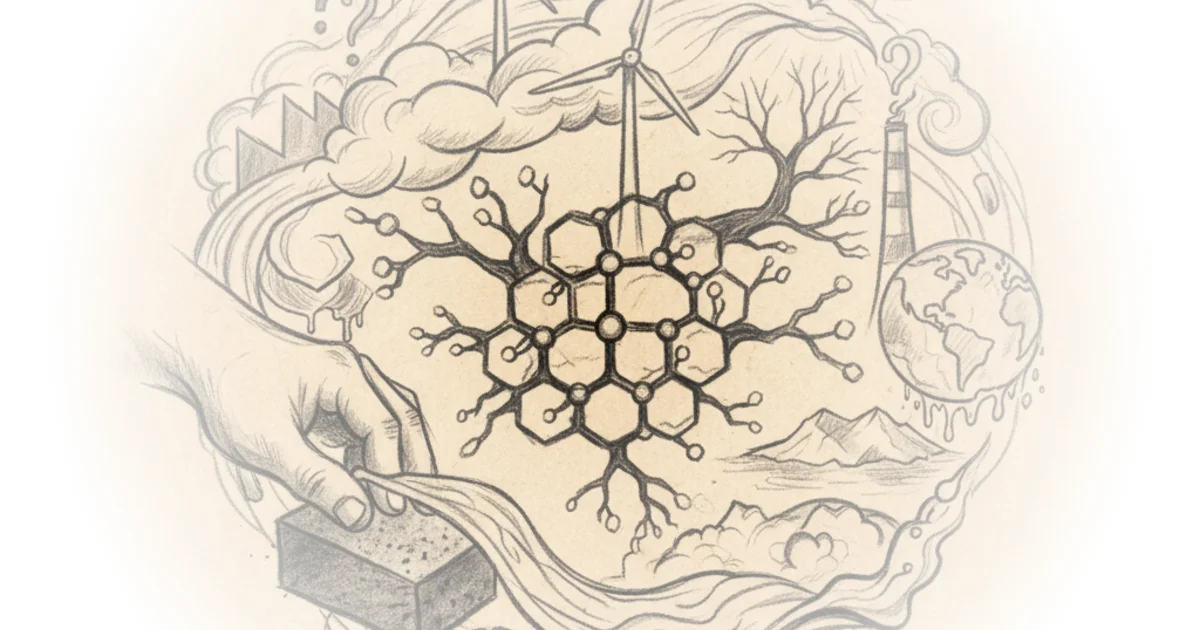
Dave Borlace opens with a playful demonstration—peeling tape off graphite to reveal a single-atom-thick layer of carbon—only to pivot quickly to a sobering reality: the material that could revolutionize climate action has long been trapped by the very difficulty of making it. The piece's most striking claim is that the "magic" of graphene is no longer just theoretical; recent breakthroughs in explosive synthesis and continuous manufacturing have finally unlocked the door to industrial-scale production, turning a laboratory curiosity into a potential global climate tool.
The Manufacturing Breakthrough
Borlace frames the history of graphene not as a story of slow academic progress, but as a sudden shift in human problem-solving. He notes that for years, the only way to make high-quality graphene was the "Scotch tape method" used by Sir Andrei Geim and Konstantin Novoselov in 2004, a technique that won a Nobel Prize but offered no path to volume. "Following the very best traditions of the human approach to problem solving... it was only a matter of time before one group of people decided to see if they could make more graphene more quickly by blowing stuff up," Borlace writes. This refers to a 2017 experiment by Kansas State University researchers who used a spark plug and acetylene gas to create an explosion that left behind pure carbon in a graphene structure.
This reframing of "explosions" as a manufacturing solution is effective because it highlights the ingenuity required to overcome the cost barrier. Borlace explains that while the resulting material wasn't in neat sheets, the sheer quantity produced was a massive leap forward. He then contrasts this with a 2018 MIT development, where researchers created a continuous process feeding foil through a system "like a printing press." As Dave Borlace puts it, "if this were in a factory it'll be running 24/7... you'd have big spools of foil feeding through." The argument here is that the bottleneck has shifted from scientific discovery to industrial scaling, a critical distinction for investors and policymakers watching the sector.
"Short of making you a cup of tea in the morning, that doesn't seem to be much this stuff can't."
Concrete, Water, and the Carbon Cost
The commentary then moves to the practical applications, starting with the construction industry. Borlace identifies concrete as the "third largest emitter of carbon dioxide," noting that producing one ton of cement releases 1.25 tons of CO2. The potential fix lies in adding graphene to the mix. He cites researchers at Exeter University who found that graphene can "double the strength of standard concrete and increase its water resistance by four times." This allows for a reduction in cement usage, which Borlace describes as a "game-changer for the construction industry."
This section is particularly strong because it connects a microscopic material property to a macroscopic environmental crisis. Borlace quotes Professor Monica Crassian, who estimates the technique could reduce carbon emissions by "around four hundred and forty six kilograms per tonne." Critics might note that the energy required to produce the graphene itself must be factored into this net-zero calculation, but Borlace's focus on the reduction in cement volume addresses the largest source of emissions directly. The argument holds weight because it targets a ubiquitous material that is currently impossible to replace entirely, offering a way to make the existing infrastructure greener rather than waiting for a complete paradigm shift.
The Water and Energy Frontier
The piece expands its scope to water scarcity, a crisis affecting "more than 40 percent of the global population." Borlace argues that current desalination methods are "extremely expensive and massively energy-hungry," but graphene membranes offer a solution. He highlights research from the University of Manchester and MIT, noting that graphene filters are "many tens of times higher" in permeability than conventional reverse osmosis membranes. "The beauty of graphene is that its structure is tightly packed enough then it can allow water through while filtering out the salt," Borlace explains.
This application is compelling because it addresses two problems simultaneously: energy consumption and water access. However, the transition from lab success to global deployment remains a hurdle. Borlace acknowledges this by mentioning the European Union's "Graphene Flagship," a billion-euro initiative designed to coordinate research on an "unprecedented scale." He suggests this level of funding is essential for "implementing the distributed smart electrical grid" across Europe.
"The ability to use graphene is making possible truly flexible, low-cost, transparent solar cells that can turn virtually any surface into a source of electrical power."
Finally, the commentary tackles energy storage, a critical weakness in the renewable transition. Borlace points out that while solar panels are improving, the ability to store that energy efficiently is lagging. He cites a 2015 report by Ray Doner on the skeptical science website, noting that graphene has already been used to "vastly improve the recharge time, reportedly 15 minutes, and increase the capacity by as much as 10 times of lithium batteries." The potential for "holy graphene" capacitors with "unparalleled energy density" suggests a future where batteries charge instantly and last indefinitely.
Critics might argue that the timeline for commercialization is optimistic, especially given the history of "hype cycles" in battery technology. Borlace tempers this by referencing a specific project by Sanson Carbon aiming for production batteries by 2020, grounding the futuristic claims in concrete (pun intended) development schedules. The narrative effectively builds a case that graphene is not a silver bullet, but a force multiplier that could make existing renewable technologies viable at scale.
Bottom Line
Borlace's strongest contribution is his ability to strip away the "Nobel Prize" mystique and focus on the industrial mechanics of scaling a material that was once impossible to mass-produce. The argument's biggest vulnerability lies in the assumption that cost reductions will happen fast enough to outpace climate tipping points, a timeline that remains uncertain. Readers should watch for the commercial rollout of graphene-enhanced concrete and desalination membranes, as these are the first tangible indicators that the "explosive" manufacturing breakthroughs are translating into real-world climate solutions.