Jason Slaughter doesn't just critique a transit system; he exposes a profound cultural contradiction where a city claims to value its people while systematically prioritizing the convenience of single-occupancy vehicles. In a piece that blends historical context with visceral frustration, Slaughter argues that Toronto's streetcars are not merely outdated, but actively sabotaged by a planning philosophy that treats cars as the default and everyone else as an obstacle. This is essential listening for anyone who believes urban density and transit ridership are mutually exclusive, because Slaughter proves that high demand exists even when the service is deliberately crippled.
The Car-First Legacy
Slaughter begins by dismantling the nostalgia often associated with Toronto's transit history, revealing that the city's current struggles are the result of intentional policy choices rather than inevitable decay. He notes that while many North American cities scrapped their streetcar networks to accommodate automobiles, Toronto retained its lines only to neglect them. "The Queen Street subway should be started at once, eliminating 80% of the remaining street car operation in the downtown area and freeing many main streets for one-way traffic," Slaughter quotes from a 1954 transit official, highlighting how early leadership viewed streetcars as impediments to car flow rather than vital public infrastructure.
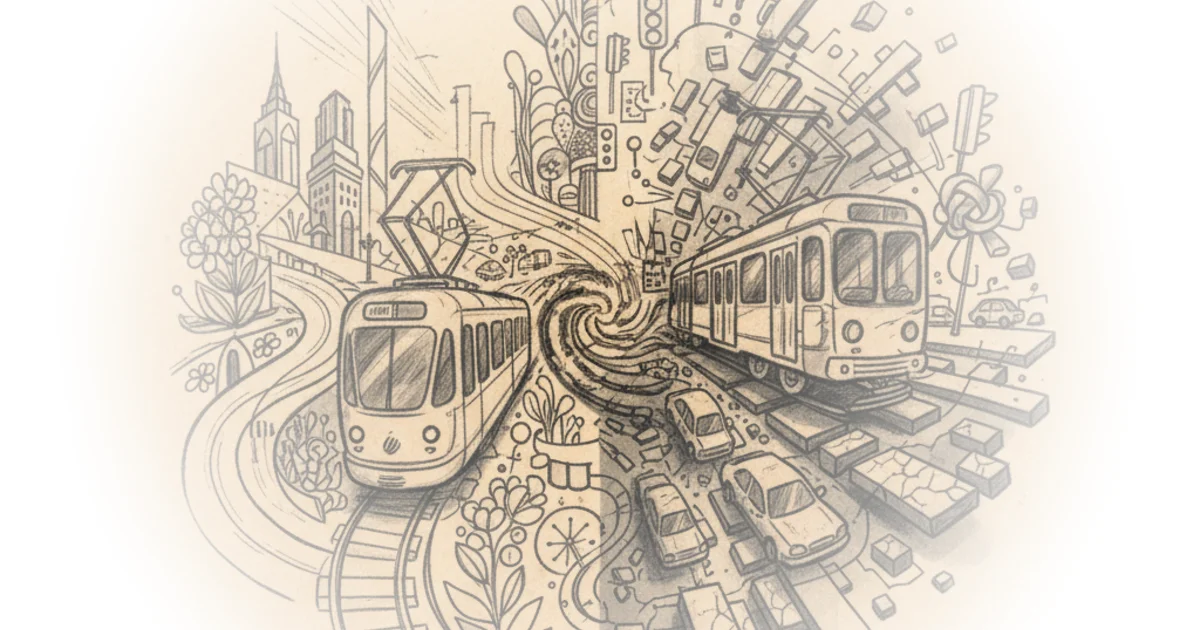
The author's historical framing is effective because it shifts the blame from "bad luck" to "bad design." He explains that despite public pressure stopping the removal of lines in the 1970s, the system was never modernized, operating instead as a "historic obligation" rather than a functional network. This oversight is critical: it suggests that the current inefficiency is not a lack of resources, but a lack of political will to treat streetcars as a priority. Critics might argue that retrofitting decades-old infrastructure in a dense, historic city is uniquely difficult, but Slaughter counters this by pointing to Amsterdam, where similar challenges were overcome through dedicated lanes and signal priority.
"The Toronto street cars move around 250,000 people every weekday... despite the fact that they've been so badly neglected and chronically underfunded for decades."
This statistic is the piece's most damning evidence. It proves that the system works despite the city, not because of it. The sheer volume of ridership in the face of such dysfunction underscores a desperate public need that the city has failed to meet.
The Physics of Frustration
Moving from history to the daily reality of riding the system, Slaughter details the specific mechanical and operational failures that make the streetcar experience maddening. He describes a scenario where the vehicle is "literally faster to walk" because it is stuck in mixed traffic, forced to stop for parking cars, and delayed by red lights that offer no priority to transit. "It is not an exaggeration to say that when you are on a Toronto street car, you will wait at almost every single intersection, if not for the red light, than for the street car stop," he writes, illustrating how the frequency of stops and the lack of signal priority destroy any sense of speed.
The author's comparison to European systems is particularly sharp. He notes that in Amsterdam, trams have dedicated lanes and traffic lights that automatically change to let them pass, whereas in Toronto, even dedicated lanes are undermined by poor signal timing. He describes a specific intersection on Spadina Avenue where a streetcar with dozens of passengers must wait for a few cars to turn left, even though the light is green for the tram. "Because cars come first and everything else needs to fit around that," Slaughter concludes, identifying the root cause as a hierarchy of road users that places the individual driver above the collective passenger.
This argument holds up under scrutiny, especially when considering the density of the neighborhoods served. The author points out that these areas have some of the highest population densities in Canada, yet the transit design assumes a car-centric lifestyle that the residents do not practice. A counterargument worth considering is that traffic engineers face complex trade-offs in signal timing to prevent gridlock on surrounding streets, but Slaughter's evidence suggests these trade-offs are consistently skewed against transit without sufficient justification.
The Accessibility Crisis
Perhaps the most damning section of Slaughter's commentary addresses the physical inaccessibility of the system, particularly for those with mobility challenges. He contrasts the seamless, level boarding found in modern European trams with the archaic process required in Toronto. "If someone in a wheelchair wants to get on or off a street car, they need to push a special button. This notifies the driver who needs to get out of the street car, go to the door, and extend a ramp," he explains, highlighting a process that is slow, unreliable, and undignified.
The author emphasizes that this is not a minor inconvenience but a fundamental design failure. Even with the introduction of new low-floor vehicles, the platforms remain too low, forcing a ramp deployment that requires the driver to leave their post. "There is no form of motorized transportation that is more accessible than a well-designed tram," Slaughter asserts, before immediately undercutting that potential by describing the reality of the Toronto system. This juxtaposition is powerful; it shows that the city has the technology to be world-class but chooses to operate at a fraction of its potential.
"You cannot see the street car. You are supposed to be there, not here."
Slaughter uses this quote from a safety announcement to illustrate the absurdity of the current setup, where passengers must step out into active traffic lanes to board. The lack of island platforms and the reliance on curb-side stops create a dangerous environment where drivers frequently ignore the flashing lights meant to protect boarding passengers. This section is the emotional core of the piece, transforming the argument from one of efficiency to one of basic human safety and dignity.
Bottom Line
Jason Slaughter's critique is a masterclass in connecting historical policy failures to present-day human suffering, making a compelling case that Toronto's streetcar system is a victim of its own car-centric planning. The strongest part of his argument is the undeniable proof that high ridership persists despite systemic neglect, proving that the demand for transit is robust even when the supply is broken. However, the piece's biggest vulnerability is its reliance on the assumption that political will can simply be switched on to fix these deep-seated infrastructure issues, a challenge that often proves far more complex than design changes alone. Readers should watch for how Toronto's city council responds to these specific, actionable critiques, particularly regarding signal priority and platform modernization.