Kings and Generals delivers a surprisingly sharp political autopsy of the Galactic Republic, framing the Clone Wars not as a sudden invasion, but as the inevitable collapse of a bloated bureaucracy unable to manage its own expansion. While the source material is a 3D documentary script, the analysis cuts deep into institutional decay, arguing that the Republic's greatest weakness was its own success in creating a peace that bred complacency and corruption.
The Illusion of Stability
The narrative begins by dismantling the myth of the "Great Peace." Kings and Generals writes, "This era of Peace would not last forever as the Republic grew larger cracks began to form within its bureaucratic system." The authors correctly identify that the Republic's stability was an illusion maintained by the Jedi Order acting as a de facto police force rather than a neutral guardian. By noting that the Jedi "slowly transformed from guardians of Peace into Protectors of the Republic," the commentary highlights a critical shift in institutional identity that alienated the very people they were meant to serve.
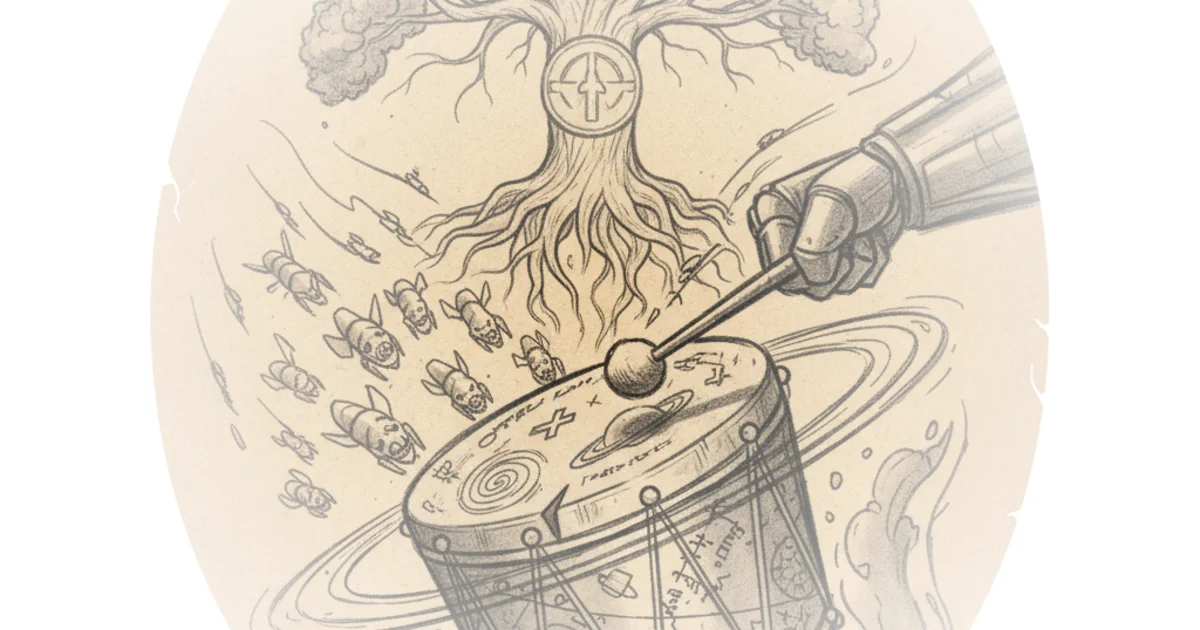
This framing is particularly effective because it moves beyond the surface-level "good vs. evil" trope often found in pop culture analysis. Instead, Kings and Generals points out that the Jedi "had confused the will of the force for the good of the Republic," a distinction that explains why the Outer Rim planets felt abandoned. The argument holds weight: when a peacekeeping force becomes a political enforcer, legitimacy evaporates. Critics might note that the documentary glosses over the genuine security threats the Jedi faced, but the core thesis—that the Republic's internal rot made the Jedi's overreach inevitable—remains compelling.
The Jedi had confused the will of the force for the good of the Republic, acting as policemen and ambassadors and playing their hand at politics.
The Corporate Secession
The piece then pivots to the economic drivers of the conflict, portraying the Separatist movement not as a chaotic rebellion, but as a calculated response to systemic neglect. Kings and Generals explains that mid and outer rim worlds, feeling exploited by the Core Worlds, began forming "business unions and trade federations that were legally recognized in the Republic as businesses but in truth functioned more as independent nations." This is a crucial distinction; the secessionists were leveraging the Republic's own legal framework to undermine it.
The authors argue that the tipping point was the Taxation Bill of 32 BBY, which targeted the Trade Federation. As Kings and Generals puts it, "The Nabu crisis made a good portion of the outer and mid rims turned towards the corporations instead as decisive action in their eyes was better than in action." This observation underscores a dangerous political reality: when a central government appears paralyzed by bureaucracy, radical alternatives become attractive. The documentary effectively illustrates how the Trade Federation's blockade was not just a criminal act, but a symptom of a government that had lost the trust of its constituents.
The Machinations of the Shadow Council
Perhaps the most chilling section of the commentary is its treatment of Count Dooku and the manipulation of the Senate. The authors reveal that while Dooku presented himself as a political activist, his "Rexus address" was a calculated move to legitimize a separatist council that was "entirely controlled by Dooku and his selective separatist Council." The narrative exposes the tragedy of the situation: the Republic was being dismantled from within by the very mechanisms designed to protect it.
Kings and Generals notes that the Senate's response was to pass laws making it "illegal for Republic representatives to meet with any representatives from the separatists," a move that only "further propelling the crisis." This is a classic example of how authoritarian measures intended to preserve order can accelerate collapse. The authors then detail the discovery of the Clone Army on Kamino, revealing that the Jedi had unknowingly commissioned a private army to fight a war the Republic didn't officially want. As the text states, "The Jedi Council sent Jedi Knight Obi-Wan Kenobi to investigate a lead he had discovered... he discovered the camans had been making a clone army for the Republic for years." This revelation reframes the entire conflict: the Republic was forced to militarize because its leadership had been outmaneuvered by a shadow war.
The Jedi toted that they followed the will of the force and all else wasn't their concern but in reality the Jedi had confused the will of the force for the good of the Republic.
Bottom Line
Kings and Generals succeeds in transforming a space opera into a rigorous case study on institutional failure, arguing that the Clone Wars were the result of a Republic that prioritized bureaucratic procedure over the needs of its citizens. The strongest part of this argument is the depiction of the Jedi's loss of neutrality, which serves as the catalyst for the entire conflict. However, the analysis occasionally underplays the genuine malice of the Sith's manipulation, treating the conflict more as a political inevitability than a deliberate conspiracy. Readers should watch for how this framework applies to real-world institutions where bureaucracy and security forces begin to blur the lines of accountability.
The Republic was unlike anything that came before it... but now nearly 25,000 years after its founding it was beginning to fall apart with its once hopeful light being swallowed by an unseen dark force.