Most observers dismiss the current tariff frenzy as economic self-sabotage or political theater. Joeri Schasfoort, writing for Money & Macro, argues the opposite: the chaos is a deliberate, high-stakes gambit to dismantle the very global trading system the United States built. This isn't just about trade balances; it is a calculated attempt to reorient the entire world order to address a specific national security threat: deindustrialization.
The Strategic Chaos
Schasfoort frames the administration's erratic behavior not as incompetence, but as a necessary phase in a larger strategy. He points to the administration's inner circle, specifically Treasury Secretary Scott Bessent and economic adviser Steven Miran, as the architects of this shift. "President Trump's tariff policies have begun the process of reorienting our International economic relations," Schasfoort notes, quoting Bessent directly. The core argument is that the current volatility is a tool to generate leverage before a new, rigid structure is imposed.
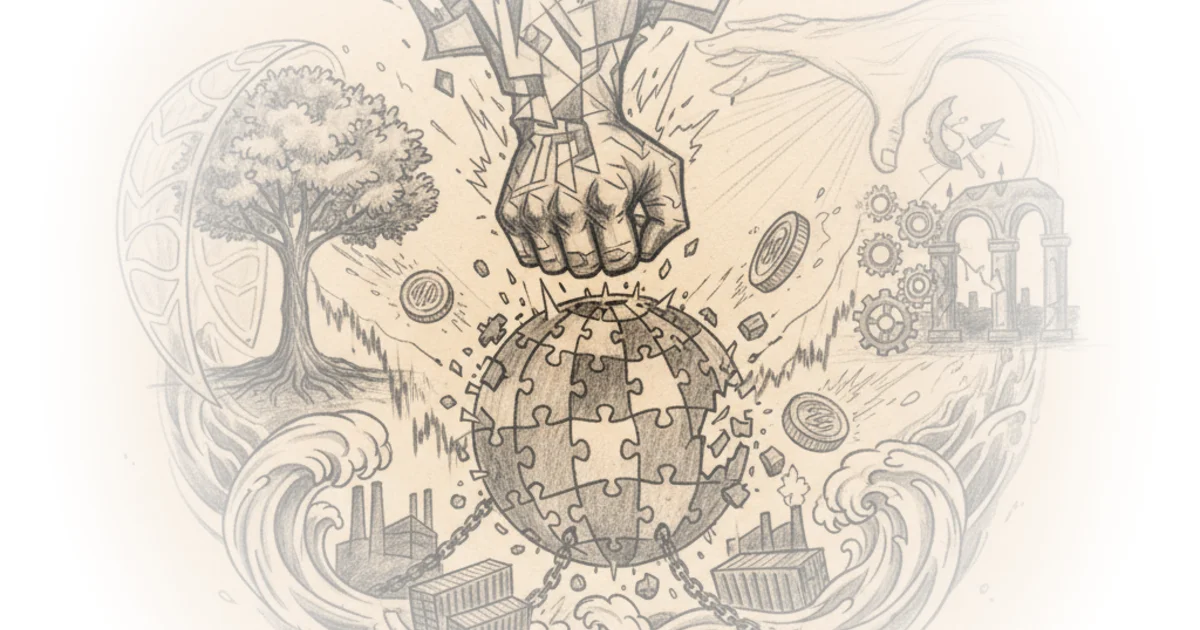
The author suggests that the administration is moving away from the "neoliberal world order" that prioritized global efficiency over domestic industrial capacity. Schasfoort writes, "This has really only happened twice before: once in 1944... and then in the early 80s with Reagan and Thatcher." By invoking these historical pivots, he positions the current moment not as a breakdown, but as a foundational reset. The administration's willingness to alienate allies is framed as a feature, not a bug, of this new approach.
"His tariff chaos is just a start of a much bigger plan: a plan that aims to upend the entire world trading system that the US itself created."
Critics might argue that such a blunt instrument risks triggering a global depression before the new order can be established. However, Schasfoort's analysis suggests the administration is betting that the pain of the transition is preferable to the long-term strategic vulnerability of a hollowed-out industrial base.
The Security Imperative
The driving force behind this shift, according to Schasfoort, is a profound fear of China's military potential. He highlights a specific concern raised by the administration: the inability to rapidly convert civilian manufacturing into military capacity in a crisis. "As Vice President JD Vance has noted, US de-industrialization has gotten so bad that one of Beijing state-owned firms built more commercial ships just last year than all of America has produced since the end of World War II," Schasfoort reports. This statistic anchors the entire argument, transforming tariffs from a trade dispute into a defense necessity.
The piece details how the previous global order, characterized by low tariffs and open investment, inadvertently accelerated the decline of US manufacturing. Schasfoort explains that while the "exorbitant privilege" of the US dollar allowed for massive military spending, it also made domestic production uncompetitive. "The strong dollar made Americans in general much richer than they would otherwise have been," he writes, "however on the flip side it did make Manufacturing in the US much more expensive."
This creates a paradox the administration is trying to solve: how to maintain the dollar's dominance while rebuilding the factories needed to defend it. Schasfoort argues that the administration believes this is possible, citing Miran's work which suggests the US can "have your cake and eat it too." The strategy involves a three-step process, beginning with the current "tariff chaos" to force negotiations, followed by a system of reciprocal tariffs to ensure a level playing field.
A New Global Hierarchy
Perhaps the most striking element of Schasfoort's coverage is the description of the proposed new global order. He describes a system where countries are sorted into distinct categories based on their alignment with US interests. "I think we should make it very clear that there is a green a yellow and a red bucket," Schasfoort quotes Bessent, outlining a world where access to the US market and military protection is no longer a right of the neoliberal era but a privilege granted to allies.
In this vision, "green" countries receive low tariffs and preferred dollar access, while others are left to fend for themselves. Schasfoort writes, "It will become very clear that some countries Get Low tariffs, military protection and maybe even some preferred US dollar access, while others are left to fend for themselves." This represents a fundamental departure from the post-WWII model, which sought to integrate as many nations as possible into a rules-based system.
The author acknowledges the risks, noting that the first trade war under the previous administration failed to significantly reverse deindustrialization. Yet, he argues the current approach is different because it targets the structural incentives of the global system rather than just specific trade deficits. "The administration shows that it means business," Schasfoort observes. "It no longer cares about the stock market crashing."
"If you want to go to third world status, lose your reserve currency. We have to have it; we cannot lose it."
Bottom Line
Schasfoort's strongest contribution is reframing the administration's erratic tariff policy as a coherent, albeit risky, strategy to solve the national security crisis of deindustrialization. The argument's biggest vulnerability lies in its assumption that the global economy can absorb the shock of a sudden, hierarchical restructuring without collapsing the very supply chains the US seeks to protect. Readers should watch to see if the administration can transition from the current phase of chaos to the proposed system of reciprocal, tiered trade before the political or economic costs become unsustainable.