More Perfect Union exposes a terrifying paradox: beef prices are at record highs, yet the company processing 5% of America's supply is shuttering a plant that employs half a small town. The author doesn't just report a closure; they argue this is a calculated strategy by an oligopoly to manipulate markets, a claim that reframes a local tragedy as a symptom of national economic failure.
The Anatomy of a Ghost Town
The piece grounds its high-stakes economic argument in the visceral reality of Lexington, Nebraska. More Perfect Union writes, "All the money for the town is coming from the Tyson... It is everything of the town." This framing is crucial; it moves the story from a corporate restructuring memo to an existential threat for 11,000 residents. The author captures the immediate panic of workers who fear losing their homes, noting that for many, "Hearing that news was like hard cuz first the first thing you think is like I'm going to lose my house."
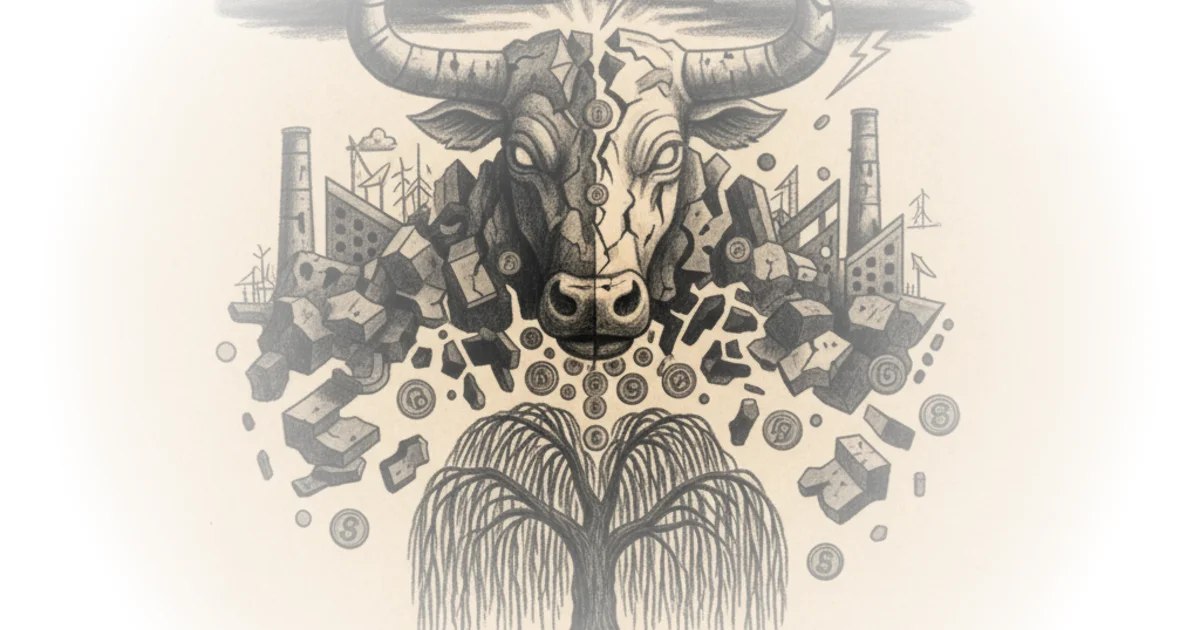
The narrative effectively highlights the absurdity of the situation: the plant is closing not because it is failing, but because it is too successful in a broken market. A local supervisor insists the facility has "always been in the green," yet Tyson cites low cattle supply. This contradiction suggests the closure is less about economics and more about market control. The author points out that Tyson's decision coincides with the opening of a competing plant owned by Walmart, leading workers to believe, "In order for this company to make money, they're going to close this one down... They don't want to be competing with them."
If that plant is going to close, the town is going to be a ghost town.
Critics might argue that attributing the closure solely to anti-competitive behavior ignores legitimate supply chain issues, such as the drought affecting cattle herds. However, the author marshals data showing that beef prices have soared nearly 50% in five years, making the "low supply" excuse feel like a convenient cover for strategic consolidation.
The Oligopoly's Playbook
The commentary shifts from local grief to a broader indictment of the meatpacking industry's structure. More Perfect Union explains that "four companies control almost 90% of the market," creating an environment where competition is "non-existent." The author argues that these "ultra mega meat packing plants" are designed to operate at such massive volumes that they become fragile; if they cannot sustain 7,000 cows a day, they simply shut down rather than adapt.
This concentration allows packers to "fix prices, to fix wages, and really to control the market." The piece draws a sharp contrast between the mid-20th century, when the top four packers controlled only 22% of production and small towns flourished, and today, where consolidation has driven the price of beef to 12 times its level from 50 years ago while farmers see their share shrink. The author suggests a chilling logic behind the shutdown: "Rather than processing beef domestically, they'll just revert to imports... It's cheaper to bring beef in from abroad than to raise and slaughter cattle in the US."
This reliance on imports allows major packers to maintain high consumer prices while depressing the value of domestic cattle, a move that benefits shareholders but devastates rural communities. The author notes that this isn't new behavior, citing similar strategic shutdowns in the late 2000s and mid-2010s designed to "make higher profits."
A Radical Solution for a Broken System
Faced with this reality, the piece pivots to a controversial proposal: treating beef processing as a public utility. More Perfect Union writes, "We have to start thinking of this as an essential public service... whether it's we regulate it like a utility... or whether we just have state and county governments get more into the business." The author points to historical precedents, such as city-owned facilities in Austin and county-owned plants in Florida, to argue that government intervention is not only possible but necessary.
The argument gains traction by noting that even in deep-red states, there is a growing recognition that private industries prioritize shareholders over community survival. One resident bluntly states, "These private industries, their responsibility is to their shareholders... So my message I guess to the government is that we need to enact policies to prevent such things from happening."
We've allowed concentration to go so off the charts.
A counterargument worth considering is whether nationalizing or heavily regulating an industry could stifle the very innovation and efficiency that keeps food prices stable. However, the author counters this by showing that the current "free market" has already failed to deliver stability, instead delivering chaos for workers and inflated prices for consumers.
Bottom Line
More Perfect Union's strongest asset is its ability to connect the abstract mechanics of antitrust law to the concrete devastation of a Nebraska town, proving that market concentration is a human crisis. The piece's biggest vulnerability lies in the political feasibility of its proposed solutions, which require a level of government intervention that remains deeply polarizing. Readers should watch to see if the bipartisan outrage over beef prices can translate into the kind of structural reform the author demands.