Tom van der Linden offers a rare, unsentimental autopsy of Indiana Jones and the Kingdom of the Crystal Skull, arguing that the film's true value lies not in its action sequences, but in its unintentional critique of colonialist treasure hunting. While most critics focus on the film's divisive alien plot, van der Linden identifies a more profound tension: the movie attempts to update the franchise's moral compass while remaining trapped in its outdated DNA. This is essential listening for anyone trying to understand why legacy sequels feel so stuck between honoring the past and acknowledging its flaws.
The Colonial Hangover
Van der Linden begins by dismantling the nostalgia that often clouds judgment of the franchise. He notes that for many, the series is a sacred American artifact, yet he approaches it from a European perspective where the cultural weight was lighter. "I feel like it's very much a piece of Americana," he observes, noting that while others treated the films as essential history, they were merely "perfect cable re-watch movies" for him. This detachment allows him to spot the genre's inherent contradictions that fans might miss. He argues that the franchise is fundamentally rooted in "Colonial Dynamics," where the hero enters a foreign world to extract value, a trope the 2008 film tries to navigate but cannot fully escape.
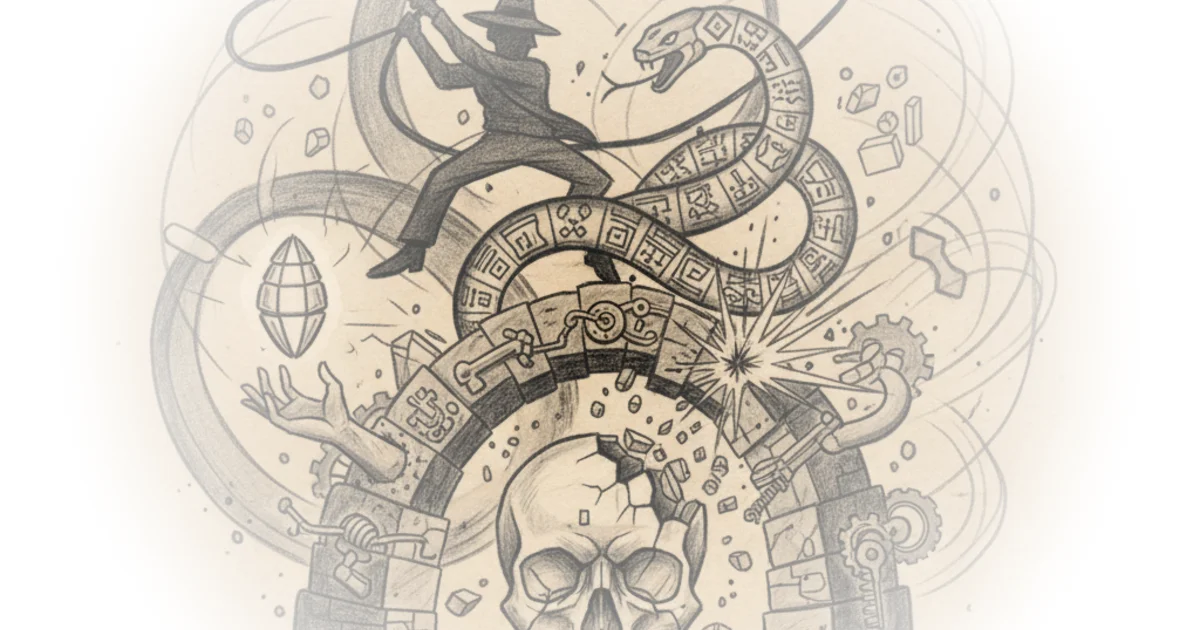
The author points out that while the plot involves returning an artifact, the execution still relies on faceless, nameless antagonists. "There's a slightly different sensibility in how it engages with that but then you still get to those places and have like some you know like what is coded as like Savages like running out and screaming," van der Linden writes. This observation is sharp; it highlights the film's inability to fully decouple from the very imperialism it seems to question. The movie wants to be progressive about repatriation while still delivering the same adrenaline rush of conquering the "other."
Critics might note that van der Linden is perhaps too harsh on the film's attempt at sensitivity, given that 2008 was still early in the mainstream cultural reckoning with these issues. However, his point stands: the film is a transitional object, trying to steer toward a new moral center while its wheels are still stuck in the mud of the 1980s.
The Myth of Linear Progress
The most compelling part of van der Linden's analysis targets the film's reliance on the "ancient aliens" trope. He argues that this narrative device is not just a sci-fi gimmick, but a philosophical failure. "We tend to assume that the technological and just like knowledge has a certain linear progression that we are now at the peak of," he explains. By attributing ancient ingenuity to extraterrestrials, the film inadvertently dismisses the wisdom and technical know-how of human ancestors.
This argument reframes the alien plot as a symptom of a deeper arrogance. Van der Linden suggests that the story perpetuates a worldview where "progress is this linear line and not this kind of negotiation between information that is gained and information that has lost." This is a devastating critique of the genre's tendency to treat history as a ladder we climbed, rather than a complex web of lost and found knowledge. The film's reliance on aliens to explain ancient wonders is, in his view, a "denial" of human capability.
"To look back and say or look at all the things that we were able to do or that people used to be able to do that we now no longer know how they were done and say oh it's probably aliens or something that's there is a certain denial there of or a certain dismissal of the value of those cultures and of Our Own past essentially."
The Melancholy of the Legacy Sequel
Finally, van der Linden situates the film within the broader trend of "legacy sequels" that emerged in the late 2000s. He identifies a pervasive "undercurrent of melancholy" in these stories, where the focus shifts from adventure to the aging of the hero. "They were more focused on like I think in all of those movies there's at least one joke of how the main protagonist in this case Indiana Jones is now an old man and not who he used to be," he writes. This melancholy infuses the film with a sense of finality, a "one more like final round" for a hero who is already fading.
He contrasts this with the "second wave" of legacy sequels, which focus on passing the torch to a new generation. In Crystal Skull, the attempt to introduce a successor is undercut by the film's own nostalgia. The moment where the hat is swiped back from the younger character is symbolic: "at least yeah... and then I got into trouble and then it was never again." The film wants to move forward but keeps pulling the audience back to the past.
Critics might argue that this melancholy is exactly what makes the film emotionally resonant, providing a necessary bridge between the golden age of adventure and modern storytelling. Yet, van der Linden's analysis suggests that this emotional weight comes at the cost of narrative coherence, leaving the film stranded between two eras.
Bottom Line
Van der Linden's strongest contribution is reframing the film's sci-fi elements as a failure of historical imagination rather than just a bad plot twist. His biggest vulnerability is perhaps underestimating the film's self-awareness, as Crystal Skull often seems to wink at its own absurdity. Readers should watch for how future legacy sequels navigate this tension between honoring the past and evolving the genre's moral framework.