Most people assume that in an era of constant news cycles and global upheaval, popular music has become a louder megaphone for political dissent. Daniel Parris dismantles this assumption with a counterintuitive statistical reality: the most politically charged era of American songwriting wasn't yesterday, but the turbulent decades between 1964 and 1979. By quantifying "political density" across decades of Billboard hits, Parris reveals a landscape where the very genres dominating our playlists today are the least likely to engage with the machinery of government or social justice.
The Data Behind the Silence
Parris begins by challenging the ambient dread many feel about the current moment. "Given the sheer pervasiveness of political news today, this pattern came as a surprise," he writes, noting that he assumed the anxiety of the modern age would be reflected in the charts. Instead, the data shows a sharp decline in political lyricism following the late 1970s, a period that included the Vietnam War, the Civil Rights Movement, and the Watergate scandal. The author's methodology is rigorous, counting politically oriented terms like "justice" and "revolution" against total unique words to create a "political density" ratio. This approach strips away the nostalgia we often attach to protest songs and forces a confrontation with the numbers.
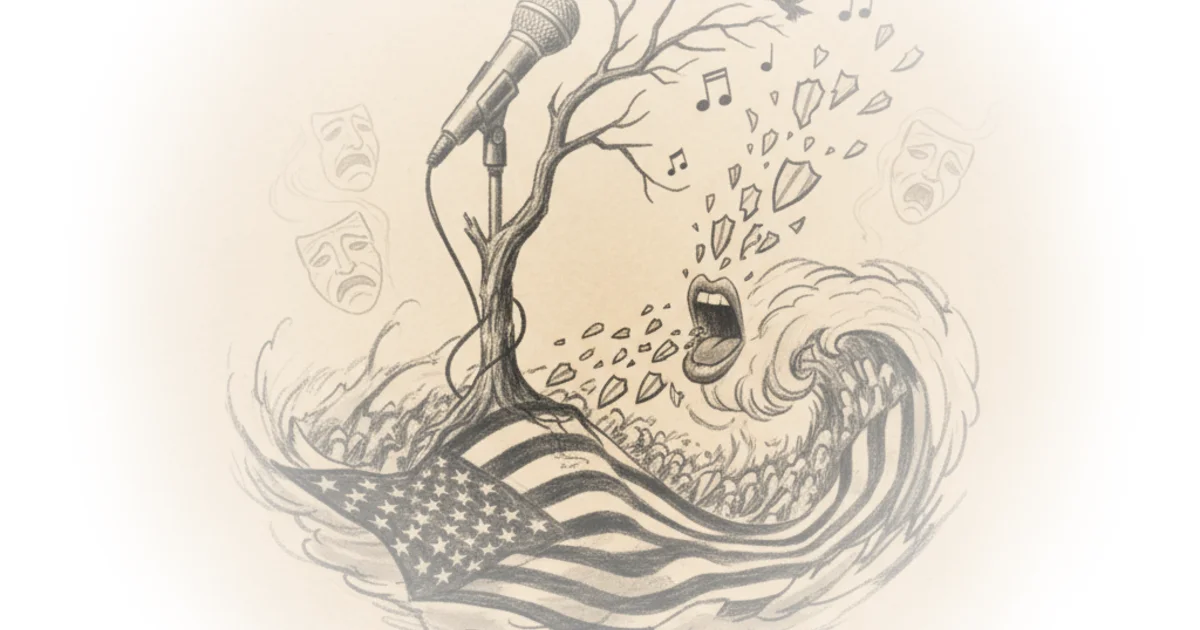
The findings are stark when broken down by genre. While rock acts historically scored highest in political engagement, the current mainstream is dominated by pop, which Parris identifies as the least socially oriented format. "Pop music is often defined by what it lacks—complexity, specificity, guitar, or substantive ideology (political or otherwise)," he observes. This isn't just a matter of taste; it is a structural outcome of how the industry operates. The author argues that the genre thrives on "escapism and spectacle," a formula that inherently resists the friction required for political commentary.
Pop music is often defined by what it lacks—complexity, specificity, guitar, or substantive ideology (political or otherwise).
Critics might argue that political expression has simply migrated to subgenres or independent artists who don't chart on Billboard, rendering the data incomplete. However, Parris anticipates this by comparing charting hits to non-charting tracks, finding that even within the broader market, the shift toward apoliticism was profound and sustained. The decline wasn't just about what was popular; it was about what the gatekeepers allowed to be popular.
The Architecture of Apoliticism
So, what killed the protest song? Parris traces the downturn not to a lack of issues to sing about, but to a convergence of corporate consolidation and cultural shifts. The rise of massive media conglomerates and the consolidation of radio stations created gatekeepers who prioritized "broad commercial appeal, favoring apolitical pop over dissension." Simultaneously, the visual medium of MTV rewarded "glam, spectacle, and accessibility," further incentivizing artists to steer clear of divisive themes. The author notes that this occurred even while rock was at its commercial zenith, suggesting that the drive for profit actively suppressed political content regardless of the genre's potential.
The cultural mood also played a pivotal role. In the wake of Vietnam and social upheaval, the West shifted toward a conservatism that viewed overt ideology with suspicion. "Audiences became more sensitive to political overtones, with overtly ideological songs or movies increasingly dismissed as 'too political'," Parris writes. This sentiment is quantifiable; Google Ngram data shows a steady rise in the phrase "too political" in literature, peaking in the mid-2010s. The irony, as Parris points out, is that this phrase began declining just as a modest resurgence in political lyrics occurred in the late 2010s, likely driven by the rise of streaming which diminished traditional gatekeeping.
The format rewarded glam, spectacle, and accessibility—further incentivizing artists to steer clear of divisive political themes.
This framing effectively highlights the tension between art and commerce. The author suggests that the "too political" critique became a self-fulfilling prophecy, where the fear of backlash led to a sanitized cultural output. A counterargument worth considering is that artists today are more political than ever, but their politics are coded or personal rather than explicitly ideological. Yet, Parris's data on lyrical density suggests that even if the feeling of rebellion is present, the language of political change has been largely scrubbed from the top of the charts.
The Drift of Meaning
Perhaps the most unsettling part of Parris's analysis is the concept of "meaning drift." Even when artists do take a risk, the commercial machinery often dilutes their message over time. The author cites Bruce Springsteen's "Born in the U.S.A." as a prime example of a protest song being "appropriated by politicians like Ronald Reagan or Donald Trump during campaign rallies—much to Springsteen's condemnation." Similarly, Woody Guthrie's "This Land is Your Land," written as a socialist critique, is now a cheerful elementary school sing-along.
This phenomenon underscores a fundamental tension: "If and when a track possesses political messaging, it must meet a Goldilocks-esque middle ground: it can be political but not too political—it has to be 'just right'." The author argues that this calibrated softening opens the door to contradictory interpretations, where a song's original intent becomes "unmoored from its original context." This raises a cynical question: "What's the value of a modern protest song if it risks backlash in the moment, only to have its message diluted—or, worse, completely inverted—over time?"
What's the value of a modern protest song if it risks backlash in the moment, only to have its message diluted—or, worse, completely inverted—over time?
Parris ultimately rejects the cynical conclusion that "no good comes from 'being political'." Instead, he advocates for a "practical naivete," suggesting that "every action has a meaningful consequence, even if not readily apparent." He champions artists like John Lennon and The Chicks for their willingness to be "too political," arguing that despite the risks of boycotts or meaning drift, the world needs voices that refuse to play it safe. This is a compelling stance, though it leaves the reader wondering if the current commercial ecosystem can truly sustain such voices without neutralizing them.
Bottom Line
Daniel Parris delivers a necessary corrective to the assumption that modern music is inherently more political, proving instead that commercial consolidation and genre shifts have actively suppressed lyrical dissent. The piece's greatest strength is its data-driven dismantling of nostalgia, yet its vulnerability lies in whether streaming algorithms and fragmented audiences might eventually disrupt the very gatekeeping structures he identifies. The reader should watch for whether the current modest resurgence in political density can survive the industry's relentless drive for the "just right" middle ground.