This piece arrives with a startling premise: that the true defense of democracy in 2026 will not come from Washington, but from the frozen streets of Minneapolis. Sarah Longwell, Tim Miller, and Bill Kristol argue that the federal government has become an engine of authoritarianism, leaving ordinary citizens as the only viable check on executive overreach. They frame recent events in Minnesota not as a local anomaly, but as a national blueprint for survival. For a reader short on time but hungry for context, this is a crucial pivot away from personality politics and toward the mechanics of resistance.
The Minnesota Model as National Blueprint
The authors anchor their argument in a personal history with the state, tracing their admiration from the 1965 baseball pennant to Hubert Humphrey's civil rights leadership. But they quickly pivot to the present, where they claim Minnesotans have provided a "example of civic courage and citizen responsibility" that the rest of the country must emulate. They describe a spontaneous, bottom-up network of neighbors using Signal text chains to monitor and counter federal immigration agents. "These proud Minnesotans gave a lot of credit for their success to the state's strong network of civic organizations and to its culture and tradition of public-spiritedness," they write. This observation is powerful because it shifts the burden of defense from institutions to individuals, suggesting that the "specialness" of the moment lies in the willingness of citizens to act, not in the state's unique geography.
We need the grass-roots, spontaneous exercise of civic leadership in the fight against authoritarianism on every front for the next three years.
The commentary here is sharp, yet it relies on a specific definition of "civic courage" that may not translate easily to every community. Critics might note that the "Minnesota Model" assumes a level of social cohesion and resources that many other regions lack, potentially romanticizing a localized effort as a universal solution. However, the authors' insistence that "the rest of us need to follow in Minnesota's footsteps" serves as a necessary call to action, regardless of local demographics.
The Asymmetry of Power
The piece takes a grim view of the current political landscape, arguing that traditional checks and balances have failed. Sarah Longwell, Tim Miller, and Bill Kristol assert that "the federal government generally has more power than state and local governments, and especially a federal government ruthless and relatively united in the service of its aims." They paint a picture where Congress is paralyzed, big business is compliant, and the media establishment is ineffective. In this vacuum, they argue, only "widespread citizen activism and resistance could make the difference."
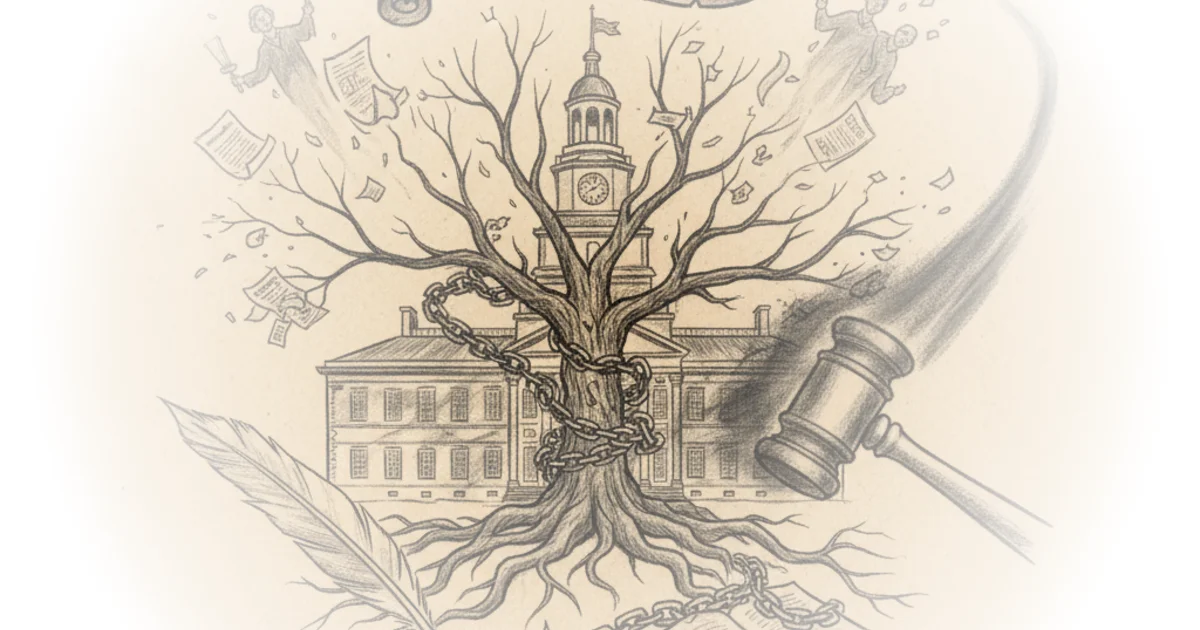
This framing is effective because it strips away the illusion that the system will self-correct. They draw historical parallels to the civil rights movement and Eastern European dissidents, noting that "the Trumpists, like the Southern segregationists and the Soviet-bloc communists before them, have been pretty effective in mobilizing the executive branch." The comparison to Soviet-bloc tactics is particularly striking, especially when juxtaposed with the recent removal of slavery exhibits from the National Park Service site at George Washington's Philadelphia home. Just as the administration appeals a judge's order to restore those exhibits—claiming "completeness" while erasing history—the authors see a broader pattern of institutional erasure that requires a non-institutional response.
We need to think not only of election campaigns but of popular campaigns. We need to learn lessons from the civil rights movement of the 1950s and 1960s, and from Eastern European dissidents in the 1970s and 1980s.
The argument here is that conventional politics is insufficient against an "all-of-government conspiracy against our liberties." While this is a compelling narrative, it risks underestimating the resilience of democratic institutions that have survived previous crises. The authors acknowledge that "conventional politics remains critically important," but their emphasis on "internal dissidence" and "surreptitious" resistance suggests a shift toward more radical forms of engagement.
The Human Cost and the Departure of a Megaphone
The commentary does not shy away from the human toll of these policies. The authors reference the "killings of two Minneapolis protesters by DHS agents" and the "horrible treatment of migrants in DHS custody" as evidence of a department in crisis. They note the departure of Tricia McLaughlin, the Department of Homeland Security spokesperson, as a sign of the administration's vulnerability. "McLaughlin—with her pedal-to-the-metal, incendiary style and richly earned reputation as a whole-hog propagandist—may not be the best fit for a department suddenly trying for a new PR strategy," they observe. This detail adds a layer of irony: the administration is losing its most aggressive voice precisely when it needs to manage a narrative of control.
The piece also touches on the internal fractures within the opposition, highlighting the White House's "political fatwa" against Representative Thomas Massie. The authors suggest that Massie's defiance is a sign of a growing "retirement caucus" and potential defections. "The [Republican] margin is razor-thin, so on any given day, I would need just one or two of my own co-conspirators to get something done," Massie is quoted as saying. This highlights the fragility of the current political order, where a single maverick can disrupt the executive branch's agenda.
It needs to be a harbinger of what's going to be done. It needs to be a model not just admired but emulated.
The authors' call for emulation is urgent, but it leaves the reader with a difficult question: how does one replicate a movement born of specific local conditions? The piece does not offer a step-by-step guide, but rather a philosophical imperative. The strength of the argument lies in its refusal to accept the status quo as inevitable. The weakness, perhaps, is the assumption that the will to resist is the only variable missing.
Bottom Line
The strongest part of this argument is its unflinching assessment that the federal government has become the primary threat to democracy, necessitating a shift from institutional reliance to citizen-led resistance. Its biggest vulnerability is the potential over-reliance on a specific cultural model of civic engagement that may not be easily transferable to more polarized or resource-poor environments. Readers should watch for how this "Minnesota Model" evolves as the administration faces further legal and political challenges in the coming months.