Kings and Generals presents a historical figure whose biography reads less like a naval record and more like a fever dream of maritime audacity, arguing that Lord Thomas Cochrane was not merely a skilled captain but a "single most insane sea captain of the age of sail." The piece distinguishes itself by focusing less on grand fleet maneuvers and more on the psychological profile of a man whose "utter stubbornness made him the enemy of every superior officer he ever served under," framing his career as a relentless collision between individual brilliance and institutional rigidity.
The Fighting Clan and the Defiant Youth
The narrative begins by grounding Cochrane's volatility in his heritage, noting that his family name derives from an old Gaelic portmanteau meaning "the roar of battle." Kings and Generals writes, "The Cochrans had a long history of military service to the British Empire... and the family was affectionately nicknamed the fighting Cochrans." This lineage sets the stage for a protagonist who views authority not as a hierarchy to be respected, but as an obstacle to be circumvented. The authors highlight Cochrane's early rebellion against his father's wish for him to join the army, quoting his own autobiography regarding the "inflexible leathern collar" that cased his neck. This anecdote is crucial; it establishes that Cochrane's later insubordination was not a career flaw but a character constant.
"This was the first time Cochrane showed defiance in the face of authority and it would become a theme for the rest of his life."
The commentary suggests that the Royal Navy, a bastion of rigid discipline, was the worst possible environment for such a man, yet the only one where his specific brand of chaos could yield results. Critics might argue that the piece romanticizes insubordination, ignoring the genuine operational risks such behavior posed to fleet cohesion. However, the authors effectively use this tension to explain why Cochrane's greatest victories often occurred when he was operating on the fringes of command.
The Art of Deception and the Speedy
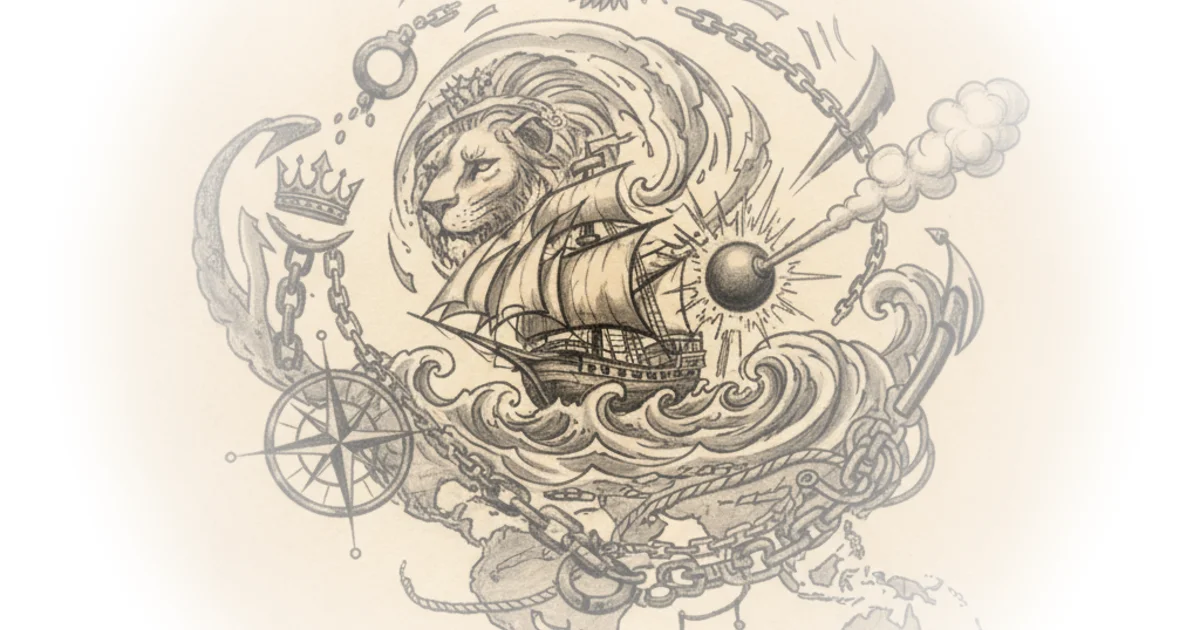
The core of the coverage focuses on Cochrane's command of the HMS Speedy, a tiny sloop he described as a "species of gun little larger than a blunderbuss." Kings and Generals argues that this vessel, likely assigned as a punishment by his superiors, became the perfect instrument for Cochrane's unique brand of warfare. The authors detail how Cochrane utilized "deceptive cunning and clever use of false flags" to capture vastly superior enemy ships. As Kings and Generals puts it, "Cochrane had no intention to risk battle with a vessel far superior in firepower to his... luckily he had space and time to spare."
The piece vividly reconstructs the capture of the Spanish frigate El Gamo, where Cochrane ordered his crew to hoist an American flag to approach the enemy without raising suspicion. The authors note that "the Spaniards hesitated, unwilling to risk a diplomatic incident by firing on what could be a neutral vessel," allowing Cochrane to close the distance until "he could see the whites of her crew's eyes." This moment encapsulates the entire argument: Cochrane's success relied on exploiting the rules of war and the psychology of his enemies rather than out-gunning them. The narrative emphasizes the brutality of the subsequent boarding action, where Cochrane ordered his men to blacken their faces with soot "so as to appear more terrifying."
"I told the men that they must either take the frigate or be themselves taken."
This quote underscores the high-stakes gamble Cochrane constantly played. The authors frame this not as reckless gambling, but as a calculated necessity given the disparity in forces. The coverage effectively illustrates how Cochrane turned the Speedy's small size from a liability into a tactical asset, striking fast and slipping away undetected. By July 1801, the authors note, the sloop had captured, sunk, or run aground "a mind-boggling 53 enemy ships."
The Cost of Genius
Despite his unparalleled success, the piece pivots to the tragic irony of Cochrane's career: his genius was his undoing within the British system. Kings and Generals writes that after the loss of the Speedy, Cochrane was "honorably acquitted" of any blame, yet he "expected three things: a swift promotion to post-captain, a shiny new frigate to command and a return to the bountiful fame of Napoleonic warfare." The authors point out that "none of this would come to pass," as the Royal Navy brass dragged their feet, allowing rivals to advance while Cochrane waited.
The commentary highlights the institutional resentment Cochrane faced, noting that his public berating of Lord St. Vincent earned him the "icy stare of the aristocratic oligarchy that was British naval command." This section serves as a critique of the British Admiralty's inability to utilize unconventional talent. The authors suggest that the system was designed to suppress mavericks like Cochrane, who refused to play by the unwritten rules of aristocratic advancement. As Kings and Generals concludes regarding the aftermath of his early successes, "his ill-advised aggressions had come back to haunt him as the vengeful Lord St. Vincent saw to it that the new post-captain was stiffed again."
Bottom Line
Kings and Generals delivers a compelling portrait of a naval genius whose career was defined by a paradox: he was too effective for his own good within a rigid hierarchy. The strongest part of this argument is the detailed reconstruction of the Speedy's campaigns, which vividly demonstrates how Cochrane's psychological warfare outperformed traditional naval tactics. However, the piece's biggest vulnerability is its tendency to frame institutional pushback solely as petty vengeance, potentially overlooking the legitimate command concerns regarding Cochrane's insubordination. Readers should watch for how this pattern of brilliance followed by bureaucratic rejection shaped the broader evolution of naval doctrine in the 19th century.