In a lecture that refuses to treat history as a static backdrop, Yale University reframes the origins of modern Russia not as a pure, ancient lineage, but as a chaotic product of violent encounters and foreign contact. This is not a dry recitation of dates; it is a direct challenge to the idea that any nation-state emerges from a state of innocence, arguing instead that the very identity of the Russian state was forged through the collision of Vikings, Mongols, and Byzantines. For those trying to understand the current war in Ukraine, this historical lens offers a crucial correction to the Kremlin's narrative of eternal unity.
The Myth of Pure Origins
Yale University opens by dismantling the comforting but false notion that nations begin in a state of harmony before being corrupted by outsiders. "Origins are always tricky because it would be nice if we could have something from nothing," the lecture notes, pointing out that national stories often claim an ethnicity was "pure" and "simple" before foreigners arrived. This framing is essential because it exposes the logical fallacy at the heart of imperial propaganda: the belief that a state can exist without external influence. The argument suggests that history is more like Ovid's Metamorphoses, where "unexpected things arise from the Encounters of things" rather than a linear progression from a golden age.
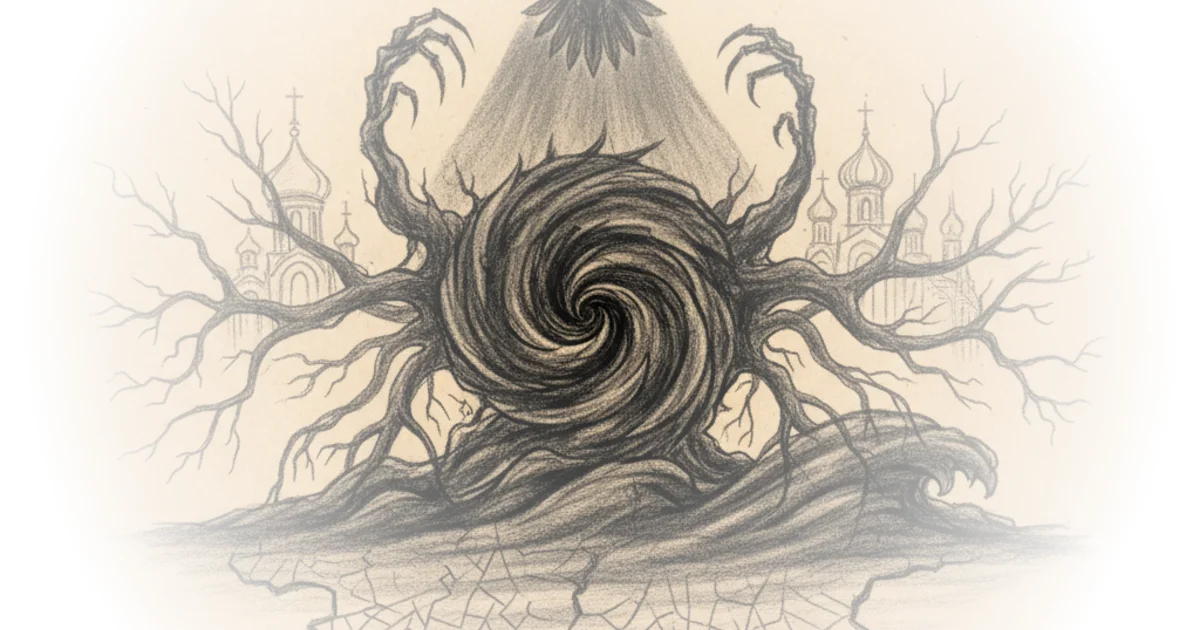
This approach effectively strips away the mystical aura often attached to state formation. By insisting that "things don't come out of nowhere," the lecture forces the listener to confront the messy, often violent reality of how borders and identities are actually drawn. Critics might note that this emphasis on external contact risks downplaying the role of internal cultural evolution, but the evidence presented suggests that without these external pressures, the specific political entities we know today would never have coalesced.
History is more like that; it's an unexpected things arise from the Encounters of things and then later on you tell a story about how it had to be that way but at the time it's all very messy and confusing.
The Post-Viking World and the Fate of Ruse
The lecture then pivots to a fascinating comparison between England and the East Slavic lands, revealing that both were shaped by the same "post-Viking" dynamics. Yale University explains that England, Denmark, and the East Slavic lands were all part of a vast network where Vikings acted as the connective tissue between the Franks, the Byzantines, and local populations. "The England of Shakespeare is a post-viking state," the text asserts, noting that the Normans who invaded in 1066 were essentially Vikings who had settled in France. This synthetic history is evident in the English language itself, which Yale University argues would be unrecognizable without the French influence brought by the conquest: "It would be very hard for me to create a sentence in English which doesn't involve a word which came from French."
However, a critical distinction emerges when looking at the East Slavic world. While England, Norway, and Denmark survived as durable political entities, the lecture points out that "Ruse is not still around." This disappearance is not a natural evolution but the result of specific historical pressures. The Mongols from the East and the Teutonic Knights from the West created a "symphony" of forces that destroyed the original Ruse, forcing new states like Lithuania to rise from the ashes. The argument here is that the modern Russian state is a later construction, built on the ruins of a system that was shattered by external invasions, rather than a continuous, unbroken line from the past.
The Mongol Shadow and the Rise of Muscovy
The core of the lecture addresses how the destruction of Ruse by the Mongols created the conditions for the rise of Muscovite power. Yale University argues that the rise of Lithuania as a major power "only makes sense if you understand Teutonic Knights pushing from the West [and] Mongols have come in from the East and destroyed Roos." Without the Mongol devastation, the political vacuum that allowed Muscovy to consolidate would not have existed. The lecture uses Chaucer's Canterbury Tales to illustrate this, noting that the poet's reference to "Roost" (Ruse) appears alongside Prussia and Lithuania as lands defined by these crusading and invading forces.
This historical context is vital for understanding the current conflict, where the justification for war often relies on the idea of a permanent identity stretching back a thousand years. Yale University challenges this by showing that the "continuation of some kind of permanent identity from Kiev a thousand years ago into Russia Today" is a fabrication. The reality is that the people fighting and dying in Ukraine today, including indigenous groups from deep Asia like the Buriats, are products of a state that expanded through the very mechanisms of conquest and assimilation that the lecture describes. The question "who are these buriats and why are these buriats doing so much fighting and dying in Ukraine" is answered not by ancient bloodlines, but by the expansionist logic of a state built on the ruins of Ruse.
The justification for the war or one of the justifications for the war has to do with the continuation of some kind of permanent identity from Kiev a thousand years ago into Russia Today.
Bottom Line
Yale University's most powerful contribution is the demonstration that the Russian state is a product of violent transformation, not a timeless entity, directly undermining the ideological foundation of the current war. The argument's greatest strength lies in its refusal to separate history from the messy reality of contact and conquest, though it leaves the reader to fully grapple with the implications for modern national identity. The most urgent takeaway is that the "permanent identity" claimed by the aggressors is a historical fiction designed to justify a war that is, in fact, a continuation of the very cycles of destruction and state-building the lecture exposes.
The justification for the war or one of the justifications for the war has to do with the continuation of some kind of permanent identity from Kiev a thousand years ago into Russia Today.