The Baseball Nerd delivers a scathing indictment of the National Baseball Hall of Fame, arguing that the institution is not a guardian of morality but a profit-driven entity engaging in historical hypocrisy. The piece's most provocative claim is that the Hall functions as a "church when expedient" to condemn players while acting as a "museum" to monetize their records, a contradiction that exposes a selective application of character standards that has never been applied to previous generations.
The Museum of Artifacts, The Church of Exclusion
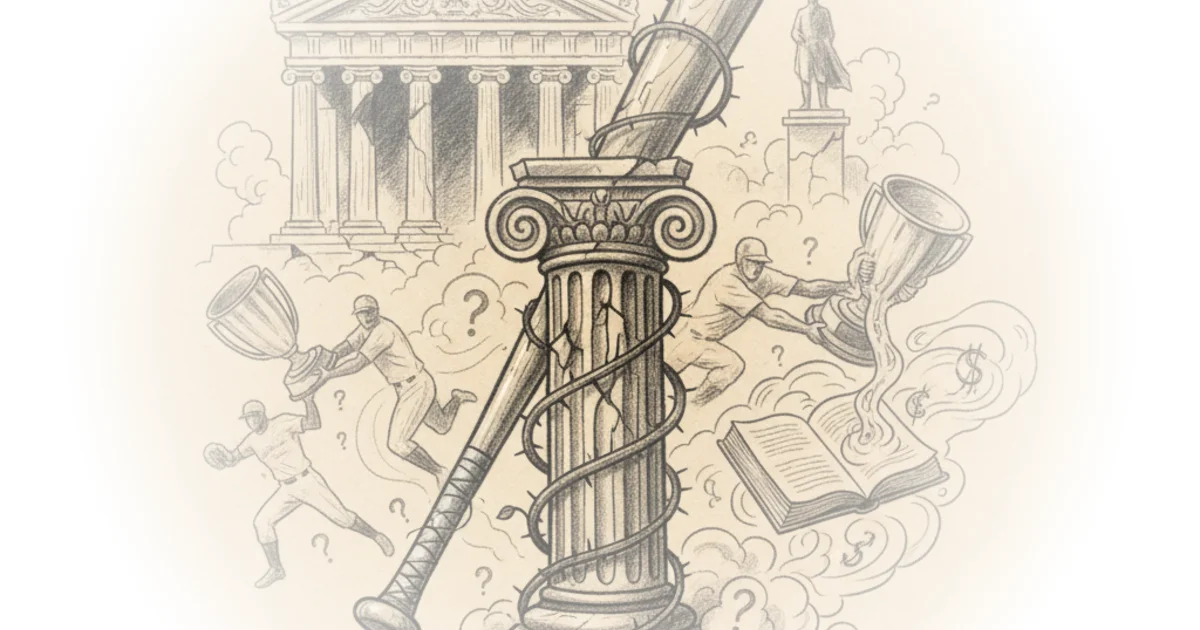
The author builds a compelling case around the physical reality of Cooperstown, noting that the Hall displays the very equipment of the players it refuses to honor. "They display steroid-era artifacts while excluding the players who created them," The Baseball Nerd writes, pointing out the jarring presence of Barry Bonds' record-breaking ball and Mark McGwire's 70-home-run bat in glass cases. This observation is potent because it forces the reader to confront the financial reality: the institution charges admission to see the evidence of the "sin" while denying the sinner a plaque. The argument gains weight by contrasting the treatment of these modern figures with the admission of Bud Selig, the former commissioner whose tenure oversaw the era. As The Baseball Nerd puts it, "The plaque credits Selig with presiding over revenue growth. But that growth came largely from the steroid era." This reframing shifts the blame from individual athletes to the leadership that prioritized economics over enforcement, a point that resonates deeply when considering the institutional failures documented in the Mitchell Report.
The Hall of Fame doesn't uphold moral principles. It protects institutional reputation at players' expense.
Critics might argue that the Hall has a duty to uphold a higher standard of conduct for its inductees, regardless of the era's context. However, the author effectively dismantles this by highlighting that the "character clause" is applied with inconsistent rigor. The piece suggests that the exclusion of Bonds and Clemens is less about moral purity and more about scapegoating to preserve the institution's image after a period of negligence.
The Precedent of the Spitter and the Segregation Era
The commentary strengthens its position by drawing on historical precedents that the Hall has conveniently ignored. The author points to Gaylord Perry, who admitted to throwing spitballs for years and wrote a book bragging about it, yet was inducted in 1991. "The standard applied to Gaylord Perry should apply to steroid era players," The Baseball Nerd argues, noting that Perry's rule violations were era-specific and widely tolerated, much like the steroid era's lack of testing. This comparison is particularly sharp when juxtaposed with the segregation era, where legends like Babe Ruth benefited from an artificially limited talent pool by excluding Black players. "We don't hold this against pre-1947 players," the author notes, observing that the Hall accepts era-specific advantages for the past but punishes them for the present. This inconsistency reveals what the author calls "moral cowardice rather than moral principle."
The argument extends to the ubiquitous use of amphetamines, or "greenies," from the 1950s through 2005. The author reminds readers that Hank Aaron and Willie Mays played in an environment where stimulants were distributed by trainers and considered normal. "Nobody is excluded from the Hall of Fame for amphetamine use," The Baseball Nerd writes, suggesting that the focus on steroids is a selective enforcement mechanism designed to avoid implicating beloved legends. This historical context is crucial; it suggests that the current exclusion of steroid-era players is not about the drugs themselves, but about the social acceptability of the era's corruption.
The Impossible Standard
The core of the author's critique lies in the creation of an "impossible standard" that exists nowhere else in baseball history. The Baseball Nerd writes, "Players must have pristine character unless they're pre-1990 players, then character doesn't matter." This double standard is illustrated by the inclusion of players with significant character flaws, from Ty Cobb's racism to Roberto Alomar spitting on an umpire, while excluding those who were never convicted of steroid use. The author argues that this is not a principled stand but "institutional scapegoating." The piece effectively uses the example of Tony La Russa, a manager inducted despite managing players who admitted to steroid use, to show that accountability is reserved only for the players, not the leaders who enabled the environment.
This isn't moral principle. This is institutional scapegoating.
A counterargument worth considering is that the steroid era represented a unique disruption to the integrity of the game's statistics, distinct from the cultural biases of segregation or the tactical cheating of spitballs. However, the author's point stands that if the Hall is willing to contextualize the past, it must do so for the present. The refusal to acknowledge the systemic nature of the steroid era—enabled by the administration of the league and ignored by Congress—makes the punishment of individual players seem arbitrary.
Bottom Line
The strongest part of this argument is the undeniable evidence of the Hall's hypocrisy: displaying the artifacts of the excluded while honoring the leaders who enabled the era. The piece's biggest vulnerability is that it relies on the assumption that the Hall should function as a pure historical archive rather than a moral arbiter, a tension that may never be fully resolved. As the series concludes next week, readers should watch for how the author synthesizes the statistical cases for Bonds, Clemens, and Rodriguez to determine if their on-field achievements can ever outweigh the institution's selective memory.