Cory Doctorow delivers a startling thesis: the path to breaking Big Tech monopolies doesn't run through Washington, D.C., but rather through a coalition of fifty American state attorneys general and international regulators who are no longer waiting for federal permission. While much of the political discourse focuses on personality clashes, this piece argues that the structural fusion of the executive branch and Silicon Valley has created an unprecedented crisis where domestic enforcement is impossible, forcing a radical shift to "regionalized" global cooperation.
The Global Playbook vs. The Gilded Age
Doctorow begins by dismantling the historical analogy often used against modern antitrust efforts. He contrasts today's tech giants with the robber barons of the 19th century, noting that while John D. Rockefeller's Standard Oil was a global monster, it operated differently in every nation. "It wasn't like this during the era of the first Robber Barons," Doctorow writes. "John D Rockefeller's Standard Oil had many of the world's economies in chokeholds, but each country got its own, national chokehold." In Germany, for instance, Rockefeller monopolized ports; in the U.S., he controlled refineries. The lack of common facts made international collaboration nearly impossible.
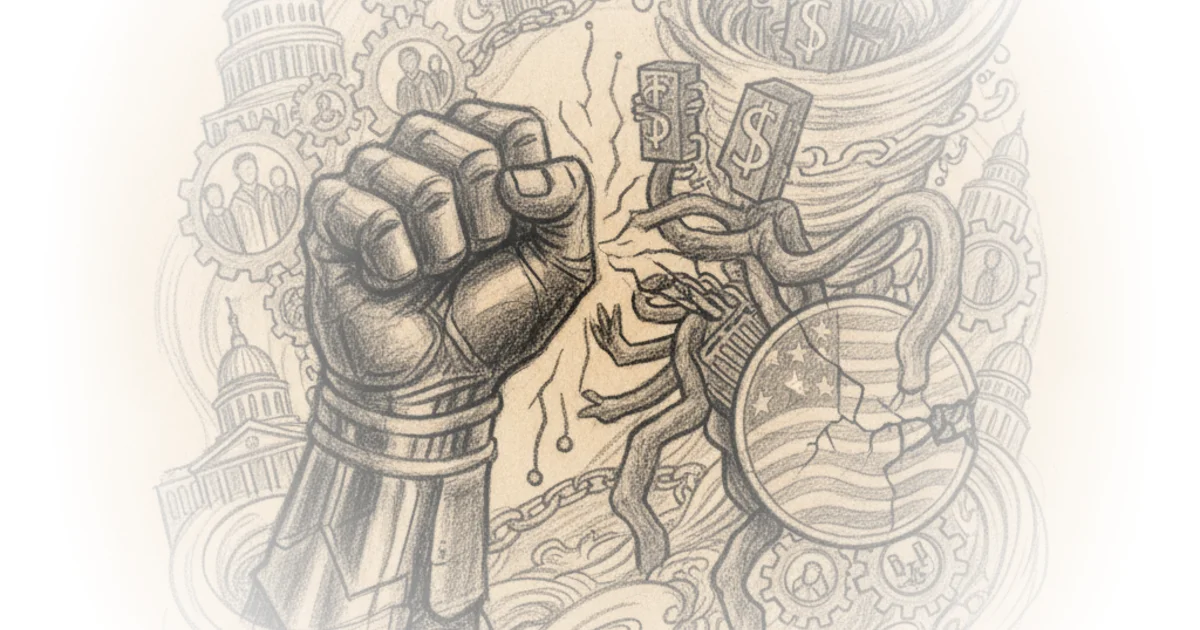
The argument gains significant traction when Doctorow highlights how modern technology has inverted this dynamic. "That's not how companies like Google, or Meta, or Apple, or Microsoft, or Oracle work," he asserts. Because these firms deploy the identical anti-competitive playbook in Brussels, Seoul, and London simultaneously, evidence gathered in one jurisdiction is directly transferable to another. This creates a unique window for coordination that was absent during the original antitrust era.
Furthermore, Doctorow points out a forgotten historical fact: the legal framework for this global cooperation was actually built by American technocrats after World War II. He reminds readers that "the technocrats who oversaw the Marshall Plan understood that large, monopolistic firms played a key role in the rise of fascist governments," leading them to transplant U.S. antitrust statutes like the Sherman Act and Clayton Act onto the lawbooks of Europe and Japan. This means that when a regulator in South Korea builds a case against Apple, they are effectively using American laws to fight an American company.
"The fears of the Marshall Plan technocrats have been realized: Big Tech is Trump and Trump is Big Tech, and together, they are executing an authoritarian takeover of the USA and countries around the world."
Critics might argue that relying on foreign enforcement against U.S. companies invites geopolitical retaliation or legal non-enforcement, but Doctorow counters this by emphasizing the sheer scale of the threat to global democracy, suggesting that isolationism is no longer a viable strategy.
The Collapse of Federal Will and the Rise of State Power
The commentary takes a sharp turn as it addresses the current political reality. Doctorow describes a "fusion" where the federal government has effectively become an arm of Big Tech, rendering agencies like the Federal Trade Commission (FTC) and the Department of Justice (DoJ) impotent. He details how tech CEOs have embedded themselves in the highest levels of power, providing material support for policies that harm vulnerable populations. "If you end up in a concentration camp thanks to one of Trump's ICE chuds, you can blame Microsoft for providing the administrative software; Google for providing the location data used to track you down," Doctorow writes with chilling specificity.
This federal capture has triggered a domino effect globally. In the UK, the head of the Competition and Markets Authority was replaced by an Amazon executive; in Ireland, a former Meta lobbyist was appointed to regulate her former employer. Doctorow scrutinizes this appointment of Niamh Sweeney, noting that she took seven months to issue a vague statement about whether she could legally criticize Meta due to non-disparagement clauses. "If she is truly able to do this job, then it shouldn't take her half a year to issue a weasel-worded, heavily caveated statement," he observes.
The piece argues that the solution lies in bypassing the federal government entirely and looking inward to the U.S. states. Doctorow highlights an often-overlooked provision of the Clayton Act: "When Congress wrote the Clayton Act, Sherman Act and other US federal antitrust laws, they explicitly wrote in the power of state Attorneys General to enforce them." This legal mechanism allows fifty independent jurisdictions to act as a decentralized enforcement network.
He champions the idea of "regionalized enforcement" proposed by Tyler Clark, where coalitions of state attorneys general can fine and break up tech giants without waiting for federal approval. "When states fine US companies and order their breakup, it's a lot harder for those companies to flout those orders," Doctorow explains, because state courts are first-class actors in the U.S. judicial system, unlike foreign courts which often struggle to enforce judgments against American corporations.
The Whistleblower Advantage
Perhaps the most compelling tactical suggestion involves leveraging the thousands of employees being laid off by Big Tech's failed AI ventures. Doctorow argues that these ex-employees hold the key to proving intent, the hardest element in antitrust cases. He points to the case of Sarah Wynn-Williams, a former Meta executive fined $111 million for publishing a memoir, as evidence of the industry's desperate attempts to silence internal critics.
"One place this could start: joint hearings that call ex-Big Tech employees as key witnesses, daring companies like Meta to invoke their gag orders," Doctorow suggests. By combining state-level subpoenas with international pressure, regulators could force these companies into a corner where they must either reveal damaging internal memos or admit to the gagging of their own staff.
"Together, US states and foreign enforcers have the opportunity of the century — a chance to shatter the power of Trump's tech giants, who are so key to Trump's authoritarian takeover."
This strategy reframes the narrative from a hopeless federal stalemate to an active, multi-front legal war where the sheer volume of evidence and the diversity of jurisdictional actors create a pincer movement against monopolists.
Bottom Line
Doctorow's strongest move is identifying the specific legal loophole—the state enforcement power embedded in the Clayton Act—that allows for immediate action despite federal paralysis. However, the argument relies heavily on the assumption that fifty different states can coordinate their strategies and resources as effectively as a single federal agency, which remains an unproven logistical hurdle. The reader should watch to see if state attorneys general can truly form a unified front capable of withstanding the immense legal and political pressure from a tech industry backed by the executive branch.