This piece delivers a startling correction to the standard narrative of American independence: the Revolution was not just fought on native soil, but was intellectually and tactically forged in the fires of Indigenous governance and warfare. Reason argues that the very concept of liberty embraced by the Founders was not an abstract European import, but a reaction to the living examples of stateless societies they encountered daily.
The Geography of Rebellion
The article opens with a powerful reframing of physical space. It insists that "the American Revolution took place in Indian country" in two distinct senses: the literal landscape and the mental framework of the rebels. Before European arrival, centuries of controlled burning had transformed dense forests into open woodlands. As Reason notes, these fires were set when dampness made them easy to control, creating a parklike environment where John Smith boasted he could "gallop a horse through" the trees.
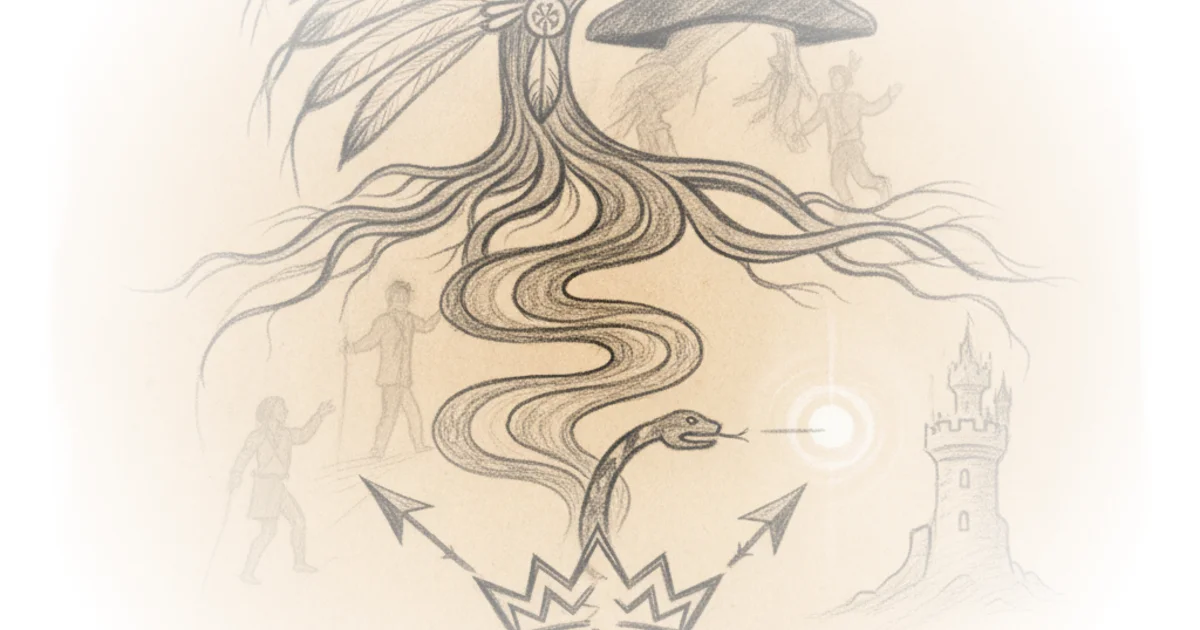
This environmental engineering was not merely scenic; it dictated military movement and settlement patterns. The piece points out that the first 50 colonial villages in New England were built on the sites of emptied native settlements, with roads constructed over existing Indigenous trails. When General George Washington marched to Yorktown, he traveled a network of widened native roads, and the battlefield itself was once a capital of Tsenacommacah, the Powhatan imperium encountered at Jamestown.
Much as the Thirty Years' War in Europe was fought on the geography created by the Roman Empire, the Revolution was fought on the geography created by native people.
This connection between land management and political history is compelling. It forces a re-evaluation of who shaped the American landscape before the first shot was fired at Lexington. The argument holds weight when considering how cultural burning practices, similar to those detailed in companion deep dives on the Mohawk Trail, created the very corridors that armies would later use.
Tactics and the "Skulking Way of War"
The coverage shifts from geography to military doctrine, challenging the romanticized image of European-style discipline clashing with colonial amateurism. The piece highlights how colonists initially failed against Indigenous tactics before adopting them wholesale. During the Pequot War of 1636–38, missionary John Eliot noted with chagrin that "God pleased to show us the vanity of our military skill, in managing our arms, after the European mode."
By the time of the Revolution, British soldiers were baffled by the rebels' methods. One officer complained that the colonists did not fight like a regular army but rather as "savages, behind trees and stone walls," declaring them "full as bad as the Indians." The article argues that this shift was decisive. Ethan Allen explicitly invited the Haudenosaunee to join his Green Mountain Boys, stating, "I know how to shute and ambush just like Indian... You know they Stand all along close Together Rank and file and my men fight as so as Indians Do."
Critics might argue that Washington's reliance on these tactics was limited; the piece itself notes he remained leery of them, preferring massed armies in open fields while using Indigenous allies primarily for scouting. However, the cultural penetration is undeniable. The "skulking way of war" became a defining characteristic of American military identity, moving away from the rigid formations of European aristocracy toward flexible, decentralized command structures.
The Proclamation and the Spark of Independence
Perhaps the most significant historical reorientation in this piece concerns the political origins of the Revolution. Reason traces the immediate fury that led to independence not just to taxes, but to the Proclamation of 1763. After Pontiac's Rebellion—a broad-scale assault by a coalition of native nations on British forces—King George III banned colonists from moving west of the Appalachians.
The article explains that this ban blocked off an area of roughly 600,000 square miles and granted natives permanent title to land they had occupied for generations. To the colonists, this was a betrayal of the promise of free land. The reaction was violent; in Pennsylvania, a militia known as the "Black Boys" raided supply trains and seized control of western territory, refusing to be indicted by a grand jury.
Nowhere was the anger more volcanic than in Pennsylvania... Even as the conflict with Pontiac continued, tensions rose between Pennsylvania's colonists and their government in Philadelphia.
This reframing is crucial. It positions the Declaration of Independence not merely as a philosophical document but as a direct response to the Crown's attempt to protect Indigenous sovereignty against settler expansion. When the Declaration denounces the King for supporting "the merciless Indian Savages," it is referencing his diplomatic efforts with native coalitions in the Ohio Valley. The piece argues that this conflict was a dress rehearsal for the broader revolution, proving that land rights and indigenous autonomy were central to the colonial grievance.
The Intellectual Debt to Indigenous Governance
The final section tackles the philosophical underpinnings of American liberty. Reason asserts that Enlightenment thinkers like Locke, Rousseau, and Voltaire were deeply fascinated by Native Americans, using them as foils to critique European monarchy. While these philosophers often viewed natives through a romanticized or primitive lens, actual visitors to North America reported something more profound: societies with vastly more personal autonomy.
Jesuit missionary Paul Le Jeune observed that Indigenous people "imagine that they ought by right of birth, to enjoy the liberty of wild ass colts, rendering no homage to anyone whatsoever." The article details how Haudenosaunee leaders, such as the tadadaho, could not act without the consent of a council and clan mothers, and could be deposed if they lost the people's faith. This stood in stark contrast to the "Great Chain of Being" in Europe, where social hierarchy was divinely mandated.
The baron [de Lahontan], he said, was a fool for "choos[ing] rather to be a French slave than a free Huron."
This argument suggests that the American experiment in republicanism was not an isolated invention but a synthesis of European political theory and Indigenous practice. The idea that leaders must persuade rather than command, and that authority is derived from consent rather than bloodline, was modeled by the very peoples the colonists would later displace.
Bottom Line
The strongest element of this coverage is its unflinching linkage of land policy, military tactics, and political philosophy to Indigenous agency, stripping away the myth of a purely European-derived revolution. Its biggest vulnerability lies in the tragic irony it highlights: the very systems of freedom admired by the colonists were built on a foundation that would eventually be destroyed by their expansionist ambitions. Readers should watch for how this historical lens reshapes modern debates about land rights and sovereignty.
The Revolution was fought on the geography created by native people, inspired by their ideas of freedom, and sparked by the Crown's attempt to protect them.