"Freddie deBoer delivers a rare, lucid autopsy of the AI detection industry, arguing that the technology's fatal flaw isn't a bug—it is a feature of its own design. While the public debates ethics, deBoer demonstrates that the very mechanism used to flag artificial text relies on patterns that any human can mimic, rendering the tools fundamentally unreliable for high-stakes judgment."
The Paradox of Detection
The piece begins by dismantling the binary debate surrounding AI writing detectors. deBoer notes that he is often invoked by both sides, yet he occupies a nuanced middle ground: he views these tools as "both inevitable and necessary," but insists they must be understood as "fundamentally and permanently limited." This framing is crucial because it shifts the conversation from "will this work?" to "how do we live with its inevitable failures?"
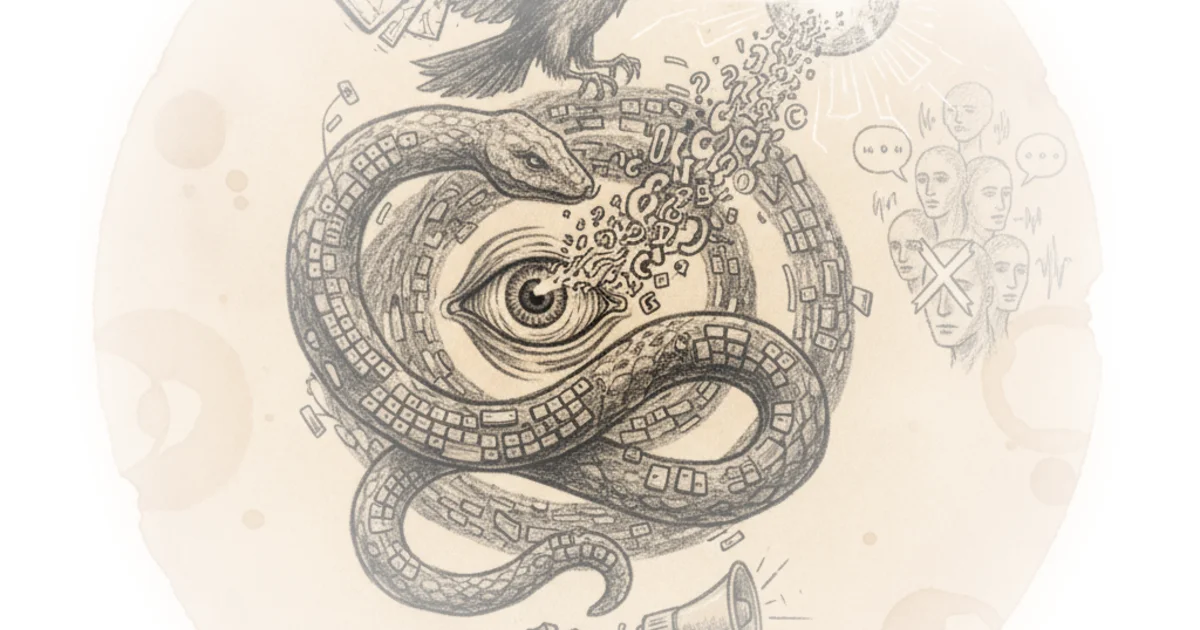
The author's central thesis is a logical trap that many enthusiasts ignore: "AI detection software is AI." He argues that Large Language Model (LLM) detectors rely on the same principles as the models they seek to catch. Because LLMs are trained on human text, the patterns they generate are merely reconfigurations of human writing. Therefore, "LLMs reconstitute the human." This leads to an inescapable conclusion: if a detector flags text based on human-derived patterns, a human can inevitably reproduce those patterns.
"If a human being can write something in a text box, if it is textually possible for them to produce the same text that will be flagged as AI written, then false positives are literally inevitable."
This argument holds up under scrutiny because it addresses the mathematical reality of the problem. The author points out that while Pangram boasts a 1-in-10,000 error rate, the sheer volume of digital text means "there are billions of monkeys at their typewriters." Critics might argue that a 0.01% error rate is acceptable for low-stakes filtering, but deBoer correctly identifies that in education or journalism, a single false positive is a catastrophic injustice. The technology cannot distinguish between a human mimicking a style and a machine generating it, because the style itself is the common denominator.
The Anatomy of a False Positive
deBoer moves from theory to a practical, almost satirical guide on how to trigger a false positive. He argues that to fool the detector, one shouldn't try to write like a robot, but rather like the "arithmetic mean of every human who ever held a pen." This is a profound insight into the nature of the training data: the detector isn't looking for "robotic" traits, but for the statistical average of the internet's writing.
He offers specific, actionable advice on how to manufacture this "average" voice. One must "pick a LinkedIn topic" and "argue but take no position," favoring "both-sidesy summary" over genuine argument. The goal is to "write like an HR professional" who "equivocates" and "hedges." deBoer suggests adopting the "five paragraph format," a structure he calls the "old bete noire of the college writing instructor," because it is so prevalent in the training corpus that it has become a statistical certainty for detection.
"The goal isn't writing like the computer, the goal is becoming the arithmetic mean of every human who ever held a pen."
The author also highlights the role of "burstiness"—or the lack thereof. Human writing naturally varies in rhythm and sentence length, whereas LLMs tend to be flat. However, deBoer notes that a human can easily throttle their style to match this flatness: "Flatten your sentence rhythm. Throttle the fucking life out of your style." By avoiding contractions, eliminating anecdotes, and using a "signature ChatGPT lexicon" of words like "delve," "tapestry," and "landscape," a human can perfectly replicate the "low burstiness" the algorithm seeks.
This section draws on the concept of stylometry, the statistical analysis of writing style. Historically, stylometry was used to attribute anonymous works (like the Federalist Papers) by finding unique authorial fingerprints. deBoer's argument inverts this: if the "fingerprint" is just a generic, unedited, corporate-adjacent style, then the "unique" identifier is actually a shared, common trait. The irony is that the more "generic" a human writes, the more likely they are to be flagged as fake.
The Ethical Imperative
Despite the technical critique, deBoer is not a Luddite. He expresses genuine admiration for the engineering behind Pangram, noting that finding "consistent non-human textual patterns" in a sea of recombined human text is "genuinely very hard to do." He envisions a future where these tools are used not as "final proof of anything," but as conversation starters.
"Pangram can start a conversation but shouldn't end one."
He suggests that if he were still teaching, he would use the tool to prompt a student to defend their work, noting that "it's incredible how poorly your average student plagiarist is at defending themselves when they're guilty." This reframes the technology from an accuser to a diagnostic tool. The danger lies in the "one-shot kill" mentality, where an administrator or editor treats a flag as a verdict.
The author warns against the "bizarre level of faith" some have that false positives are impossible. He points out that this belief persists even when the tool's own creators admit otherwise. This highlights a broader societal issue: a desire for technological certainty in a world that is inherently ambiguous. As deBoer puts it, "It's a classic Type I-Type II error issue: you can decide whether you fear false positives or false negatives more and which you want to weight for or against, but you can't decide to have neither."
"Modesty and doubt are always going to be necessary."
This call for modesty is the piece's moral core. In an era of high-speed content and automated moderation, the demand for absolute certainty is a recipe for error. deBoer reminds us that "humans produced the writing that produced the LLM that produce LLM writing," creating a loop where the distinction between human and machine blurs. The solution isn't better algorithms, but better human judgment.
Bottom Line
deBoer's argument is a masterclass in demystifying AI, proving that the "black box" of detection is actually a mirror reflecting our own average writing habits back at us. The strongest part of his case is the demonstration that false positives are not anomalies but mathematical inevitabilities. The biggest vulnerability remains the human tendency to trust the machine's "verdict" over the complexity of human expression; until institutions accept that these tools are probabilistic, not definitive, the risk of punishing honest writers will remain high.