Close Reading Poetry opens with what amounts to a provocation: the claim that poetry requires an entirely different kind of reading than prose — not just different content, but a fundamentally different engagement. The author frames this as a question of definition — what is poetry? — and immediately challenges readers to think about verse literature as something other than prose dressed up in line breaks. This isn't a popular appeal or a casual observation; it's an argument built on centuries of poetic authority, from Boccaccio to Arnold.
Poetry as a Different Mode
The core thesis lands hard: "poetry is a special mode of literature which of course requires a special kind of reading." The author immediately distinguishes this from prose — verse poetry operates differently. This framing matters because most readers approach poetry treating it like prose, and the video argues that's a fundamental error.
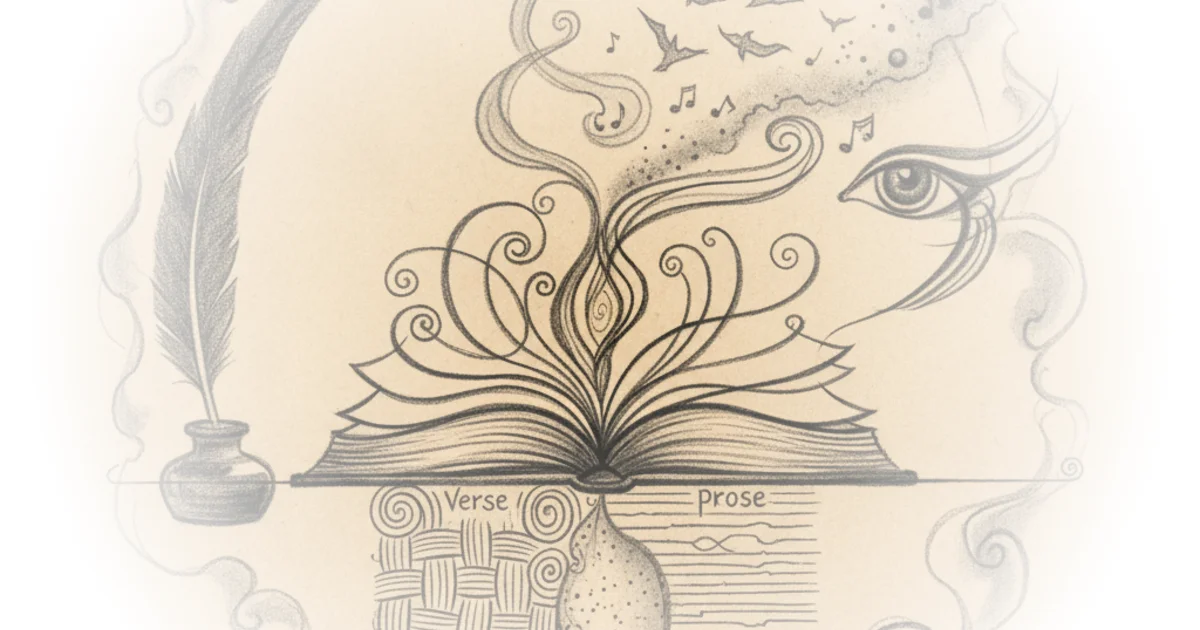
The second claim is even more provocative: "a poem is the shape of sound and sense together" — meaning you cannot separate what a poem says from how it says it. The author reinforces this with direct language: "in poetry sound and sense are inextricable." This is the intellectual backbone of the piece, and it's where Close Reading Poetry makes its strongest case.
The third claim pushes further: "a poem is not just a description of something it also enacts something" — poetry doesn't merely represent experience; it performs it. The reader isn't just receiving information about a scene, they're experiencing the poem's movement through sound and structure.
Authority and Definition
The author builds credibility by sourcing poets and critics who define poetry differently but converge on one point: poetry is distinct from everyday language. Boccaccio called poetry "exquisitely wrought" — emphasizing artistry. Sidney described it as "a speaking picture" — highlighting its visual, sensorial nature. Johnson saw it as teaching "the Art of Living" — connecting poetry to practical human wisdom.
Poetry is the spontaneous overflow of powerful feelings recollected in Tranquility.
That Wordsworth definition is crucial: poetry isn't premeditated or calculated; it's spontaneous. And Coleridge's contribution — "poetry is the best words in the best order" — emphasizes that both content and craft matter equally. This is where the author argues you can't separate what from how.
Shelley added something transcendent — poetry "redeems from Decay the visitations of divinity in man" — suggesting poetry bridges human experience with something divine. Arnold's framing — "poetry is the criticism of life" — means appreciation, not depreciation. These aren't contradictions; they're different angles on the same truth: verse literature demands more from readers than prose does.
Prose vs. Poetry
The author demonstrates this difference concretely through two examples. First, a passage from Walter Scott's novel Old Mortality describes a graveyard with beautiful prose — long sentences that communicate an idea or feeling and end when communication is complete. The words "are pretty much ordered in the same order in which they would be spoken in conversation." Prose tends toward the conversational.
But then the author turns to Thomas Gray's Elegy Written in a Country Churchyard, and everything changes. Unlike Scott's prose, these lines are grouped into stanzas — four lines per stanza called a quatrain. There are rhymes: "day" with "way," "me" with "see." Each line contains exactly ten syllables, and five of those syllables receive stress.
This is iambic pentameter — the meter establishes an expectation in your mind, quiet restfulness at twilight, and the poem fulfills that expectation. The author calls this the difference between hikers and walkers: "hikers go for the exercise, walkers go for the view" — poetry requires you to amble, to stop, to receive.
Sound and Sense
The analysis of Gray's stanza is where Close Reading Poetry earns its keep. Listen to how sound operates: "the curfew tolls" — the repeated S sound throughout creates what scholars call sibilance, imitating evening breezes dying away into silence. The long E in "beetle wields" almost sounds like an insect flying by. "Drowsy tinklings" calls back to "glimmering" — one of sight, the other of sound, phonetically calling back to each other.
The point isn't that poetry is superior to prose; it's that poetry obeys different rules, more rules. The author emphasizes: "poetry involves an awareness of not only what's being communicated by the words in the poem but how you're receiving it." A poem is an organic unity bound up in human experience — you can't read quickly like prose.
Counterpoints
Critics might note that this distinction, while intellectually compelling, could overstate the case. Prose also uses sophisticated sound techniques — Walter Scott's graveyard passage contains considerable artistry. And not all poetry operates with such strict formal regulation; free verse, for instance, deliberately breaks meter and rhyme. The author acknowledges this nuance by noting "poetry can be anything" but maintains that verse form represents a meaningful qualifier.
Bottom Line
The strongest part of this argument is the demonstration: rather than just telling readers poetry is different, Close Reading Poetry shows exactly how through Scott's prose and Gray's elegy. The vulnerability is in the assumption that verse necessarily requires more careful reading — free verse often demands just as much attention, sometimes less. But for readers willing to approach poetry as walkers instead of hikers, this piece offers a rigorous framework for understanding verse as something fundamentally different from prose.