Most economic analysis treats the shift away from US dominance as a simple story of rising powers and declining hegemons. Joeri Schasfoort argues that this misses the real engine of change: geoeconomics, where economic tools are wielded as geopolitical weapons. His piece is notable because it moves beyond the noise of headlines to explain why sanctions and aid work differently than standard economic models predict, offering a framework to understand the coming chaos in global trade.
The Mechanics of Influence
Schasfoort begins by redefining the battlefield. He writes, "Geoeconomics is the study about how countries use their economic strength to exert influence on foreign entities to achieve geopolitical or economic goals." This reframing is crucial. It suggests that the US or China aren't just trading partners; they are hegemons using their economic weight to force political compliance. The author explains that these powers offer an "inside option" of market access and loans in exchange for political alignment, or an "outside option" of isolation and sanctions.
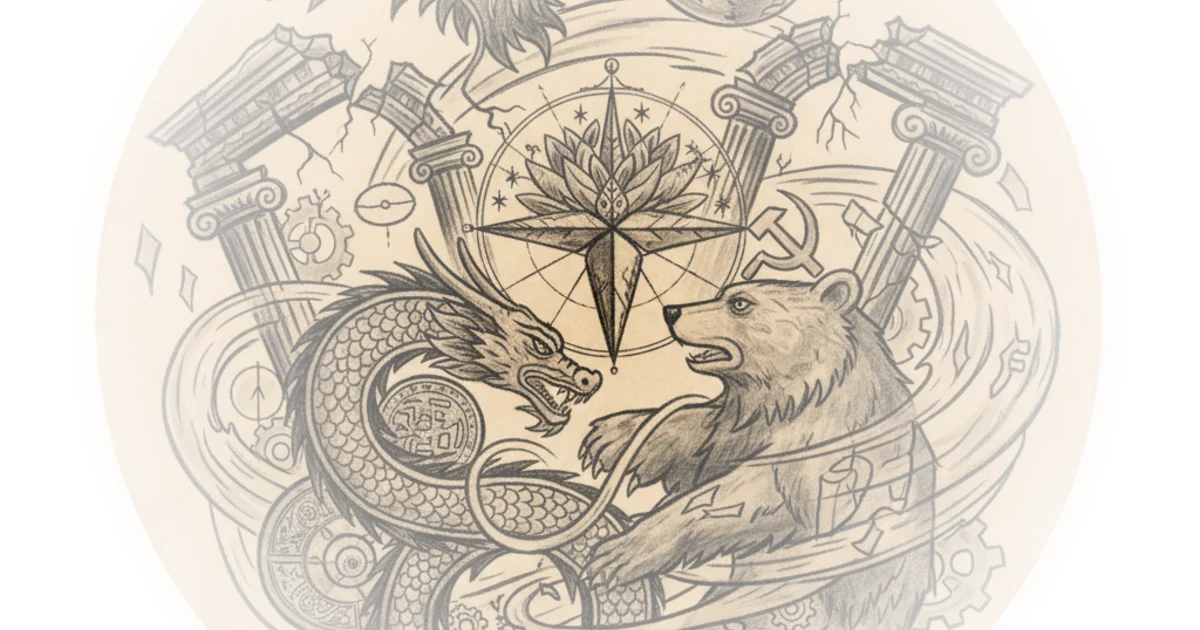
The analysis becomes particularly sharp when addressing the efficacy of these tools. Critics often dismiss foreign aid as a failure to generate growth, but Schasfoort counters this by noting, "US aid to Egypt makes total sense if we look at it through the lens of geoeconomics, as US aid raised the value of the inside option for Egypt." The argument holds up well here: the goal wasn't necessarily Egyptian prosperity, but Egyptian alignment. Similarly, he challenges the narrative that sanctions fail because they don't immediately force regime change. Instead, he argues they serve a broader deterrent function: "If the hegemon does not carry out its threat against one entity today then other entities may think they will also be let off the hook in the future."
"The hegemon is much more powerful if it can get a coalition of countries to go along with it."
This insight into coalition building explains why the US-led order is weakening. It isn't just that China is rising; it's that the US coalition partners, Europe and Japan, have become relatively less powerful. Schasfoort notes that "US sanctions against Russia were far less painful than they could have been because the coalition did not include China and India." This is a vital distinction for readers trying to gauge the resilience of current sanctions regimes. A counterargument worth considering is that this model assumes rational actors who always calculate costs and benefits perfectly, which may not hold in moments of intense nationalist fervor or ideological rigidity.
The Three Futures of Global Order
With the mechanics established, Schasfoort pivots to the future, outlining three distinct scenarios for a multipolar world. The first is the "Russian vision," characterized by spheres of influence where great powers use threats to maintain control. He warns that this path leads to "economic trade and finance crashing down," reminiscent of the 1930s. This scenario aligns with the pessimism of leaders like Singapore's Prime Minister, who recently declared that "the era of rules-based globalization and free trade is over."
At the other end of the spectrum lies the "inclusive multipolarity" championed by Brazil's President Lula. Schasfoort describes this as a world where "great powers work together inside existing institutions like the United Nations" rather than competing for spheres of influence. While the author admits this sounds "naive," he acknowledges the historical precedent of the European Union, where former rivals integrated under US guidance. However, he ultimately dismisses this as the least likely outcome, assigning it only a 5% probability.
The most probable future, according to Schasfoort, is a "second Cold War" scenario. In this world, the globe splits into two economic blocks, one centered on the US and the other on China. He predicts that "only a hegemon of intermediate size will use threats," meaning a multipolar world dominated by intermediate powers will see more frequent and active use of tariffs and sanctions. This creates a volatile environment where "global trade tends to go down and money moves across borders less easily."
"The multipolar world order which is by definition dominated by multiple intermediate hegemons will have more economic threats and they will be acted upon more."
This prediction carries significant weight for investors and policymakers. If the world fragments into competing blocs, the efficiency of global supply chains will degrade, likely driving up inflation and creating persistent uncertainty. Schasfoort's assessment that the US and China were far more interconnected than the US and Soviet Union were suggests that the pain of this fragmentation will be acute, even if it avoids the total trade collapse of the Russian scenario.
Bottom Line
Schasfoort's strongest contribution is his application of geoeconomic theory to explain why the US-led order is fraying not just because of China's rise, but because of the weakening of its own coalition. The piece's biggest vulnerability is its heavy reliance on rational actor models, which may underestimate the role of domestic political chaos in driving erratic foreign policy. Readers should watch for how the "intermediate hegemon" dynamic plays out in the next few years, as this will determine whether the world drifts toward a manageable Cold War or a chaotic free-for-all.