The Illusion of Predictability in War
War remains humanity's most catastrophic failure of imagination. What makes this review of Phillips O'Brien's War and Power striking is its demolition of the comfortable assumption that military outcomes can be forecast by counting tanks and troops. The authors expose how Western analysts catastrophically misread Ukraine's resilience—and Russia's weakness—before February 2022.
The Great Power Delusion
Sarah Longwell, Tim Miller, Bill Kristol write that "the threshold for being a 'great power' has been regularly redefined, muddied, and even lowered, to such a degree that by 2022 an economically weak and political corrupt system such as Vladimir Putin's Russia was widely hailed as one." This conceptual fog originates with Leopold von Ranke, the nineteenth-century German historian who coined the term. The label persisted long after its usefulness expired.
"If there is one general truth in war, it is that how a war ends bears very little resemblance to how people imagine it will end when it starts."
The Pentagon's pre-invasion briefing predicted Kyiv would fall in seventy-two hours. Ukraine would suffer fifteen thousand battle deaths; Russia, four thousand. These numbers were not cautious estimates—they were confident projections from the Chairman of the Joint Chiefs of Staff. Volodymyr Zelenskyy was expected to flee westward. None of it happened.
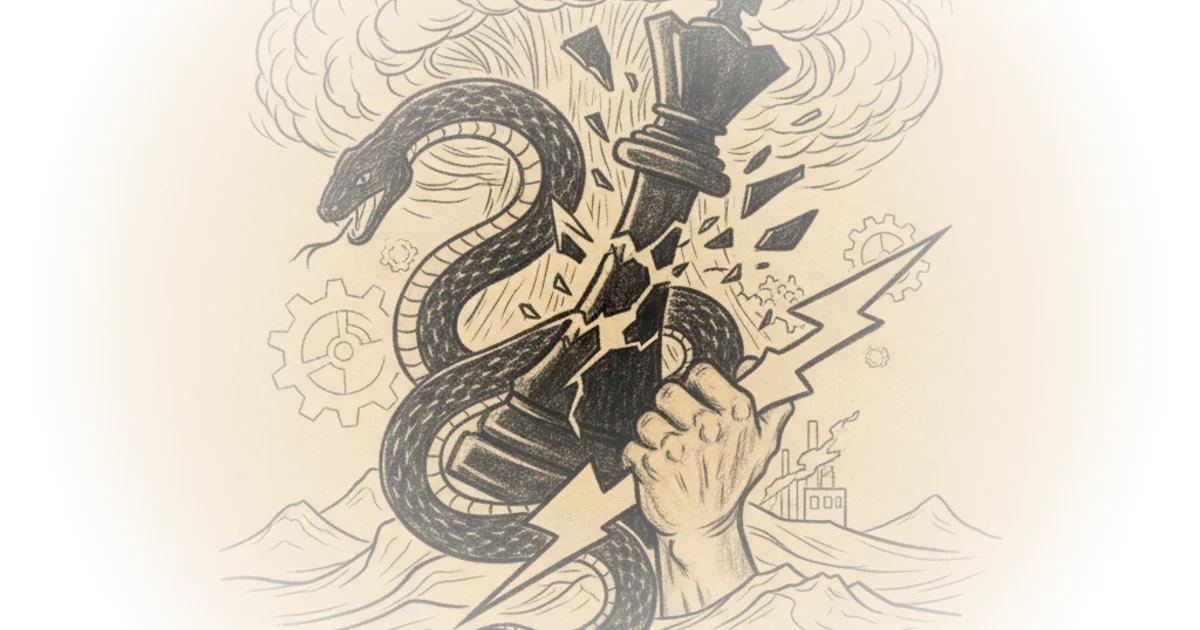
Sarah Longwell, Tim Miller, Bill Kristol note that O'Brien dissented from this analytic consensus, "noting the weaknesses of the Russian military and Ukraine's underappreciated strengths." The authors emphasize that "merely counting up guns and ships and airplanes and troops is profoundly misleading." Power cannot be reduced to arithmetic.
Critics might note that O'Brien's subtitle—"Who Wins Wars—And Why"—contradicts his own skepticism about prediction. If war's outcomes defy imagination at the starting line, what methodology can reliably explain them?
What Actually Makes States Strong
The foundation of state power, per O'Brien, is economic and technological capacity: "the ability to develop and make the most advanced 'stuff' in very large numbers." The HMS Dreadnought exemplified this—not because the battleship itself shifted European power, but because its construction revealed Britain's underlying productive capacity. France and Russia lacked the industrial base to compete. Only the United States and Germany could.
Sarah Longwell, Tim Miller, Bill Kristol point to a contemporary parallel: "At the outset of the Russia–Ukraine war, Ukraine had no capacity to speak of to produce drones. By 2024, it was producing a variety of configurations of drones in the millions." Russia, initially dependent on Iranian imports, expanded its own production. Industrial adaptation became a battlefield.
The Society That Must Fight
Leadership matters—individual personalities shape state destinies. But societal commitment matters more. Sarah Longwell, Tim Miller, Bill Kristol explain: "A society that believes that it is going to end up on the winning side of a war or that it is has no alternative but to fight a war has a significant advantage." Ukraine fights for existence. Russia fights for Putin's choice. The difference permeates every unit, every supply line, every decision.
The Vietnam War illustrates the inverse. The United States never lost a battle. It inflicted 1.1 million casualties versus fifty-eight thousand American dead. Yet it suffered a humiliating defeat. Societal faith in victory collapsed. The government could not continue prosecuting a war its people rejected.
Critics might note that this framing risks oversimplifying Vietnam's complex geopolitical dynamics and understates how North Vietnamese societal commitment—not American doubt—proved decisive.
The Alliance Advantage
"Rarely does one power win a war," O'Brien writes. "They are almost always won by coalitions, often large and wieldy ones, where a range of allies bring different strengths to the table." Ukraine enjoys European support and, for a time, American backing. Russia's coalition consists of autocracies: China, North Korea, Iran, Belarus.
Sarah Longwell, Tim Miller, Bill Kristol observe that American commitment has been "finicky and fickle," imposing severe restrictions on weapon use and pressuring Ukraine toward disastrous terms. The review notes that "today, the United States is almost systematically jettisoning its allies, casting doubt on its commitment to NATO, waging a trade war against friendly powers across the globe." This erosion of alliance reliability jeopardizes American security.
Critics might argue that alliance cohesion depends less on American consistency than on whether partners perceive shared interests—interests that shift with domestic politics in every democracy.
The China Question
O'Brien's net assessment of a potential U.S. conflict over Taiwan is bleak. In a short war, the United States might prevail. But China's manufacturing advantage grows with duration. The consequences would surpass anything witnessed since 1945.
Sarah Longwell, Tim Miller, Bill Kristol conclude that armies are "imperfect representations of the underlying strengths and weaknesses of the states and societies that create them." Economic capacity, leadership, societal commitment, alliances—these combine in complex, unpredictable interactions. There are no simple answers.
Bottom Line
War and Power dismantles the arithmetic of military prediction and replaces it with something more honest: uncertainty grounded in structural realities. The book's value lies not in forecasting victories but in exposing why confident forecasts fail. For policymakers still counting tanks while societies decide fates, that lesson is overdue.