The story of Fyodor Dostoevsky's near-execution is one of the most remarkable moments in literary history. In the winter of 1849, Russian authorities arrested the young writer for his involvement with a revolutionary group. He was led to an open field, tied to stakes, and prepared for a firing squad. The soldiers told him he had five minutes to live.
In that moment, something unexpected happened. Dostoevsky experienced each minute as if it were its own lifetime. He used the first two minutes to say goodbye to his friends. The next two minutes to review his entire life. Then, in his final minute, he looked around at the world one last time and saw a church spire gleaming in the sunlight — rays of light shooting off in all directions.
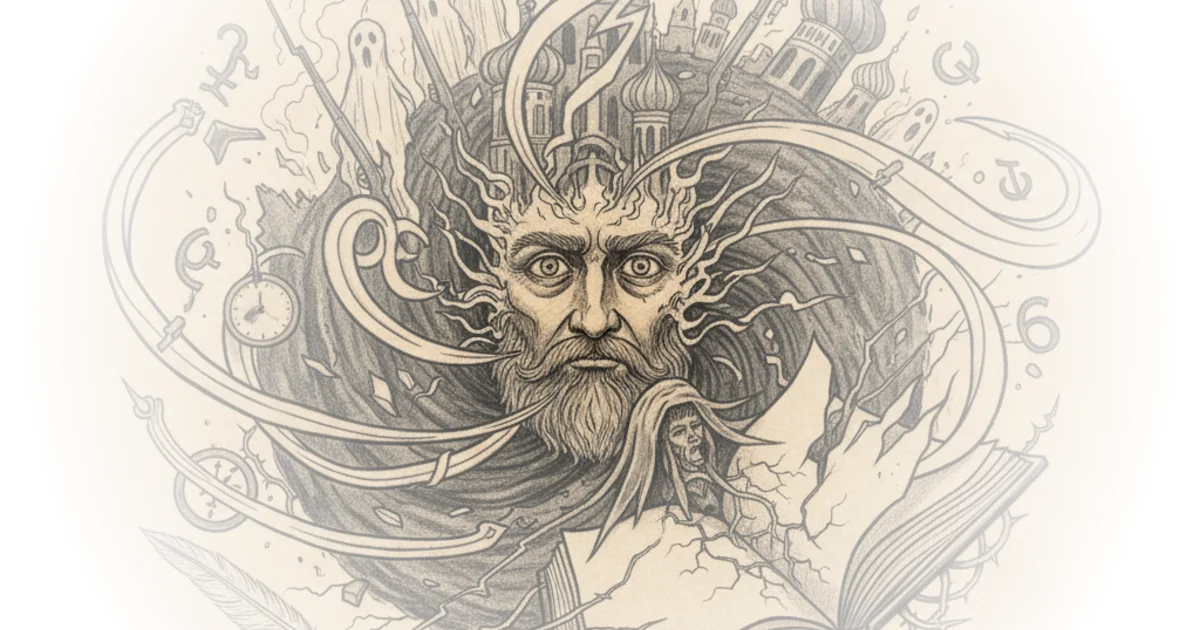
The experience transformed him. In that final moment, he asked himself: if I survive, what will I do with my life? He knew exactly what he would do. He would count every minute. He wouldn't waste a single second. The weight of this realization was so intense that he later wrote he wished they'd just hurry up and shoot him to escape the thought.
Then, as the rifles were about to fire, a rider arrived on horseback with a stay of execution. It was all a staged mock execution — a political maneuver by Tsar Nicholas I to appear benevolent. But Dostoevsky emerged profoundly changed. He served four years in a Siberian prison, then five years in the Russian military, and finally published his first major work after this experience: Notes from Underground in 1864.
This story is central to understanding The Idiot, one of Dostoevsky's five great novels. It explains why he chose to tell it through Prince Mischkin — a Christlike figure living among ordinary humans.
The Christlike Figure
Dostoevsky explicitly aimed to create what he called in letters to his niece "the positively beautiful man" — an example of goodness placed into the messy reality of human relationships and psychology. This was no simple task. Authors throughout history had attempted to bring a Christlike figure to life, from Dickens's Pip to Hugo's Jean Valjean. But Dostoevsky believed every one of these attempts fell short.
What makes his approach unique is his realism. Unlike other writers who created idealized moral characters in controlled narratives, Dostoevsky wanted to drop someone like Jesus into the middle of actual human psychology and society — messy, complicated, deeply flawed. The result? From the outside, most people would think such a person is simply an idiot.
This connects directly to the title. The Idiot asks: what happens when you plant a truly moral sage into annoying real-world scenarios? Someone harassing them at the mall, trying to manipulate them, taking advantage of them — and they do nothing because that's what Christlike figures do. What does this person do when someone's harassing a monk at the mall?
The Curse of Sainthood
Dostoevsky discovered something profound: even if you could create someone morally ideal, there's a "curse of sainthood" that makes their impact uncertain. Prince Mischkin in The Idiot doesn't make the world around him better. In fact, sometimes his religious self-sacrifice — his humiliation for the sake of helping others — actually makes people's lives worse.
This is what Dostoevsky wanted to explore: not whether goodness exists, but how tenable it is in an imperfect world. If Crime and Punishment tested Raskolnikov's ideals and Demons tested Western liberalism, then The Idiot tests Dostoevsky's own ideal of sainthood — his own vision of what a perfect person might look like.
The Beauty Question
Prince Mischkin's entire journey has been described as one long conversation about beauty. He begins the book returning from years in a mental hospital for epilepsy treatment, sitting on a train. He meets Rogyn — a character defined by selfishness and shallow thinking. Every main character in The Idiot thinks about beauty differently, and these different perspectives define who they are.
This connects back to Dostoevsky's famous quote: "Beauty will save the world." The phrase has sparked endless debate. But understanding that he wrote this after his near-execution — after watching that church spire and feeling each minute as a lifetime — gives it new weight. He wasn't just describing aesthetics. He was describing what happens when you truly understand the preciousness of every moment.
In that five-minute moment facing a firing squad, Dostoevsky discovered something about time: each minute felt like an entire lifetime, and he suddenly understood exactly how he would spend all his remaining days if he were allowed to live — he wouldn't waste a single one.
Bottom Line
Dostoevsky's deepest insight in The Idiot is that goodness alone doesn't guarantee impact. His vulnerability lies in the ambiguity: if even Christlike figures can make things worse, what's left? The strongest part of this argument is how it exposes the gap between moral ideals and messy reality — a tension every reader faces when trying to live ethically in an imperfect world. }