Wes Cecil makes one claim that's hard to believe at first: an obscure Danish writer who was virtually unknown when he died in 1855 became the foundation for three-quarters of modern philosophy. He's not exaggerating. The list of thinkers influenced by Kierkegaard reads like a who's who of twentieth-century thought — Kafka, Derrida, Levinas, Buber, Barth, Tillich. These weren't vague inspirations; they were actively quoting and arguing with him.
The Danish Outsider
Cecil opens with a detail that reveals how different things used to be: Kierkegaard had to petition the King of Denmark just to write his dissertation in his native language. "He wanted to write his dissertation in Danish... he had to petition the King to do this which is just bizarre to think about."
This wasn't some academic formality — it was a deliberate act of resistance against the German philosophical tradition that dominated Europe. The languages of education were Latin and German; writing in Danish sounded like trying to skip out on being educated. So Kierkegaard had to defend his dissertation orally in Latin just to prove he was serious.
Cecil captures this tension perfectly: "He was really emphasizing his Danish-ness and his resistance to the German philosophical tradition but that's why he's so important is because while he wanted to write in Danish... he was writing against the German philosophical tradition has he understood it which of course puts him firmly in the German philosophical tradition."
The Reformation's Aftermath
The core of Cecil's argument centers on what happened when the Catholic Church split. "When you get a Reformation inside the Catholic Church is you split the fundamental notion of the unitary system in which you can believe... it was all within the notion of worth all fighting within one box but we agree about the box so that was okay."
The Reformation shattered that unity, and Kant, Hegel, Schopenhauer — what Cecil calls "the big Germans" — spent their careers trying to think their way back to some absolute truth. Kierkegaard wasn't buying it.
God is still alive and you can't get to him with reason. He just said you can't actually achieve what you need which is to get back to this unitary faith in God with reason at some level it just becomes this leap of faith.
This is the heart of his influence: he articulated the problem so well that everyone who came after him built on his foundation, even when they dropped God entirely.
The Struggle Within
What makes Kierkegaard fascinating isn't just his philosophy — it's his biography. "I think it's impossible for anybody who has faith to write this much about faith right you just can't write hundreds if not thousands of pages about the centrality of faith if you have faith."
Cecil suggests that Kierkegaard lived in perpetual spiritual struggle, coming from a tradition that told him he was terrible no matter what. "He was always trying to perfect his way out of the human condition... he's hating himself as hard as he could and it didn't seem to get him to love himself right."
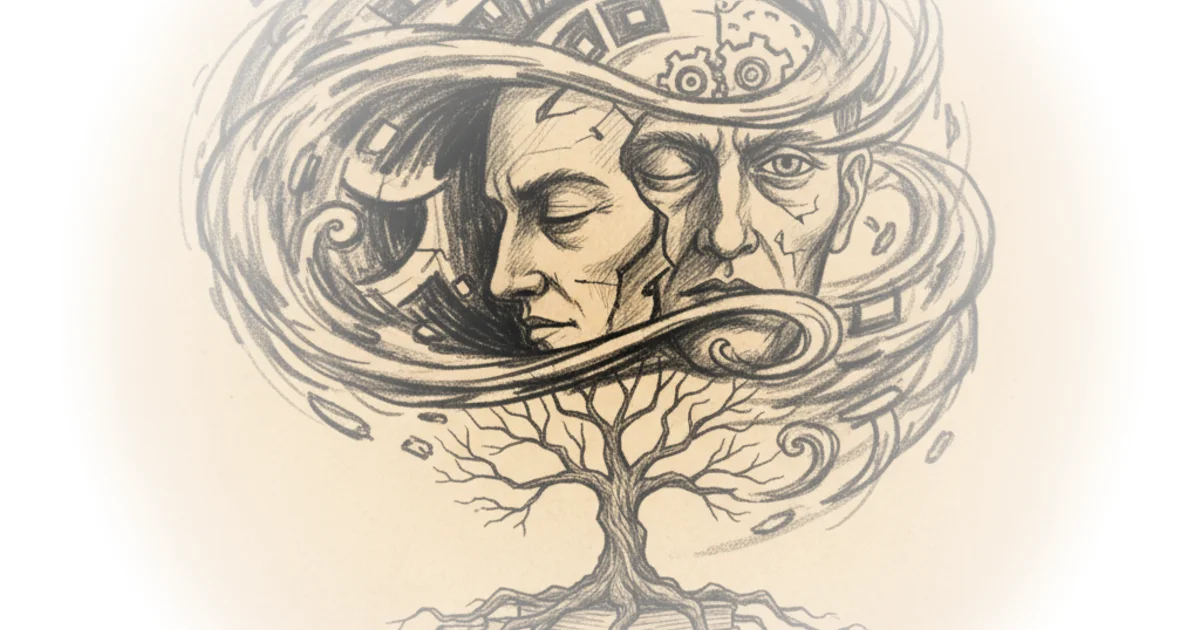
This is where the lecture becomes almost psychological: Kierkegaard wasn't writing from certainty — he was working through exactly why he couldn't get there. And that struggle became the template for modern existential thought.
The Pseudonyms
One of the most unusual aspects of his work involves how he published. "He did not believe in systems and so he published under pseudonyms anonymously he would publish multiple works at one time that contradicted each other so you couldn't really tell which was the position that Kierkegaard was taking."
This wasn't confusion — it was deliberate. He wanted readers to struggle with competing perspectives, none of them definitive, because the truth about existence isn't a system you can wrap up neatly. Cecil notes this is something Derrida later did too, "and I always thought that came from daring all that like I'm like wow what a great idea."
Counterpoints
Critics might note that framing Kierkegaard as primarily a reaction to the Reformation oversimplifies his project. He was also deeply engaged with aesthetic philosophy and the nature of authenticity itself — concerns that extend far beyond theological debates. Additionally, calling him "more poet/writer than philosopher" risks underplaying the rigor of his actual philosophical arguments about ethics, ontology, and the nature of choice.
Bottom Line
Cecil's strongest move is reconnecting Kierkegaard's personal spiritual struggle to his intellectual legacy — the man who couldn't find faith became the template for everyone who came after him searching for meaning. His biggest vulnerability is treating this as primarily a theological problem when Kierkegaard's real innovation was making the existential question itself rather than just answering it. The lecture's power comes from that tension: an obscure Danish writer who shaped everything, and never quite believed in what he was shaping.