Most historical narratives paint the medieval Eastern Roman Empire as a slow-motion collapse, a 'sick man' waiting for the end. Kings and Generals shatters this passive view, arguing that the 10th century was not a period of decline but a violent, calculated resurgence driven by a specific military culture. This documentary doesn't just list battles; it exposes how a fractured Islamic world created a geopolitical opening that a disciplined Byzantine state was uniquely positioned to exploit.
The Myth of Terminal Decline
The piece opens by dismantling the assumption that the empire was doomed after the loss of Egypt and Syria. Kings and Generals writes, 'from a geopolitical standpoint the eastern roman empire is often depicted as the sick man of the middle ages however amidst the constant territorial retreat there were periods when they pushed back against the invading tide.' This reframing is crucial because it shifts the focus from inevitable decay to active agency. The author correctly identifies that the empire's survival wasn't luck; it was the result of a 'string of capable military-minded men' who understood that the balance of power was shifting.
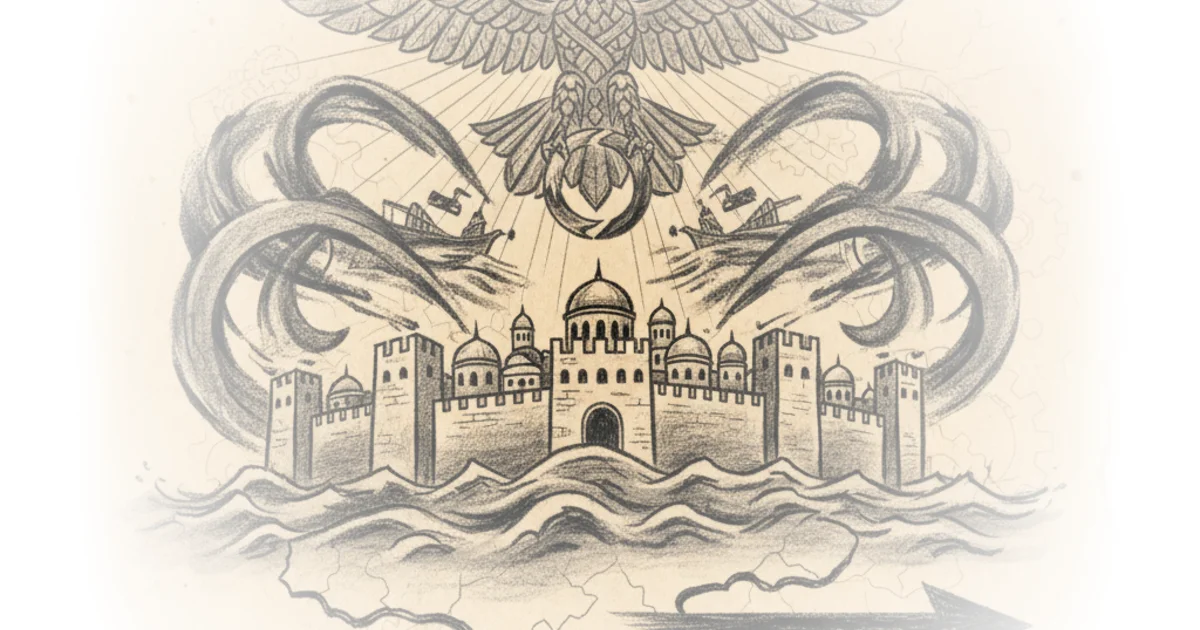
The narrative highlights the specific threat of the Emirate of Crete, which had become a 'perfect base from which arab pirates launched constant and devastating raids into the coastal towns of the aegean sea.' Kings and Generals notes that by the early 9th century, 'byzantium... looked to be a polity in terminal decline,' yet this was a momentary illusion. The commentary effectively uses the rise of Basil I to illustrate how internal consolidation preceded external expansion. Basil's ability to 'bring the bulgars and south slavs into the eastern orthodox fold' and 'seizing barry which had been a muslim stronghold' set the stage for a renaissance 'not seen since the days of justinian.'
However, the piece glosses over the fragility of these gains. Critics might note that the 'regressive trend' following Basil's death was not just a temporary setback but a structural weakness that nearly undid the empire before the Macedonian dynasty fully matured. The narrative acknowledges this, stating that 'the games basil the first had made to ensure the security of byzantine borders had begun to falter' under the pressure of Bulgarian wars and Arab raids.
The geopolitical situation would soon tilt back in the romans favor the abbasid caliphate which had long been eastern rome's greatest rival had been slowly losing grip of their central authority since the late 800s.
The Fractured Enemy
The most compelling argument in the coverage is the analysis of the enemy's internal decay. Kings and Generals posits that the Byzantine resurgence was possible because 'the islamic world was nevertheless more fractured than it had ever been a political climate ripe for exploitation.' This is a sophisticated geopolitical observation: the empire didn't just get stronger; its rivals got weaker simultaneously.
The documentary details how the 'powerless central abbasid authority' could do little as peripheral provinces gained autonomy. This fragmentation allowed generals like John Kourkouas to achieve what seemed impossible. Kings and Generals writes, 'the capture of melatene sent a shockwave throughout the muslim world for the first time in history a major muslim city had fallen and been reincorporated into the byzantine empire.' The author frames this not just as a tactical victory but as a psychological turning point that 'sent a shockwave throughout the muslim world.'
Yet, the narrative also highlights the tragic irony of Byzantine court politics. Even as Kourkouas 'kept the burgeoning hamdinidge dynasty of aleppo at faye,' he was 'punished for his rising popularity by the scheming imperial court.' This adds a layer of complexity to the military success, suggesting that the empire's greatest asset—its generals—was also its greatest liability due to internal paranoia. The coverage notes that Kourkouas was 'dismissed from service in 944 and soon after faded from the pages of history,' a reminder that military brilliance in Byzantium was often cut short by political maneuvering.
The Siege of Chandax
The climax of the piece focuses on Nikephoros Phokas, the general tasked with retaking Crete. Kings and Generals describes him as 'the pale death of the saracens,' a moniker that underscores the terror he inspired. The documentary paints a vivid picture of the fortress of Chandax, noting that 'according to the contemporary chronicler leo the deacon it was protected on one side by the sea and on the other by tall battlements of earth and goat and pig hair mixed together and compressed thoroughly.'
The scale of the operation is staggering. Kings and Generals writes, 'it was a truly gigantic mass of soldiery total estimates ranged between around 30 000 to 50 000 men during an era when the kings of europe could barely muster armies more than a few thousand apiece.' This comparison effectively illustrates the logistical might of the Eastern Roman state. The inclusion of 'a contingent of norse axe wielders from scandinavia' further emphasizes the empire's reach and its ability to integrate diverse military cultures.
The siege itself was a brutal test of endurance. The author details how Nikephoros had to fight a 'two-front battle' against the garrison inside the walls and 'squadrons of arab gorillas who had kept enshrouded amidst the island's hills.' The narrative captures the chaos when a scouting party led by Pastillas was ambushed: 'despite being inebriated the romans fought back viciously until pastors was struck down by a hail of arrows.'
Time and again arab skirmishers would stream out of the hills and make lightning strikes against the roman stockade at times coordinating with their comrades inside kandex who would launch simultaneous sorties outside of their walls in an attempt to pincer their procedures.
The commentary here is sharp, noting that Nikephoros responded by unleashing 'death squads' to 'strike back into the cretan countryside,' shifting from a passive siege to an active campaign of attrition. This tactical flexibility is what ultimately broke the stalemate. A counterargument worth considering is whether such a massive mobilization was sustainable long-term, or if it drained resources needed for other fronts, but the documentary focuses on the immediate tactical success.
Bottom Line
Kings and Generals delivers a masterclass in military history by reframing the 10th century not as a period of decline but as a calculated, violent resurgence driven by a fractured enemy and a disciplined state. The strongest part of the argument is the clear link between the Abbasid Caliphate's internal collapse and the Byzantine ability to project power, while the biggest vulnerability is the underplayed role of political instability in potentially derailing these gains. Readers should watch for how this model of 'resurgence through enemy fragmentation' applies to other historical turning points where a declining power faces a disintegrating rival.