Yascha Mounk delivers a jarring diagnosis for higher education: the American research university isn't just struggling; its foundational architecture is collapsing under the weight of artificial intelligence. While others debate syllabus tweaks, Mounk argues that the very technologies used to assess and teach students have been rendered obsolete by large language models, forcing a complete disaggregation of the institution's mission.
The End of the Multiversity
Mounk anchors his argument in the history of Clark Kerr, who coined the term "multiversity" in 1963 to describe the sprawling, contradictory nature of the modern university. Mounk writes that Kerr viewed this entity not as a community of scholars united by shared ideals, but as a "sprawling institutional conglomerate serving at once as a research engine, a job-training facility, a credentialing mechanism." This framing is crucial because it suggests the incoherence was always a feature, not a bug. Mounk notes that Kerr believed this messy bundle worked because of a shared technological substrate—the book, the lecture, and the written exam—that allowed the university to "administer the present" despite its internal contradictions.
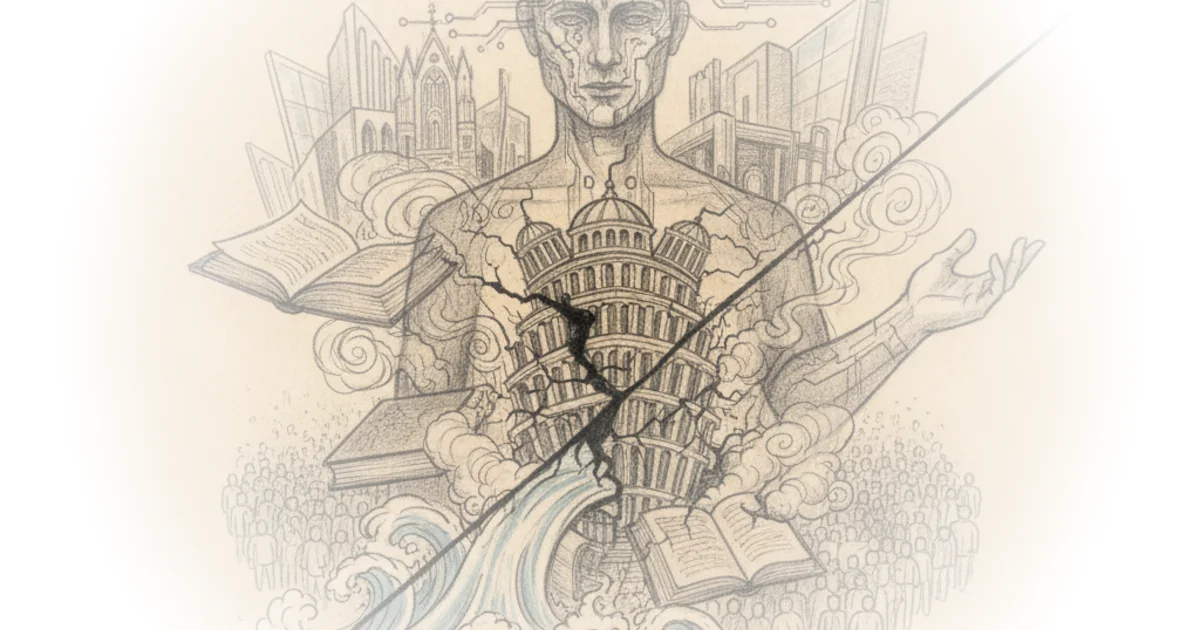
The author argues that this high modernist confidence has evaporated. The postwar bargain frayed decades ago as universities shifted from grants to loans and replaced tenured faculty with adjuncts, but AI is the catalyst that makes the old model impossible to sustain. As Mounk puts it, "The arrival of large language models is acting as a catalytic solvent, titrating out the incoherence that was always there." When an AI can produce a plausible term paper in twenty minutes or tutor a student with infinite patience, the traditional formats for intellectual discipline dissolve.
The multiversity didn't need to be coherent in order to be functionally useful as a platform for what Kerr called "administering the present."
Critics might argue that Mounk underestimates the human element of learning that persists even when content is easily generated, but his point about assessment holds weight: if the output can be faked, the process must change. The administration and faculty have largely failed to grasp this scale of disruption. Mounk points out that even the April 2026 Report of the Yale Committee on Trust in Higher Education treated AI as a mere "pedagogical inconvenience" rather than a force restructuring the economics of knowledge work. This oversight is dangerous; it suggests that even the most self-aware corners of the academy are still treating a structural revolution as a logistical hiccup.
The Co-curricular Dodge and the Need for Live Reasoning
In response to this crisis, many administrators are retreating to the "co-curricular," emphasizing residential life and human connection as the university's only remaining unique value. Mounk acknowledges that there is merit here, citing evidence that learning thrives in community settings where chance encounters and debates occur. He notes that in the 1960s, more than four-fifths of freshmen sought to "develop a meaningful philosophy of life," a goal that has since collapsed alongside the rise of vocational credentialism.
However, Mounk argues this focus is an evasion if it ignores the curriculum itself. If the primary response to AI is to tell students to ignore the technology and rely on hallway chats, institutions risk becoming irrelevant. The real solution lies in reimagining what humans can do that machines cannot. Mounk writes that "AI cannot build the trust on which institutional cooperation depends" because trust is a relationship constituted over time between persons who have staked something on each other. Similarly, AI cannot constitute goals or possess taste, as these require a valuing subject and personal distinctiveness within a community.
If the primary response of universities to the most dramatic new knowledge technology in decades... is to demand that students stick cotton in their ears and keep rowing, it will only hasten their decline into institutional redundancy.
The author proposes a radical shift in assessment: moving away from polished artifacts like term papers toward live demonstrations of reasoning. This means oral examinations, structured adversarial debates, and real-time design critiques where the focus is on "sense-making under pressure" rather than the final product. While this approach aligns with the Socratic method, it requires a fundamental change in faculty roles. Professors can no longer be mere lecturers delivering information that AI provides more cheaply; they must become interlocutors who model how to calibrate uncertainty and revise frames in real time.
Bottom Line
Mounk's strongest contribution is his identification of the "shared technological substrate" as the glue holding the multiversity together, a bond now dissolved by artificial intelligence. His argument that the term paper is dead and must be replaced by live assessment is not just a pedagogical tweak but an existential necessity for the institution's survival. The biggest vulnerability in his piece is the lack of a concrete roadmap for how universities can transition to this high-touch, low-tech model without exacerbating their financial crises or alienating students who still view degrees primarily as economic credentials.