In an era where the publishing industry often prioritizes algorithms over artistry, this piece delivers a radical, human-centric thesis: your creative survival depends less on your individual talent and more on the specific people you choose to walk beside. Jeannine Ouellette frames this not as a soft sentiment, but as a strategic necessity for navigating grief, disability, and a volatile cultural landscape. The argument is notable because it rejects the myth of the solitary genius, replacing it with a gritty, evidence-based case for deep, interdependent community as the only viable engine for sustained artistic output.
The Architecture of Intimacy
Ouellette introduces the essay by recounting her own evolution from a writer who labored in isolation to one who actively cultivates a "literary citizenship." She writes, "The thing about writer friends is, they are not only supportive and encouraging and excellent at commiserating, but, also, they help each other." This distinction is crucial; the piece argues that true community moves beyond emotional validation into the realm of tangible, career-altering intervention. Ouellette illustrates this with the story of how a recommendation from a friend led to a residency at Ragdale, a historic writers' colony founded in 1919 that has long served as a sanctuary for creative incubation. The argument lands with force because it grounds abstract concepts of "networking" in the specific, life-changing mechanics of trust.
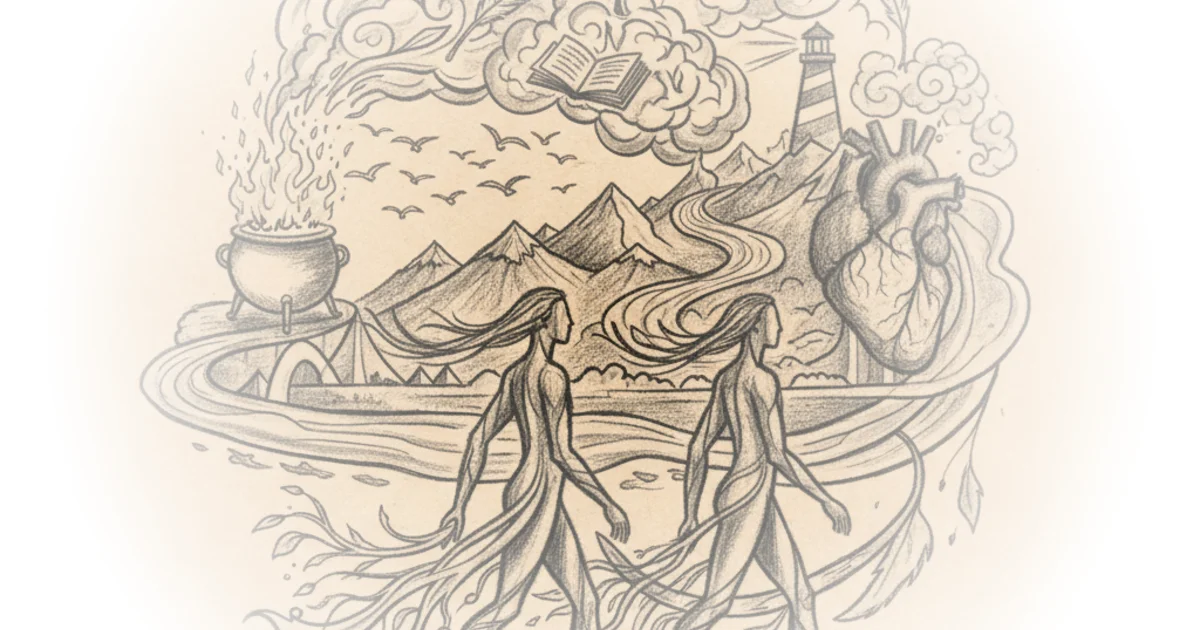
As Ouellette puts it, "There is no other way. An email here, a comment there, a post about a book, an hour on Zoom, and the next thing you know everything changes." This observation reframes the digital tools often criticized for fracturing attention spans, positioning them instead as the connective tissue that allows modern writers to sustain deep bonds despite physical distance. The evidence here is compelling because it relies on the author's lived experience rather than theoretical models. However, critics might note that this level of access requires a baseline of privilege—time, energy, and existing professional standing—that not every struggling writer possesses. The piece implicitly assumes a certain level of agency that may be out of reach for those in the most precarious positions.
"They say love makes the world go round, and their not wrong, but it's equally true that writer friends spin the globe."
The Business of Shared Survival
The commentary shifts to the professional dimension, detailing the partnership between Gina Frangello and Emily Rapp Black. Ouellette describes their collaboration as a "marriage" of sorts, one that demands negotiation and a "stubborn persistence to see each other's beauty and gifts even when (or especially when) time is tight." This framing is effective because it strips away the romanticized notion of effortless creativity, revealing the hard labor required to maintain a business and a friendship simultaneously. The narrative weaves in the context of the pandemic, noting how their virtual business model, Circe Consulting, thrived precisely because the world was forced online, turning a personal crisis into a collective opportunity.
Ouellette highlights the deliberate choice to remain a two-woman enterprise, refusing to expand despite the temptation of growth. "We never expanded to take on another business partner, because…well, in some ways, that would be a bit like becoming a real thruple," she writes. This decision underscores the central thesis: the quality of the bond is more valuable than the scale of the operation. The argument is strengthened by the specific details of their shared history—navigating divorce, illness, and the loss of children—which serves as proof that their partnership is forged in fire, not just convenience. The inclusion of the Association of Writers & Writing Programs (AWP) context, where these connections were often first solidified at conferences like the one in Philadelphia, adds a layer of institutional reality to what might otherwise feel like an isolated anecdote.
Selecting the Inner Circle
The most potent section of the piece is the introduction of Ouellette herself as the third partner in the new CRAFT SCHOOL venture. Here, the argument becomes a manifesto on the criteria for choosing one's allies. Ouellette writes, "When you are 57-years-old and you have lost your breasts, your hair, both hips, buried both your parents and two of the closest friends of the life, you do not have the time or the will to fuck around with frivolity." This raw enumeration of loss serves as a filter, separating the superficial from the essential. The piece argues that in the face of mortality and systemic oppression, the only logical choice is to surround oneself with those who understand the weight of survival.
As Ouellette puts it, "The people with whom you want to surround yourself…well, they are the people who also have little interest in that noise." She defines this noise as the cultural obsession with metrics, social media followers, and the "misogynistic, ableist, racist, ageist, heteronormative Machine." This framing is powerful because it redefines success not as accumulation, but as resistance. The argument suggests that the new CRAFT SCHOOL is not merely a writing program, but a sanctuary for those who have been marginalized by the very industry they seek to join. The reference to Dunbar's number—the cognitive limit to the number of people with whom one can maintain stable social relationships—lurks beneath this argument, suggesting that in a world of infinite digital connections, the conscious limitation to a small, trusted circle is the only way to preserve sanity and creativity.
"With what time I have left, I want to lift up."
Bottom Line
The strongest element of this piece is its refusal to separate the personal from the professional, arguing instead that the deepest creative work is inextricably linked to the quality of one's relationships. Its biggest vulnerability lies in its reliance on a specific type of resilience; the argument assumes that the reader has the capacity to choose their circle, a luxury not afforded to everyone facing systemic barriers. Ultimately, this is a vital reminder that in a fractured world, the most radical act a writer can commit is to choose their people with intention and care.