Derek Muller's Veritasium investigation begins with a premise as seductive as it is untested: "positive ions make us feel bad and negative ions make us feel good." It's the kind of claim that sounds plausible precisely because it's been repeated so often. Muller doesn't dismiss this outright — he dives into it. He finds "literally hundreds of published peer-reviewed scientific studies on the biological effects of ions" spanning about a century of research, with atmospheric ions as the specific focus. The breadth of existing science is genuinely surprising; most people assume no one has studied this at all.
Muller then lays out natural ion sources in a way that's oddly compelling: cosmic rays create roughly 500 ions per cubic centimeter at ground level, waterfalls can generate tens of thousands, and even ocean waves crashing on shore produce measurable ionization. The problem? These levels are trivially small compared to the air around us.
"unlike charges attract so moving about in the atmosphere I'd expect the positive and negative ions to find each other and then BOOM they're back to being neutral"
This is where Muller earns his keep. He's not just debunking — he's explaining why natural ionization happens despite the obvious theoretical obstacle. The science here is genuinely educational, even when it undermines the claims that triggered it.
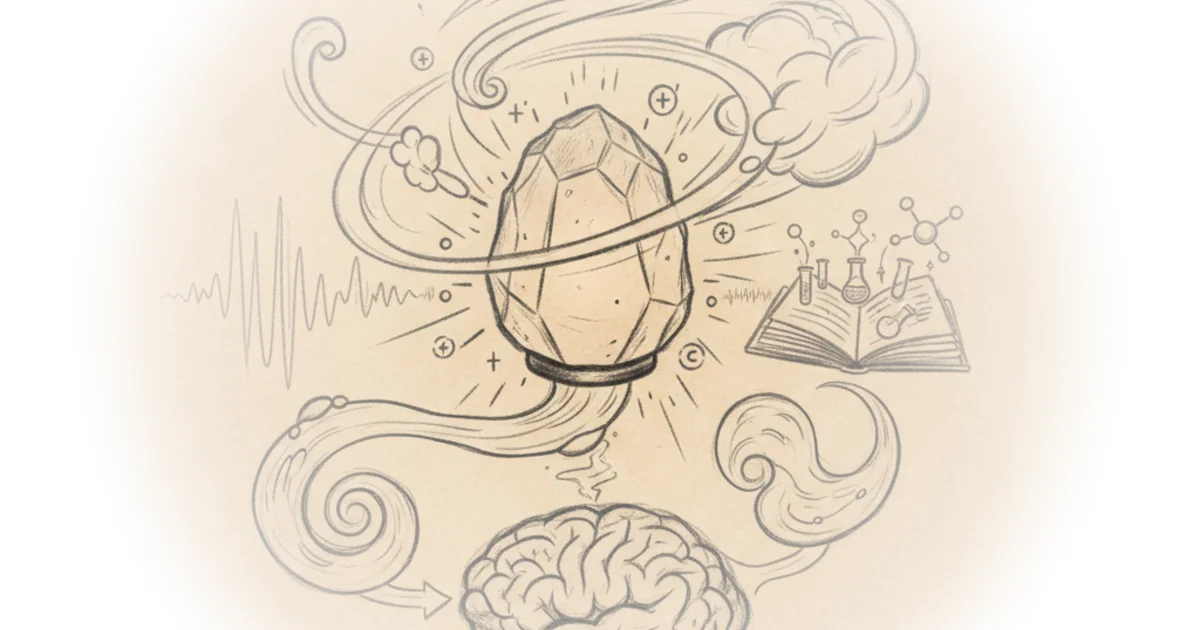
Testing the Himalayan Salt Lamp
The core of the investigation involves testing whether a Himalayan salt lamp actually produces negative ions. Muller brings in an ion expert with "55 years" of studying ions and runs the lamp alongside a mass spectrometer designed to detect ions at the inlet. The setup is rigorous, almost theatrical — you can see the audience waiting for results.
The conclusion arrives quickly: no negative ions detected. Not just few — none. Muller summarizes why with clean simplicity: "the energy required to do this is way too high so it just doesn't happen." This is the piece's most satisfying moment. The salt lamp simply cannot liberate chloride ions from its lattice at temperatures produced by a lightbulb. The chemistry fails, and the mass spectrometer confirms it empirically.
But Muller keeps going — he brings in tourmaline, which actually does produce ions when heated because "tourmaline has a structure such that if you heat it it caused it to expand it will actually develop an electric charge on the faces of the crystal." This is genuinely interesting: some crystals do work, but not salt. The contrast between the expensive gemstone and the cheap lamp makes the investigation feel like detective work rather than just debunking.
What the Research Actually Shows
Perhaps more devastating than the lamp test is what Muller finds about ion research itself. He walks through study after study — seasonal affective disorder treated with negative ions, reaction time tests, EEG experiments showing alpha wave changes, even workplace studies where employees reported fewer headaches when ionizers were fitted to HVAC systems.
Then he pivots: "the research is inconsistent no significant difference evidence for beneficial effects of negative ions on mood and performance could not be demonstrated." The studies have serious problems — small sample sizes, unblinded participants who could detect ozone by scent, measurements taken at the source rather than where subjects actually sit. A 2013 meta-analysis found "no consistent influence" across major measures like anxiety, mood, relaxation, sleep, and personal comfort.
The only statistical link Muller acknowledges is between negative air ionization and lower depression scores — but even that connection is described as requiring further evaluation of biological plausibility.
"in a cubic centimeter of air there are 10 to the 19 air molecules so even with tens of thousands of ions the amount is insignificant not even one part per billion"
This is the quantitative gut-punch. The numbers make any ion effect trivially small at atmospheric concentrations, and Muller's point lands hard: there's no reason to think extra electrons would do anything.
Counterarguments Worth Considering
Critics might note that dismissing all this research overlooks real-world workplace data — the office study where workers reported fewer headaches with ionizers fitted to air conditioning. Those results came from actual environments, not lab conditions, and they suggest some effect at scale even if the mechanism is unclear. Also worth considering: the ozone problem. The ionic air purifier tested produced 17 parts per billion of ozone initially, then jumped to over 80 when measured — levels described as "smog in a city." That's a genuine concern that deserves more attention than the brief segment it receives.
Bottom Line
Muller's strongest contribution is the empirical testing: salt lamps don't produce negative ions. His weakest argument is suggesting we should dismiss all ion research because concentrations are small — that's actually what makes the positive studies interesting, not a reason to dismiss them. The piece works best when it's specific and concrete (the mass spectrometer result, the tourmaline comparison) rather than general (dismissing the entire field). For viewers who want actual science: this is a strong debunking of Himalayan salt lamps, but it's also an invitation to think more carefully about how small effects get studied and whether they matter.