The Architecture of Attention
PILCROW's third chapter of Vice Nimrod cuts through the fantasy of institutional communications with surgical precision. What makes this piece notable is its refusal to romanticize the tower—it shows the intoxicating comfort of belonging to power while never letting readers forget the cost.
From Dupe to Liar
The protagonist Ishkebek rises through Nimrod's Communications Group during years that feel "like flying on narcotic and erotic tailwinds and updrafts of distraction and self-importance." PILCROW writes, "When things are good at work, life is a variety of perfect. And it only costs everything." That sentence lands like a hammer. The promotion Ishkebek receives isn't really about title or salary—it's about being "read into the conspiracy, shown yet more of the trick of the riddle, and advanced from a dupe to a liar. I was proud."
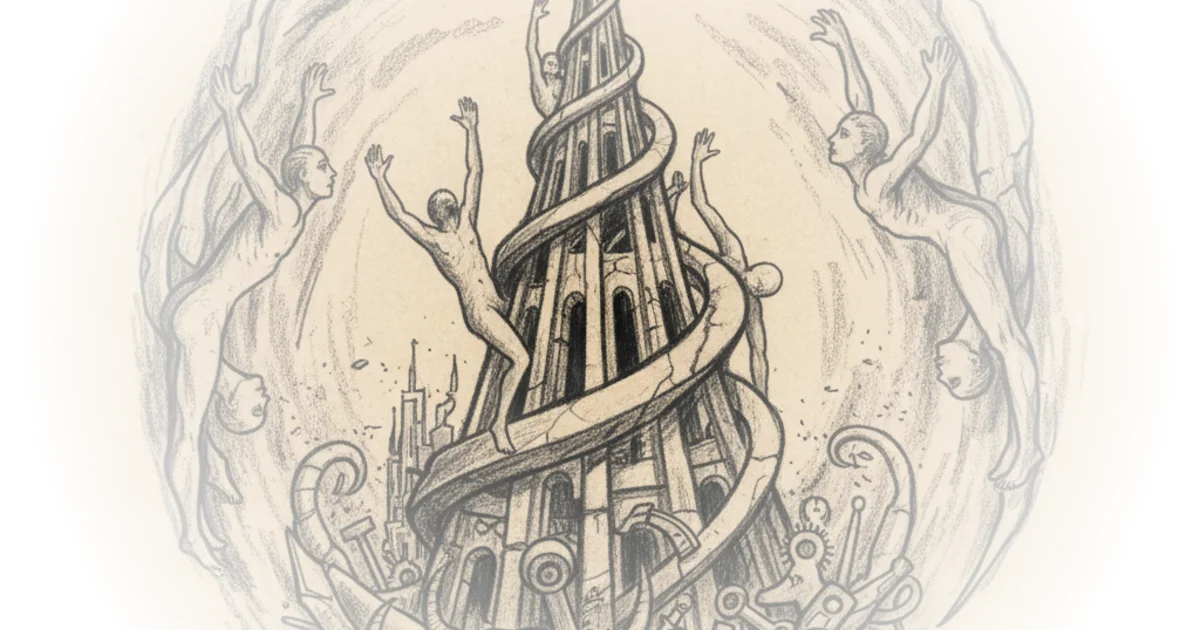
The tower's communications function operates on what Jerr, a senior manager, calls "rumor control, tumor patrol." As PILCROW puts it, "A tumor, as someone explained to me once at a party, is a bit of tissue that's too excited about growing, and so grows at the expense of the rest of the body. Cutting it out helps sometimes, but not always. A rumor works the same way." The solution isn't truth—it's drowning the rumor in more flesh, more narrative, more confusion.
"Our work serves no truth, Jerr said, it serves the tower."
Six Competing Truths
Jerr lays out the six rumors that Internal Communications must patrol: the tower as siege ladder, as divine gift, as flood barrier, as spectacle for rulers, as arbitrary center for human attention, as bulwark against death and time. PILCROW writes, "Without attention, there is no tower and there is no life in it." This is the core insight—institutional power doesn't rest on stone or brick, but on the volatile resource of human focus.
When Ishkebek asks which story the tower espouses, Jerr's answer is chilling: "Whatever ideas happen to be in fashion, we can make them serve the tower. But it can never work the other way around. Never." The tower absorbs meaning; it doesn't generate it.
Critics might note that the piece leans heavily on allegory without grounding the human cost of tower-building—the laborers, the displaced, the ones who don't get promoted. The Sodom and Gomorrah references feel decorative rather than integrated. And the prose, while lush, sometimes obscures more than it reveals.
The Colossus on a High Wire
The chapter's most striking passage comes when Jerr describes the tower's precarious existence: "We are a freestanding scandal upon the devouring murk of the earth." PILCROW writes, "All we do, with the words we use, is to shift a finger minutely, to flex the inside of an ankle, to shift a shoulder to keep from falling. That's Communications, in a nutshell."
This framing treats institutional survival as performance—constant micro-adjustments to prevent collapse. The tower isn't eternal; it's perpetually on the verge of falling, and communications work is the dance that keeps it upright.
Critics might argue this view is too cynical—that institutions can serve genuine human needs, not just self-preservation. But PILCROW's point seems to be that once an institution reaches tower-scale, truth becomes optional.
Bottom Line
This chapter succeeds as both workplace satire and institutional theory. PILCROW exposes communications as attention architecture—not truth-telling, but tower-maintenance. The verdict: sharp, uncomfortable, and impossible to dismiss if you've ever worked inside a colossus.