Dave Amos doesn't just describe a new park; he exposes the fragile, billionaire-funded machinery required to build public space in twenty-first-century New York. While most coverage focuses on the whimsical "concrete tulips," Amos argues that the real story lies in the collision of maritime history, environmental litigation, and the capricious whims of media moguls. This is essential listening for anyone who assumes public parks are the result of steady civic planning rather than high-stakes drama.
The Architecture of Whimsy
Amos opens by grounding the reader in the physical reality of Little Island, a structure that defies conventional park design. "It's not an island exactly, but 132 concrete tulips that create a 1.5 football pitch-sized park in the Hudson River on the west side of Manhattan." The author's description of the user experience is vivid and immediate, noting that the design "seems to invite you to do just that"—explore a world where serpentine paths wind through topography created by the tulips themselves. This isn't a flat lawn; it is a landscape designed for movement and discovery.
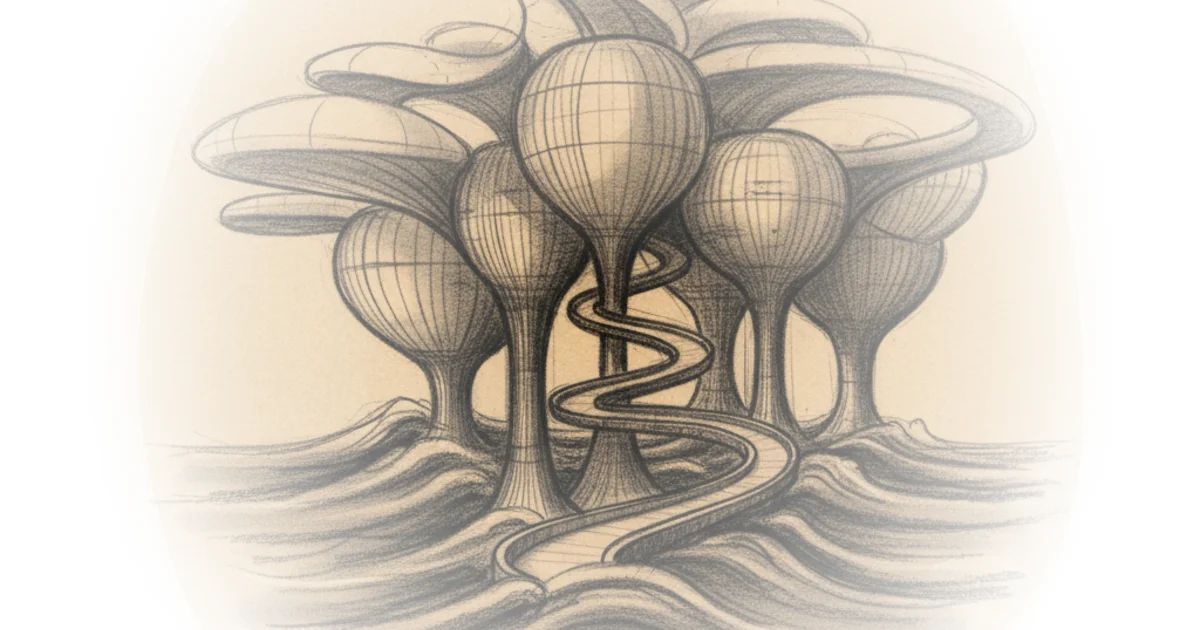
The commentary highlights the playful, almost surreal nature of the space. Amos observes that the staircases and rocky trails create a sense of adventure, noting, "It's kind of like the board game Candyland and the stairs of the Rainbow Trail and Gumdrop Pass." This comparison effectively communicates the park's unique topography to an audience that may never visit. However, the author is quick to pivot from the aesthetic to the operational, revealing that this "little world" is kept pristine by a massive financial engine. "The park and its bathrooms are impeccably pristine due to the nonprofit that operates the park... and the $120 million set aside for ongoing maintenance." This detail is crucial; it underscores that the park's beauty is not accidental but purchased, a point Amos reinforces by noting the funding came from "billionaire media mogul Barry Diller and his wife, the fashion designer Diane von Furstenberg."
The park and its bathrooms are impeccably pristine due to the nonprofit that operates the park, the concession company that runs the food kiosks, and the $120 million set aside for ongoing maintenance.
Critics might argue that emphasizing the billionaire's role overshadows the public agency's planning, yet Amos's focus on the funding source is necessary to explain the park's existence at all. Without this capital, the project likely remains a dream.
The Ghosts of Pier 54
The narrative then shifts from the present to the past, weaving a complex historical tapestry that connects Little Island to the Titanic and the decline of American shipping. Amos writes, "You can't tell the whole story of Little Island without going back to the early days of New York." He details how the site, formerly Pier 54, was once the bustling heart of global trade, handling "40 to 70% of all US trade" in the late 19th century. The historical context is not merely decorative; it explains why the site was available and why its transformation matters.
The author draws a poignant line between the pier's history and the tragedy of the Titanic. "The Carpathia, the ship that rescued the passengers from the Titanic's lifeboats, docked at Pier 54." This historical anchor adds a layer of gravity to the modern structure. Amos traces the pier's decline through the rise of containerization and the shift of shipping to New Jersey, noting that "by the 1980s, Manhattan's piers were out of a job." The transition from industrial hub to event space, and finally to a park, illustrates the changing economic soul of the city.
The coverage effectively uses Google Earth imagery to visualize this decay and rebirth. Amos notes, "Then in 2015, a cloud obscures our view and then reveals that the pier had been completely removed. It took only 4 months to tear it down." This rapid transformation sets the stage for the modern drama, showing how quickly the physical landscape of New York can be rewritten.
The Billionaire's Gamble
The core of Amos's argument lies in the political and legal maneuvering that nearly killed the project. He introduces Barry Diller not just as a donor, but as a central character in a story of risk and retreat. "His name is Barry Diller and while you probably haven't heard of him, you've heard of his resume." Amos lists Diller's impressive portfolio—Fox, QVC, Tinder—to establish the scale of the influence at play. The project began with the Hudson River Park Trust reaching out to Diller, leveraging his previous success with the High Line.
However, the path was far from smooth. Amos details the legal challenges mounted by the City Club of New York, funded by rival billionaire Douglas Durst. The lawsuits argued that the park violated the public trust doctrine and state environmental laws. "The large non-pier-like shape impeded the navigation of boats going to nearby piers," Amos paraphrases the opposition's claims. The author notes that the judge ultimately ruled in favor of the park, but the legal battle had a devastating side effect.
The tension peaks when Amos reveals Diller's reaction to the controversy. "Then, in a twist, Barry Diller decided to end his support for the project, essentially killing it." This moment is the article's dramatic climax, illustrating the precarious nature of private philanthropy in public infrastructure. The delays caused by the lawsuits increased costs, and Diller, feeling the project was becoming a "lightning rod for controversy," withdrew. The fact that the project survived only because of subsequent interventions or renewed commitment (implied by the eventual opening) speaks volumes about the fragility of such ventures.
The Little Island story is as winding as the paths, and it can teach us something about how parks and public amenities get built in the 21st century.
Amos's framing here is sharp: the park is not a triumph of civic planning alone, but a survivor of a battle between private egos, legal technicalities, and public interest. A counterargument worth considering is whether a park dependent on such volatile funding sources can truly be considered a stable public good. Yet, Amos suggests that in the current era, this may be the only way such ambitious projects get off the ground.
Bottom Line
Dave Amos delivers a compelling narrative that transcends a simple park review, exposing the high-stakes intersection of history, law, and billionaire philanthropy that defines modern urban development. The strongest element of the piece is its refusal to treat the park as an isolated aesthetic object, instead rooting it in the messy reality of New York's political and economic history. The biggest vulnerability remains the reliance on private capital; while the park stands today, the story of Diller's near-withdrawal serves as a stark warning that public spaces funded by private whims are always one lawsuit away from collapse.