Most observers fixate on China's geopolitical rivalry with the United States, but PolyMatter argues the true existential threat to the ruling party is far more domestic and mundane: a generation of young people who feel the social contract has been broken. This analysis cuts through the noise of trade wars and military buildups to reveal how a decades-old economic fix has created a ticking time bomb of disillusionment right now.
The Original Bargain
PolyMatter begins by dismantling the assumption that political unrest in China is driven by abstract ideals of democracy. Instead, the author points to hard data showing that "all lights are flashing red" across the economy, from housing to retail sales. The core thesis is that the party's greatest fear is not external pressure, but the specific metric of youth unemployment, which the government recently reported at 21% before manipulating the data.
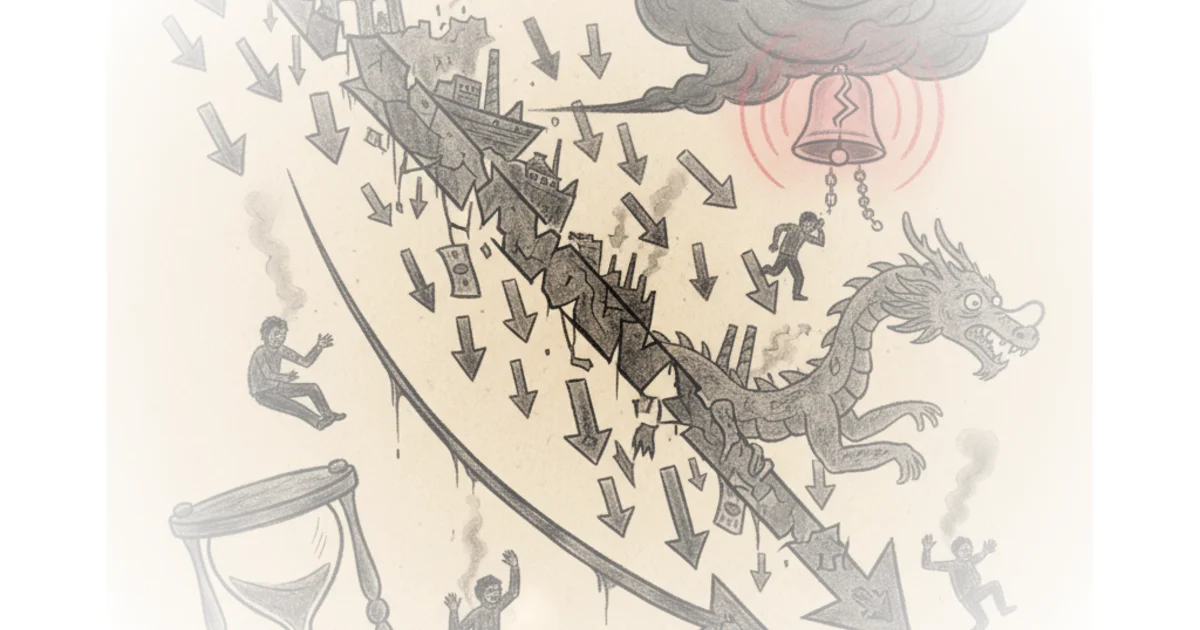
The piece draws a direct line from the economic stagnation of the late 1990s to the political strategy that defines China today. PolyMatter writes, "The flames of broader political upheaval are often ignited by the sparks of relatively mundane economic upheaval." This framing is crucial because it shifts the focus from ideology to material conditions. The author reminds us that the 1989 protests were not purely about political freedom but were catalyzed by inflation and unemployment, a lesson the leadership has never forgotten.
"The biggest threats to its survival come from within."
This observation holds significant weight. The article notes that Beijing now spends more on internal security than on its $80 billion defense budget, a stark indicator of where the regime perceives its vulnerabilities lie. The strategy employed to avoid a repeat of 1989 was not to suppress dissent immediately, but to delay it by expanding higher education. PolyMatter describes how the government issued an emergency directive to "get as many bodies in classrooms as physically possible," effectively bribing potential dissidents with the promise of a future that required them to stay in school rather than on the streets.
The Scarcity Trap
The most compelling part of PolyMatter's argument is the analysis of how this expansion created a new form of social control through scarcity. By exploding college enrollment from a tiny fraction of the population to 35 million students, the state created a system where success became a zero-sum game. The author argues that "scarcity creates a zero-sum competition, competition leads to middle class anxiety and this anxiety leads to a low trust culture that prevents any sense of solidarity."
This is a sophisticated take on authoritarian resilience. Rather than relying solely on brute force, the system keeps the middle class too exhausted and too competitive against one another to organize. PolyMatter notes that students are "preoccupied with an endless stream of exams, tutoring and homework" and that they have "no time" to read philosophy or organize. The result is a workforce that is compliant not because they love the regime, but because they are terrified of falling behind.
"The secret ingredient is scarcity."
However, this strategy relied entirely on the economy continuing to grow fast enough to absorb the millions of graduates. As PolyMatter points out, the plan worked only because the economy grew by 42% between 1998 and 2002. Now, with growth slowing, the rubber band is snapping. The article highlights that while the overall unemployment rate remains stable, the youth unemployment rate has surged, creating a generational fault line. Young people who grew up expecting the same rapid ascent as their parents now face a "brick wall."
Critics might note that the article somewhat underestimates the regime's capacity for further manipulation or the potential for rural populations to remain insulated from this specific type of urban middle-class angst. Yet, the shift in public sentiment is undeniable. PolyMatter cites research showing that while Chinese citizens previously blamed poverty on individual failures like "lack of ability," they now increasingly blame "unequal opportunity" and the "unfair economic system."
The Illusion of Spontaneity
The piece concludes by challenging the Western narrative that China is waiting for a democratic uprising. PolyMatter writes, "The free world has been waiting for the Chinese people to spontaneously rise up and demand democracy as if confirming our system is the inevitable final form." The author argues this is a projection of Western desires rather than a reflection of Chinese reality. Instead of a sudden revolution, the danger is a slow-burning erosion of legitimacy driven by the gap between expectations and reality.
The comparison to the United States is instructive but highlights a key difference in China: the lack of outlets for discontent. PolyMatter notes that in China, "the range of socially approved careers and lifestyle styles is much narrower," making the feeling of claustrophobia more acute. The contrast between parents who rode the boom years and children who missed the train is stark, creating a "politically combustible" middle class that feels both privileged and deprived.
"Frustration which a few skillfully leverage demand sweeping political change."
This final point serves as a warning. The author suggests that if a movement does emerge, it will likely start with the same "trivial complaints" about jobs and housing that sparked the 1989 protests, rather than high-minded calls for democracy. The regime's failure to provide economic opportunity is the spark; the political consequences are the inevitable fire.
Bottom Line
PolyMatter's strongest contribution is reframing China's stability not as a triumph of ideology, but as a fragile economic bargain that is currently breaking down. The argument's greatest vulnerability lies in its reliance on current economic data, which the Chinese government actively obscures, making the precise tipping point difficult to predict. Readers should watch not for a sudden political revolution, but for the gradual normalization of terms like "lying flat" and the rise of lottery ticket sales as indicators of a society losing faith in the meritocratic promise.
"The secret ingredient is scarcity."
The piece effectively argues that the most dangerous threat to the Chinese state is not a foreign adversary, but a generation of young people who have been told to work harder, only to find the finish line has moved.