Yascha Mounk returns from four weeks on the ground in Israel with a report that defies the binary simplicity dominating global discourse: the nation is not a monolith of jingoism or a broken state, but a deeply traumatized society simultaneously fracturing and holding together. What makes this account essential for the busy listener is its refusal to offer a neat moral resolution, instead presenting a raw, granular look at a citizenry that has abandoned its government while doubling down on its own survival. Mounk argues that the true story of the post-October 7 era is not just the war itself, but the unprecedented scale of mutual aid filling the void left by state failure.
The Architecture of Trauma
Mounk's central thesis rests on the idea that the national psyche is suffering from layered, compounding wounds that extend far beyond the initial attacks. He writes, "This is a country that is deeply traumatized, and not only because of October 7. The traumas are multiple, layered, ongoing." This framing is crucial because it moves the conversation away from a single event and toward a chronic condition affecting the workforce, the family unit, and the mental health of the entire population. The author details how the trauma of urban combat, the loss of hundreds of soldiers, and the endless mobilization of men in their 20s, 30s, and 40s have inflicted "lost jobs, broken marriages, failed businesses."
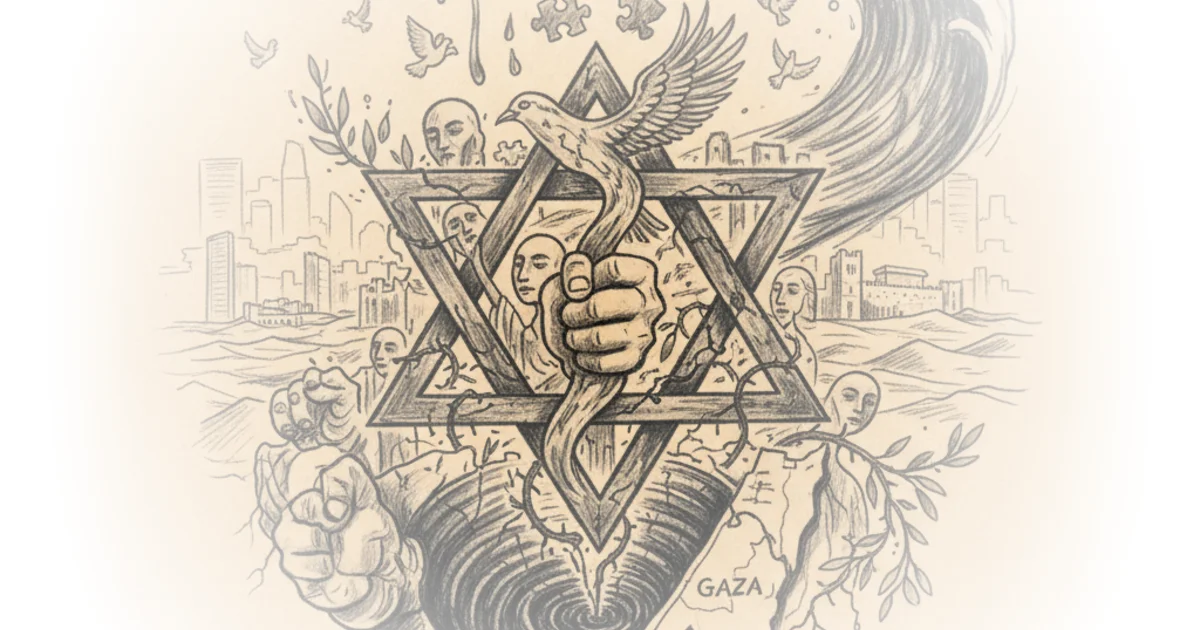
The human cost is articulated through the voices of those Mounk interviewed, including Miriam Schler, a longtime executive director of a sexual assault crisis center. She observes, "So many who champion human rights, feminism and social justice... have been bending over backwards to justify atrocities and rationalize rape." This quote captures the profound sense of betrayal felt by the liberal Israeli left, a sentiment that has eroded the country's traditional alliances in the West. Mounk is careful to balance this, noting that "anyone who cannot feel that [the trauma of the other side] is morally obtuse," yet he insists that the specific psychological toll on Israelis—where 40% are reportedly suffering from trauma according to the State Comptroller—must be tallied to understand the current political volatility.
The country may be traumatized, in other words, but it is not demoralized.
The Void of Leadership and the Rise of Mutual Aid
Perhaps the most striking element of Mounk's coverage is his documentation of the stark contrast between the executive branch's performance and the citizenry's response. He describes a government that failed to prevent the attacks, failed to mount an effective initial response, and subsequently failed to support the displaced. Mounk recounts a moment at a protest rally where Einav Zangauker, a leader of the hostage families, indicted the prime minister, whose name "invariably elicited jeers." The author notes that the leader of the country had never once visited the Hostage Square, while funds to rebuild attacked kibbutzim took months to disburse.
In this vacuum, Mounk argues, the population stepped in with a ferocity that defies typical modern civic apathy. He writes, "Anybody you talk to in Israel... ask them what they did after October 7. Everybody did something." The evidence he gathers is visceral: vegan restaurants distributing 3,000 meals a day, writers composing eulogies, and teams building ramps for disabled veterans. This narrative challenges the external perception of Israel as a militarized state by highlighting a deep cultural ethos of mutual aid rooted in millennia of Diaspora experience. Mounk suggests that the nation's resilience is not a product of government policy, but of a cultural imperative where "they share a fate."
Critics might argue that focusing on this internal solidarity risks romanticizing a society under siege, potentially obscuring the very real strategic failures that led to the crisis in the first place. However, Mounk's point is not to excuse the government, but to explain why the society has not collapsed despite those failures. The distinction is vital: the state is failing, but the people are holding the line.
The Complexity of a Divided Society
Mounk refuses to let the narrative of unity oversimplify the deep fissures running through Israeli society. He highlights the "savage internal divisions," particularly the rage against the ultra-Orthodox community for shirking military service while receiving public subsidies. He quotes a protest sticker that reads, "The secular are not slaves," and another formulation: "They pray for us, and we die for them." This tension underscores the fragility of the social contract, even in the face of external threats.
Furthermore, Mounk explores the moral ambiguity that defines the daily life of many Israelis. He describes individuals who are simultaneously protesting civilian deaths in Gaza and living with the "moral injury" of their own troops' actions. One professor he interviewed, who has publicly protested the war, finds her academic work rejected by international journals, while another activist spends weeks in the hills south of Hebron protecting Palestinian shepherds from settler violence. Mounk writes, "The same person who said, 'I'm sorry that babies and children have to pay the price for the hatred of their parents, but we have no choice,' also spoke about the 'moral injury' experienced by Israeli troops in Gaza from the things they'd had to do there."
This section serves as a corrective to the "loud, enraged, extreme, self-righteous" opinions often heard abroad. Mounk argues that "Israel is for others an idea, a symbol, a fantasy... It is good to be reminded now and then that it is also an actual place." By grounding the conflict in the specific, messy realities of people who hold contradictory views, he forces the reader to abandon the comfort of simplistic narratives. The reference to the October 7 attacks on kibbutzim like Kibbutz Be'eri and the subsequent displacement of families adds a layer of specific, painful context to the general discussion of trauma, reminding us that the "actual place" is one where neighbors are currently living in hotels and waiting for bodies to be returned.
Bottom Line
Yascha Mounk's strongest contribution is his refusal to resolve the tension between Israel's profound internal solidarity and its deep, poisonous political divisions; the piece succeeds by showing that both are simultaneously true. The argument's greatest vulnerability lies in its heavy reliance on a specific, highly educated, and progressive demographic, which may not fully represent the views of the settler movement or the ultra-Orthodox majority who are driving much of the current political direction. Readers should watch for how this internal friction between the state's failures and the people's resilience evolves as the war drags on, as the current equilibrium of mutual aid may eventually fracture under the weight of prolonged conflict.