This piece cuts through the diplomatic fog to reveal a brutal reality: while world leaders trade pleasantries in Beijing and Ankara, the grinding attrition on the Ukrainian front line is reshaping the global balance of power through the systematic strangulation of supply chains. Mick Ryan's analysis is notable not for predicting a sudden breakthrough, but for documenting a slow, suffocating victory where Ukraine is quietly dismantling Russia's logistical lifelines to Crimea and its economic engine deep within its own borders.
The Reality of the Front Line
Ryan frames the current conflict not as a static stalemate, but as a dynamic shift where Ukraine has seized the local initiative. He points to a stark reversal in territorial control, noting that according to the Russia Matters War Report Card, Russian forces lost a net 69 square miles of Ukrainian territory in just four weeks. "Ukraine has achieved notable local advances while the broader positional map remains contested," Ryan writes, highlighting that these gains are not merely symbolic but represent a tangible erosion of Russian momentum.
The author zeroes in on the northern Kharkiv Oblast, where Ukrainian forces have pushed back against Russian attempts to threaten the city. Ryan observes that these are "not spectacular breakthroughs, but they represent Ukrainian forces seizing and holding local initiative." This framing is crucial; it moves the narrative away from the binary of total victory or defeat and toward the messy, incremental reality of modern warfare. The evidence of 233 combat engagements in a single day, alongside thousands of drone attacks, underscores the ferocity of this grind.
"War does not pause for summits. In the Pacific, beginning with the Trump summit and concluding with Putin's, Xi has been basking in what the CCP portrays as China's emergence as a global stabilising influence. But in Ukraine, the front-line grinds through its 1,551st day."
This juxtaposition is the piece's most striking rhetorical move. While diplomatic theater plays out in the Pacific, the human cost in Ukraine continues to mount. Ryan reminds us that the "ferocious attritional conflict" is punctuated by deep strikes that have no parallel in recent history, including the use of the Oreshnik intermediate-range ballistic missile against Kyiv. The reference to Oreshnik serves as a grim reminder of the escalating technology of destruction, echoing the historical shift in warfare seen with the introduction of the Scud missile decades ago, but on a scale that now threatens entire energy grids.
Critics might argue that focusing on territorial inches ignores the broader strategic picture, but Ryan's data on Russian logistics suggests these small gains are the canary in the coal mine for a collapsing supply chain.
The Interdiction Campaign
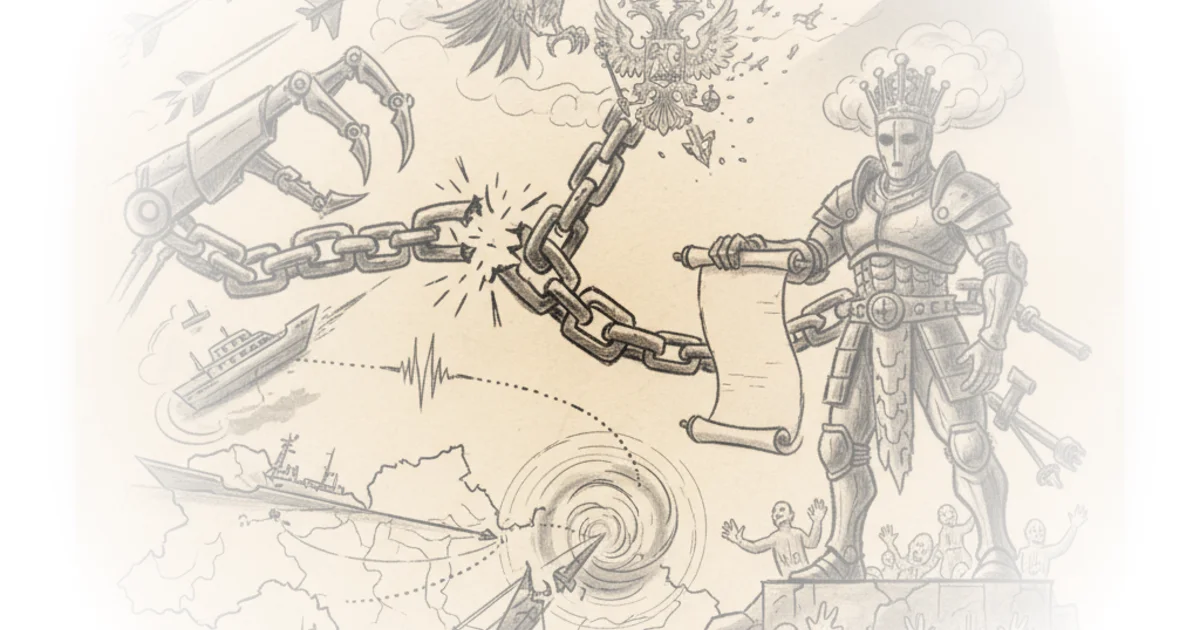
The core of Ryan's argument lies in the "Middle Strike" operations—a systematic campaign to cut off Russian logistics in southern Ukraine. He describes this as the "most consequential military development of recent months," detailing how Ukraine is disrupting the Trans-Tavrian rail link and the Melitopol-Mariupol highway. "Ukraine has effectively found a way to cut Crimea off from the Russian mainland through drone-based interdiction of supply routes rather than the ground offensive Western analysts had anticipated," Ryan writes.
This is a profound shift in military doctrine. Instead of the massive armored thrusts of the past, Ukraine is using precision, persistent drone strikes to paralyze the enemy's ability to move fuel and ammunition. Ryan details three specific lines of effort: ambushing fuel trains, hunting military trucks on highways, and striking naval assets protecting the Kerch Bridge. The destruction of an FSB patrol boat and its crew on May 4, 2026, is cited as a blow not just to naval capability, but to the security infrastructure itself.
"The campaign appears to be executing operations along three lines of effort... The rail link remains out of action."
The human cost of this interdiction is implicit but heavy. By banning civil transport along these routes, the Russian military has effectively turned these corridors into war zones, isolating the civilian population in occupied territories. Ryan's analysis suggests that this strategy is compounding over time, squeezing Russian supply capacity in ways that will eventually force a strategic retreat.
"The combination of a disabled Trans-Tavrian rail link and active drone patrols on the Mariupol highway is squeezing Russian supply capacity to Crimea and southern front forces in ways that will compound over time."
This argument holds up against the backdrop of historical interdiction campaigns, such as the strategic bombing of rail networks in World War II, but the scale and precision of modern drone warfare make it uniquely effective. The ability to strike targets 800 kilometers away, as seen in the attack on the Syzran oil refinery, demonstrates that no territory is truly safe.
Diplomatic Stasis and the Pacific Pivot
Ryan does not shy away from the diplomatic failures that surround the battlefield. He highlights a rare moment of candor from US Secretary of State Marco Rubio, who admitted that peace negotiations have stalled. "We're not interested in endless meetings that lead to nothing," Rubio is quoted as saying. Ryan interprets this as a significant removal of "diplomatic ambiguity," stripping Moscow of the ability to present itself as a willing partner while continuing its attacks.
The author then pivots to the Pacific, where the summit between Putin and Xi Jinping produced declarations of friendship but failed to deliver the critical energy pipeline breakthrough Moscow needed. "The Power of Siberia 2 pipeline... remains unresolved," Ryan notes, pointing out that while the leaders framed their partnership as a stabilizing force, the economic reality is one of unmet expectations.
"The tide of unilateral hegemony is running rampant," Xi told Putin, a phrase Ryan uses to illustrate how the China-Russia partnership defines itself against the US-led order.
This section effectively links the war in Ukraine to the broader geopolitical struggle. The failure of the pipeline deal suggests that Russia's pivot to Asia is not the panacea it claims to be. However, a counterargument worth considering is that the lack of a pipeline deal might simply be a negotiating tactic rather than a strategic failure, as China leverages its position to extract better terms.
The article also touches on the Middle East, noting that the US-Iran ceasefire has held, which has major implications for global energy markets. "Whether this leads to a durable agreement matters for the economies of the world dependent on Middle East oil, natural gas, urea and helium," Ryan writes. This connects the conflict in Ukraine to the global economy in a way that is often overlooked, reminding readers that the war's impact extends far beyond the front lines.
"This war will not end with a military victory by one side or the other... We hope that will change, because that war can only end with a negotiated settlement."
Rubio's statement, as reported by Ryan, underscores the grim reality that a total military victory is unlikely, yet the current diplomatic path is broken. This creates a dangerous vacuum where the war continues to grind on, consuming resources and lives.
Bottom Line
Mick Ryan's analysis is at its strongest when it moves beyond the headlines of summits and treaties to expose the mechanical reality of the war: the slow, deliberate strangulation of Russian logistics through interdiction. The piece's greatest vulnerability lies in its reliance on the assumption that economic attrition will inevitably force a Russian retreat, a timeline that has proven elusive in the past. As the world watches the diplomatic chessboard in Beijing and Ankara, the most critical developments are happening in the silent, drone-filled skies over the Donbas and the Black Sea, where the future of the conflict is being written in the language of supply lines and fuel shortages.