What makes this piece notable is that it comes from someone who teaches at Harvard, yet openly admits his undergraduates introduced him to how deeply connected Taylor Swift actually is to centuries of lyric tradition. The surprise here isn't that a pop star can be analyzed through literary theory—it's that a credentialed academic is willing to start where students already are, rather than trying to pull them upward toward some presumed canon.
The argument centers on an ancient lineage: Swift belongs to the same broken-heart tradition that dates back to Sappho. Close Reading Poetry writes, "Taylor Swift is I think rightly in some times unfairly called a breakup songwriter." This framing is careful—he's not saying she's trivial or superficial; he's saying her themes have "a great literary precedence" stretching back through centuries of poetry.
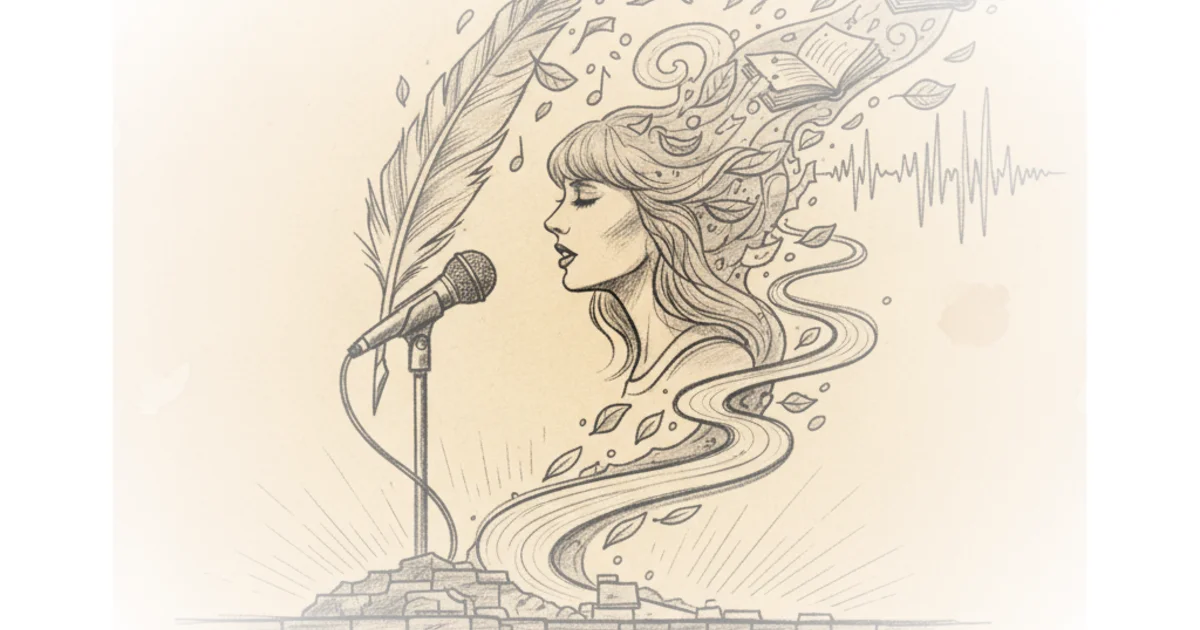
The Confessional Persona
The piece opens with a definition that feels almost textbook, until it becomes something more. Close Reading Poetry describes how "when you refer to the lyric poem... it usually stands in as simply the Persona in the poem." But then he immediately applies this to Swift: her songs sustain an illusion that she's confessing intimately, and we are "privy" to something the public world doesn't see.
This is where the analysis gets interesting. The lecturer reads Teardrops on My Guitar as a poem about divided selves—public facade versus private pain—and identifies what makes it powerful: Drew talks to her but never sees her. "He's not really seeing the real private self that is revealed to us." This is Close Reading Poetry's strongest close reading, and it's genuinely illuminating.
She's playing The Confidant to Drew—we're playing The Confidant to her.
The language about the song becoming one with the person—that preservation impulse—lands well because it captures something actual listeners have felt but critics often miss. The anxiety of losing someone, and the belief that singing can somehow hold onto what the world takes away.
The Lyre Connection
One of the piece's most distinctive claims involves history: "there came a point when the lyric poem was separated from the lyre... and it became purely a literary art object." This is an argument about how poetry changed in the Renaissance, moving from performance to pure text. Close Reading Poetry traces this through Sir Wyatt, Shakespeare's sonnets, and forward to contemporary song.
The historical detour about Greek myth—the story of Hermes making the first lyre, Orpheus descending to Hades with his song—serves a real purpose. It suggests that instruments and songs have always carried sacrificial weight, redemption power, something beyond mere entertainment. The lecturer argues this connects directly to Swift's imagery: "the only thing that keeps me Wishing on a Wishing Star" is about preservation, not just emotion.
Don't Underestimate Her
The counterargument the lecturer anticipates is worth considering. He quotes students who said, "I don't think you can expect me to believe that the poet actually is aware of everything that's going on so intricately in the poem." His response draws on Eliot and Richards—that a good poem evokes feelings the author may never have intended.
But then he makes a claim that elevates Swift: "don't underestimate Taylor Swift as a Lyricist—don't underestimate her own knowledge of the lyrical tradition." This is both the thesis and the polemic. He argues she's "highly aware as a poet I think she knows what she's doing" and familiar with English and American lyric traditions.
Critics might note that this defense could go too far—claiming a pop songwriter possesses deep literary awareness risks conflating commercial success with artistic complexity in ways that flatter both subject and analyst. But the piece doesn't overreach; it simply argues for taking her seriously as someone working within an ancient form.
Bottom Line
This lecture's strongest move is making the broken-heart tradition feel like a living conversation rather than a dead archive—showing students they already belong to it. The vulnerability lies in how briefly Swift herself appears; this is an argument about her work that often describes its effects without letting her voice truly enter. But for readers curious about where poetry and pop culture intersect, this serves as genuine evidence that the boundary was always more porous than anyone realized.