Ryan Grim and Jeremy Scahill have delivered a piece that refuses to let the Palestinian prisoner issue fade into the background of geopolitical maneuvering. Instead of treating Nael Barghouti merely as a statistic in a recent exchange, they frame his forty-five years of captivity as the central, unbroken thread of a six-decade struggle that defies the administration's latest peace architecture. This is not a story about a deal; it is a story about a people who have turned incarceration into a classroom and a prison cell into a command center.
The Architecture of Resistance
The authors anchor their narrative in Barghouti's personal history, but they quickly pivot to the systemic nature of the detention regime. Grim and Scahill write, "Without any prior warning, a prisoner is detained with no charge—a 15 year old [boy], or a woman. Malicious arrest—arrest simply to send a lesson to entire generations." This framing is crucial because it shifts the focus from individual criminality to collective punishment, a tactic that has persisted since the occupation began in 1967. The article highlights that nearly half of the 9,300 Palestinians currently held have not been charged, a statistic that underscores the arbitrariness of the system.
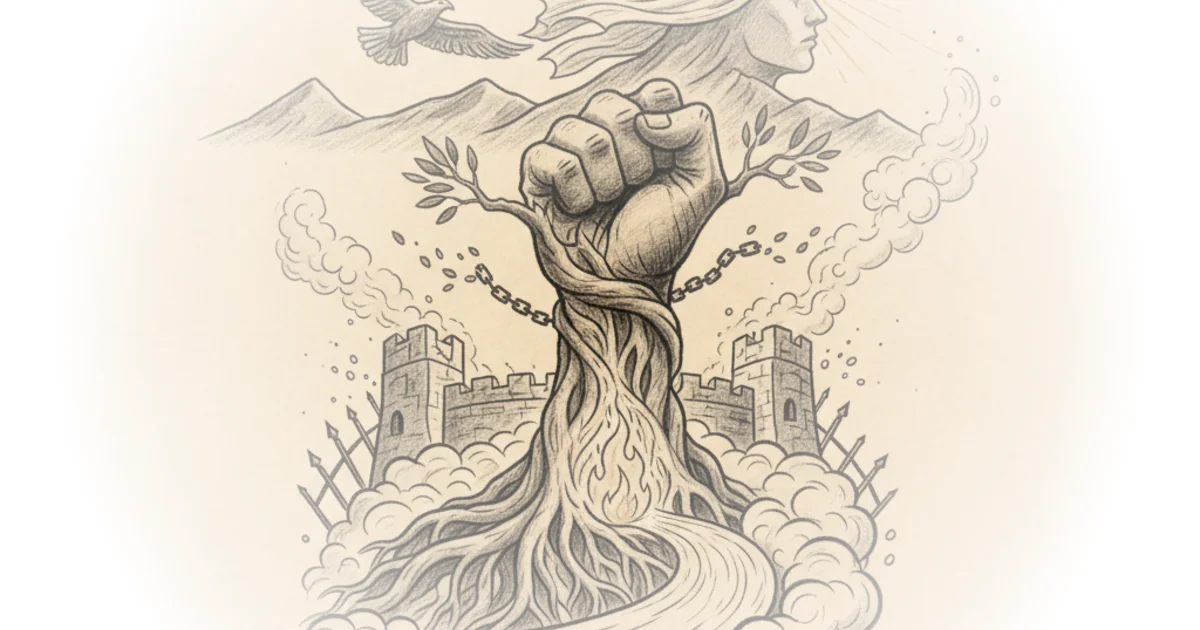
The commentary effectively uses Barghouti's voice to dismantle the notion that time in prison breaks the spirit. As Grim and Scahill put it, "I never lost hope, and I never will." This sentiment is not presented as naive optimism but as a hardened reality forged in decades of isolation. The authors detail how prisoners organized democratic elections inside cells and earned university degrees, turning the prison into a paradoxical space of political empowerment. This evidence is compelling because it contradicts the standard narrative of prisoners as passive victims; instead, they are depicted as active architects of their own political future.
Critics might argue that focusing on the resilience of prisoners risks romanticizing the conditions of detention or ignoring the severe physical toll of torture and neglect. The article does acknowledge that at least 87 Palestinians have been killed in custody since October 2023, including deaths by torture, but the primary lens remains one of unyielding political will rather than just humanitarian tragedy.
"You cannot learn this anywhere else except in prison, despite how difficult it is. Your ability to innovate and invent [ways] to communicate surpasses imagination."
The Long Shadow of History
Grim and Scahill refuse to let the reader view the current conflict through the narrow window of the last few years. They weave in the history of the 2011 Gilad Shalit exchange, noting how Barghouti and the late Yahya Sinwar were both released in that deal, only to return to their respective roles in the resistance. The authors write, "The whole story is connected together. If you want to understand the current Palestinian situation by looking only at the last two years, you will not succeed in understanding the Palestinian cause—you will fail."
This historical depth is the piece's greatest strength. By connecting the 1948 Nakba, the 1967 war, and the 2025 prisoner exchange, the authors illustrate a continuous line of displacement and resistance. They highlight how Barghouti's family, including his parents and siblings, have all been imprisoned, creating a generational legacy of defiance. The article notes that Barghouti's uncle was imprisoned during the British mandate, linking the current struggle to the very origins of the Zionist entity.
The authors also touch on the internal dynamics of Palestinian factions, quoting Husam Badran, a former Hamas commander, who states, "We define ourselves as fighters for freedom—certainly not terrorists, as the occupation describes them." This distinction is vital for understanding the internal legitimacy of these groups. The piece suggests that the leadership inside the prisons holds significant sway over external decision-making, a dynamic that external powers often fail to grasp.
The Failure of External Impositions
The commentary turns sharply toward the recent efforts by the White House to impose a peace plan without Palestinian consent. Grim and Scahill report that the administration has pushed forward with a "Board of Peace" including figures like Tony Blair and Jared Kushner, yet Barghouti dismisses these efforts as illegitimate. The authors quote him directly: "States want to sign agreements on behalf of the Palestinian people, but the Palestinian people did not authorize them and never will."
This section serves as a direct rebuttal to the idea that diplomacy can be conducted from the outside in. The authors argue that the administration's reliance on non-Palestinian figures to broker peace ignores the reality that the prisoners themselves are the ultimate decision-makers. As Grim and Scahill note, Barghouti asserts that "Money will not tempt us, and airplanes will not frighten us." This is a powerful rejection of the transactional approach to peace that has dominated recent diplomatic efforts.
The article also touches on the irony of the administration's stance, noting that Barghouti believes American politicians must "regain their reason" and stand against the influence of a lobby that damages the United States. This framing challenges the reader to consider the domestic political costs of the current foreign policy, suggesting that the pursuit of a just resolution is not just a moral imperative but a strategic necessity for the US.
Bottom Line
Grim and Scahill's most powerful contribution is their refusal to separate the prisoner issue from the broader struggle for self-determination, presenting the incarcerated not as a bargaining chip but as the moral and political core of the Palestinian cause. The piece's vulnerability lies in its singular focus on the resilience of the resistance, which, while inspiring, may understate the immediate, crushing humanitarian crisis facing those still inside. The reader should watch for how the administration's new peace initiatives will fare when confronted with a leadership that views surrender as an impossibility.