This piece cuts through the partisan noise to reveal a startling paradox: both major parties are racing to regulate artificial intelligence, yet their proposed solutions threaten to strangle the very innovation they claim to protect. While the debate often feels like a stalemate, Reason identifies a dangerous convergence where Republican fears of unchecked corporate power and Democratic anxieties over individual harm are leading to legislation that could nationalize tech giants or force invasive biometric surveillance on every user. For busy leaders tracking the future of the economy, the core insight is that the greatest threat to AI isn't a lack of rules, but a flood of contradictory, overreaching ones.
The Convergence of Control
The article opens by dismantling the illusion that the two parties are fighting on opposite sides of the issue. Instead, Reason reports that while "Republican-written AI bills tend to be less concerned with policing how individuals use the technology than with regulating the development and deployment of the underlying technology," Democrats are focusing on "individual malfeasance rather than the tech itself." This distinction is crucial, but the piece quickly demonstrates how both approaches lead to the same destination: heavy-handed government intervention.
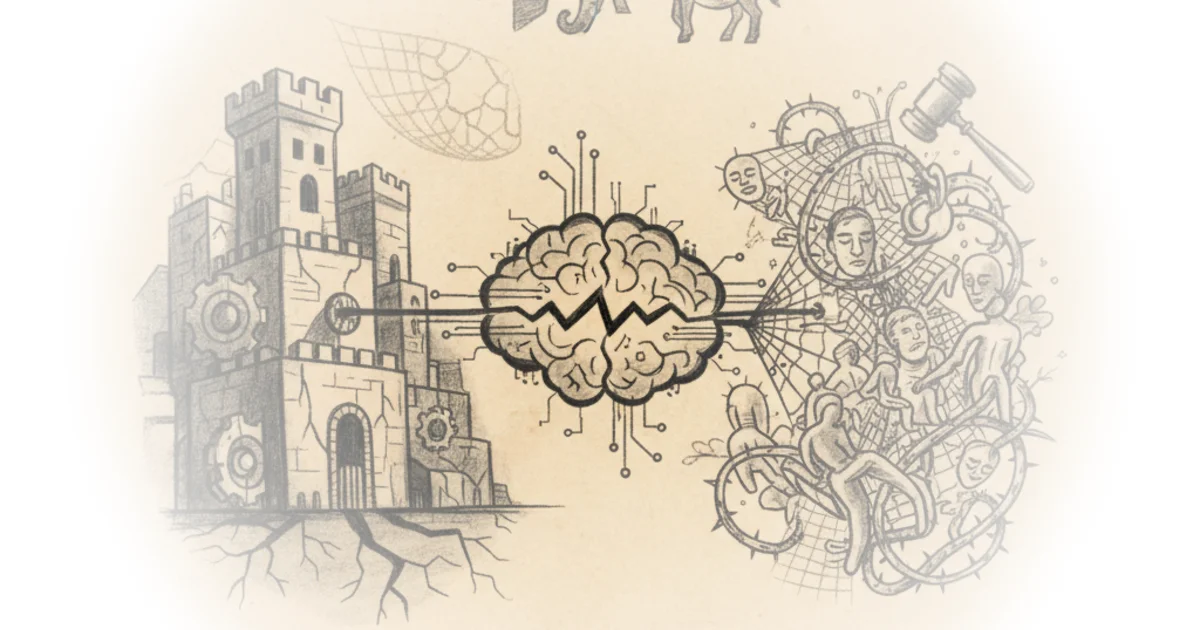
On the Republican side, the commentary highlights Senator Josh Hawley's extreme proposals, noting that he "wants frontier AI developers to submit their models to the Energy Department for potential nationalization before they're granted permission to deploy their models commercially." The argument here is that such a mechanism is a "discouraging innovation" force, as "fewer people will want to advance the technological frontier if the government has the right to take any company whose product is too good." This is a stark warning that the fear of a technological singularity is driving policy toward a form of state capitalism that has historically stifled progress.
"Talk about discouraging innovation: Fewer people will want to advance the technological frontier if the government has the right to take any company whose product is too good."
The piece draws a sharp parallel to historical precedents of nationalization, subtly echoing the complexities seen in the 1951 nationalization of Iran's oil industry, where state control of a strategic resource led to international isolation and economic stagnation rather than the promised stability. Just as that move failed to account for the global market dynamics, Reason suggests that the proposed nationalization of AI models ignores the global, decentralized nature of technological development.
On the Democratic front, the focus shifts to privacy and liability. The article notes that Senator Amy Klobuchar, outraged by a deepfake of herself, called for the right to demand removal of such content. However, Reason argues that the proposed solutions go too far. The GUARD Act, for instance, would require chatbot companies to "freeze every user account" until users provide "age data that is verifiable using a reasonable age verification process." The Electronic Frontier Foundation is quoted warning that this "means every chatbot interaction could feasibly be linked to your verified identity," creating a surveillance state within private digital spaces.
Critics might note that the urgency of protecting minors from harmful AI content is genuine and that some form of age verification is inevitable. However, the piece effectively counters that the current proposals sacrifice fundamental privacy rights for a theoretical safety that may not even be achieved, especially given recent data breaches by verification firms like AU10TIX.
The Innovation Paradox
The heart of the commentary lies in its defense of the "open" nature of AI development. Reason contrasts the regulatory frenzy with the reality of breakthrough innovations like AlphaFold, an AI system that predicts protein structures. The article quotes Taylor Barkley of the Abundance Institute, who explains that AlphaFold exists "because researchers were free to release and iterate on imperfect models in the open." The piece argues that strict liability laws, such as the AI LEAD Act, would have "discouraged the kind of experimentation that produced AlphaFold," leaving researchers without a tool that has "accelerated drug discovery, structural biology, and our basic understanding of life."
This argument is bolstered by a list of tangible benefits: AI reducing tumor segmentation time from an hour to two minutes, easing the stress on public defenders by cutting document review time by 63 percent, and saving taxpayers billions through fraud detection. The piece asserts that "no technology should be evaluated exclusively by its harms," drawing a parallel to the automobile, which kills over 40,000 Americans annually but is not banned because its benefits "outweigh their costs."
"The possible gains to humanity from AI are enormous... but AI is under threat from lawmakers at all levels."
The commentary also addresses the tragic incidents involving AI chatbots, such as the suicides of Sewell Setzer III and Adam Raine. Reason acknowledges these "AI-related tragedies" but refuses to let them define the entire technology. The piece argues that while "people using it carelessly have made embarrassing mistakes," the solution is not to ban the tool but to manage its use, much like we manage the risks of driving.
The Political Flip-Flop
The final section of the piece offers a scathing critique of the administration's inconsistent approach. It notes that while some officials like Senator Ted Cruz have called AI a "new global industrial revolution," the executive branch has flip-flopped on its laissez-faire stance. The article details how the administration, after initially pushing for a federal preemption to prevent a "patchwork of 50 State Regulatory Regimes," retaliated against Anthropic when the company refused to allow its models to be used for domestic mass surveillance.
Reason reports that in retaliation, the administration "banned all federal agencies from contracting with Anthropic," and the Pentagon labeled the company a supply chain risk. This move, the piece argues, contradicts the stated goal of fostering innovation and instead punishes ethical boundaries. The commentary suggests that this "flip-flop" reveals a deeper confusion within the government about whether AI is a tool to be harnessed or a threat to be contained.
"The president cannot create such a framework single-handedly; Congress must. But legislators are unlikely to pass a stand-alone bill for or against AI, as they remain divided on the issue."
The piece concludes by noting that while most federal bills will likely fail, the DEFIANCE Act, the NO FAKES Act, and the GUARD Act stand a strong chance of enactment. Each poses significant risks: the first two threaten First Amendment rights, while the last endangers user privacy. The overarching message is that the regulatory landscape is becoming a minefield where good intentions are paving the way for a stifled technological future.
Bottom Line
Reason's strongest argument is its demonstration that bipartisan consensus on AI regulation is not a sign of unity, but a convergence of different fears that both lead to overreach. The piece's biggest vulnerability is its perhaps overly optimistic view that the market will self-correct without any federal guardrails, given the real-world tragedies cited. Readers should watch for the passage of the GUARD Act, as its age verification mandates could set a dangerous precedent for digital privacy that extends far beyond AI chatbots.