Andrew Henry tackles a question that has haunted philosophers and scientists for centuries: are our dreams the cradle of religion, or merely its echo? In this piece for Religion For Breakfast, Henry doesn't just list examples of dream-based spirituality; he dismantles the Victorian assumption that dreaming is a primitive error, replacing it with a sophisticated modern understanding of how the brain, culture, and meaning-making collide. For the busy mind seeking to understand why we believe, this is a masterclass in separating biological mechanism from cultural interpretation.
The Universal Claim
Henry begins by acknowledging the sheer strangeness of the dream state, noting that "the average person spends between 6 and 9 hours a night sleeping" and that these "weird, vivid, strange emotional experiences" often feel more real than waking life. He leans on psychologist Kelly Balkley to make a bold assertion: "Dreams have played a creative role in virtually all of the world's religious and spiritual traditions." This is a sweeping claim, yet Henry supports it with a rapid-fire tour of global traditions that validates the universality of the phenomenon.
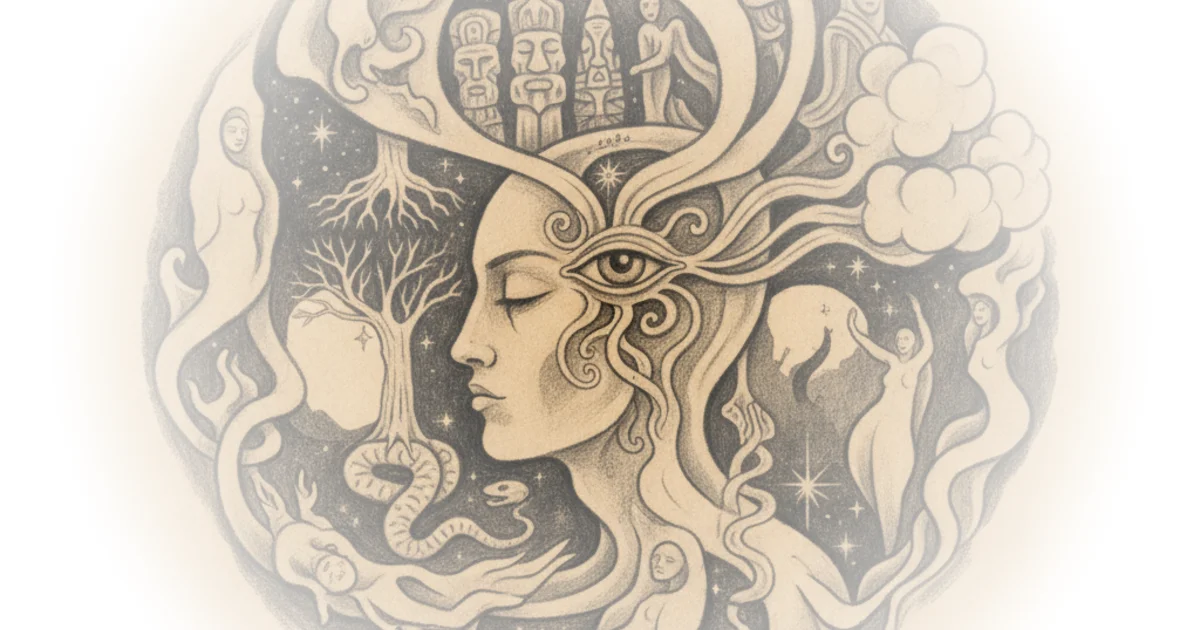
He moves from the Gospel of Matthew, where Joseph receives divine guidance to flee to Egypt, to the Tibetan Buddhist practice of "dream yoga," where practitioners use lucid dreaming as a "training ground for enlightenment." He also highlights the vision quests of the Great Plains and the rise of African Independent Churches, where a "charismatic wind swept through Africa" driven by dream-based spiritual authority. The coverage is effective because it refuses to treat these as isolated anecdotes; instead, it presents them as a "widespread pattern" of human behavior.
Critics might argue that grouping such distinct practices under one umbrella risks flattening their theological nuances, but Henry's point is structural, not theological. He is showing that the mechanism of the dream is a common thread, even if the message differs.
"These weren't just personal messages for Joseph. They were moments of divine intervention."
The Battle of the Theorists
The piece then pivots to the academic history, exposing the flaws in early anthropological theories. Henry introduces Edward Tyler, the Victorian anthropologist who proposed that religion originated from a "primitive failure to distinguish between dreams and reality." Henry rightly identifies this as a "just so story," a speculative theory that lacks empirical support and relies on a colonial worldview that dismissed non-European beliefs as irrational.
In contrast, Henry presents the sociologist Émile Durkheim, who argued that dreams are too fleeting to build a religion. "What is the dream's place in our life?" Durkheim asked, concluding it is a "quite a small place" that leaves "vague impressions." Henry uses this to set up a crucial reversal: Durkheim believed that "our dreams are shaped by what we already believe," not the other way around. This shifts the burden of proof from the dream itself to the culture interpreting it.
This section is the intellectual core of the article. By pitting Tyler's "armchair anthropologist" approach against Durkheim's structuralism, Henry clears the ground for a more modern, psychological explanation. The argument lands because it exposes how easily scholars can mistake their own biases for universal truths.
The Neuroscience of the Sacred
Moving beyond sociology, Henry dives into the hard science of depth psychology and neuroimaging. He traces the evolution from Freud's "royal road to the unconscious" to Carl Jung's concept of the "collective unconscious," which he describes as a "shared reservoir of experiences and symbolic archetypes common to all human beings." While these theories are influential, Henry notes they have faced challenges from large-scale empirical data.
He introduces the work of Calvin Hall and Robert Van de Castle, who analyzed over 10,000 dream reports to find that dream content varies by culture, suggesting our "social environment shapes what we dream about." But the most compelling evidence comes from modern technology. Henry explains how functional magnetic resonance imaging (fMRI) and electroencephalography (EEG) revealed that during rapid eye movement (REM) sleep, the "dorsolateral prefrontal cortex"—the brain's logic center—is less active, while the "limbic system," which processes emotion, remains highly active.
This biological reality explains why dreams feel so surreal and emotionally intense. The brain is essentially running a high-emotion simulation without the brakes of logic. This scientific grounding prevents the piece from drifting into pure mysticism, anchoring the spiritual discussion in physical reality.
The Social Construction of Meaning
The final and most sophisticated part of Henry's argument brings us to Dr. Anne Taves and the cognitive science of religion. Taves shifts the question entirely: instead of asking what makes a dream religious, she asks, "How do people come to see dreams as meaningful in the first place?" Henry illustrates this with the work of anthropologist Dr. Katie Glass on the Bardi people of Australia. For the Bardi, a dream is not automatically sacred; it must undergo a "collective interpretation process" where the community validates the message.
This aligns with the epidemiological approach proposed by Dr. Andreas Nordon, who identifies four features that make dreams "culturally contagious": threatening content, lack of self-agency, bizarre elements, and supernatural agents. Henry explains that "threatening content" sticks in memory because it provokes strong emotions, while "lack of self-agency" makes the dreamer feel like a passive observer of events controlled by an outside force.
"Dreams are not private experiences. They gain meaning through the cultural and social frameworks around them."
This insight is the piece's strongest takeaway. It resolves the tension between biology and culture. The brain provides the raw, emotional, surreal material, but the culture provides the script that turns a nightmare into a prophecy or a vision.
Bottom Line
Andrew Henry's coverage succeeds by refusing to settle for a single answer, instead weaving together anthropology, psychology, and neuroscience to show that the origin of religious dreams is a feedback loop between brain and society. The argument's greatest strength is its rejection of the "primitive error" narrative in favor of a dynamic model of meaning-making. The only vulnerability is the sheer density of theories presented in a short space, which may require the listener to pause and reflect on how their own culture shapes their interpretation of the night. For the busy listener, this is a rare treat: a complex idea made clear without being simplified.
Dreams are not private experiences. They gain meaning through the cultural and social frameworks around them.