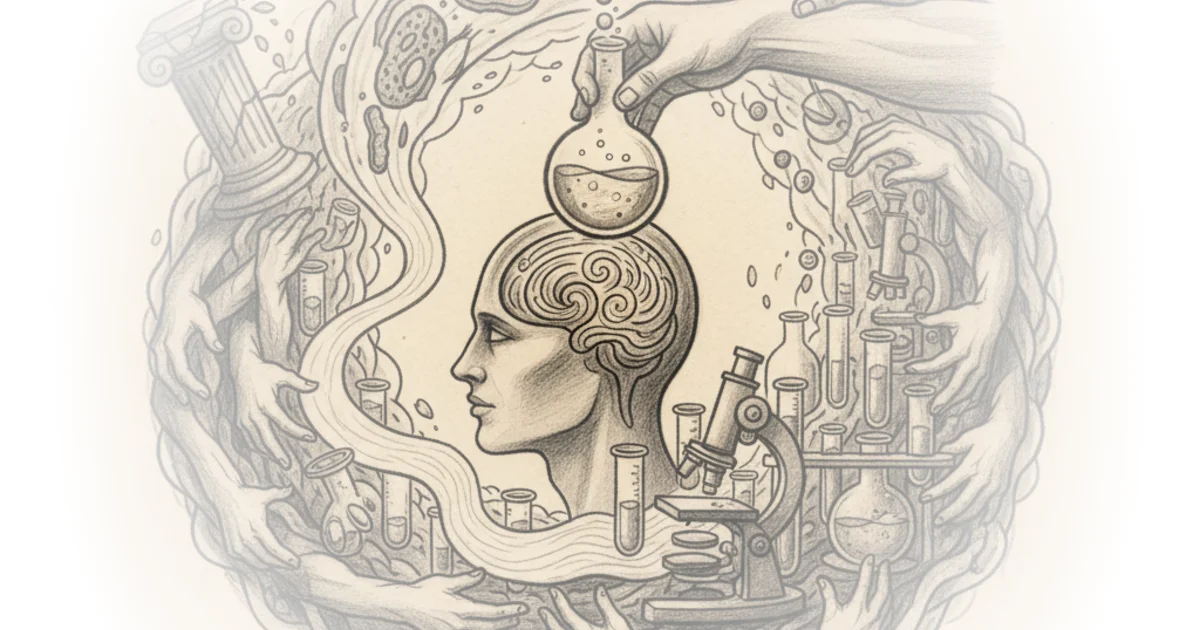
Crash Course dismantles the romantic myth of the lone scientific genius, arguing that the real engine of discovery is not a single "great experiment" but a relentless, communal dialogue of skepticism and iteration. In an era where AI and big data often obscure the human element of research, this piece offers a vital corrective: science is not a series of isolated eureka moments, but a messy, collaborative process where even the most brilliant minds stand on the shoulders of giants.
The Myth of the Lone Genius
The narrative often sold to the public centers on the individual hero. Crash Course immediately challenges this, noting that while figures like Louis Pasteur were undeniably brilliant, "None of them could have done what they did without the support of the scientific community around them." This framing is crucial because it shifts the focus from personality to process. The author reminds us that even Isaac Newton admitted, "If I have seen further, it is by standing on the shoulders of giants." This is not just a polite nod to history; it is a structural reality of how knowledge accumulates. By humanizing the scientific method, Crash Course makes the discipline feel more accessible and less like a club for the select few.
"It is very rare for just one person or one experiment to change our understanding of the world. Behind each breakthrough, there's a community of scientists connecting across decades through many experiments, all in the name of scientific progress."
The piece uses the story of Pasteur's work on germ theory to illustrate this. While Pasteur is often credited single-handedly with disproving spontaneous generation, the author points out that he was entering a debate already raging among his peers. Critics like Felix Pouchet argued that air itself had a density that would prevent microbes from floating freely, suggesting that "The air in which we live would almost have the density of iron." Rather than dismissing these skeptics as obstacles, Crash Course reframes them as essential to the scientific process. "Pouchet and the skeptics weren't just being haters. Exactly the opposite. They were being scientists." This distinction is powerful; it suggests that friction and doubt are not bugs in the system, but features that refine the final product.
The Mechanics of Iteration
The commentary then dives into the specific mechanics of how Pasteur responded to this pressure. He didn't just repeat his initial broth experiment; he iterated. When skeptics claimed his first test didn't rule out the idea that fresh air itself sparked life, Pasteur designed the famous swan-neck flask. This container allowed air in but trapped dust and microbes in the curved neck. As Crash Course explains, "Air still got in, but since nothing formed, he concluded that the microbes got trapped in the curving neck of the flask." This was a masterclass in experimental design, treating the shape of the flask as an independent variable to isolate the presence of microbes as the dependent variable.
"His experiment presented an elegant, creative approach to controlling each of those variables. The shape of the flask prevented anything heavier than air from touching the sterile broth until Pasteur wanted it to."
The author highlights that this wasn't just about being clever; it was about rigorously addressing the "confounding variables" that could distort the truth. Even after the swan-neck flask, Pasteur had to prove that the liquid itself hadn't been "destroyed" of its life force, leading him to tip the flask and let the trapped microbes slide back in, instantly restarting the growth. This level of detail serves to demystify the scientific method. It shows that a "great experiment" is often just a series of very good questions answered with increasingly precise tools. Critics might argue that this focus on the laboratory setting ignores the role of serendipity or the contributions of non-academic practitioners, but the piece effectively argues that without the rigorous testing of variables, serendipity remains just a lucky accident rather than a discovery.
Beyond the Lab: Observation and Ethics
The narrative takes a sharp turn to address the limitations of the laboratory. Pasteur himself noted, "Everything gets complicated away from the laboratory." Crash Course uses this to pivot to the concept of observational science, which is vital for studying phenomena that cannot be contained in a flask, such as climate change or the spread of disease in human populations. The author notes that for climate science, researchers cannot "generate a mock Earth with all its complicated overlapping systems and just port it into the lab." Instead, they must rely on measuring the real world.
"Science isn't always about designing the perfect experiment because sometimes an experiment isn't even the right method for doing science."
This section is particularly relevant for modern readers who often conflate "science" with "controlled trials." The author explains that observational studies, while powerful, come with their own set of challenges, specifically "confounding variables." For instance, determining if alcohol causes heart disease is complicated by the fact that heavy drinkers might also eat high-calorie foods. The piece wisely notes that "we don't always know what the confounding variables are," which is why science must build on evidence from many different types of studies. Furthermore, the commentary touches on the ethical constraints that prevent certain experiments, such as withholding life-saving cancer treatments from a control group. In these cases, observational data becomes the only ethical path forward, forcing scientists to be even more rigorous in their analysis of existing data.
The Collective Future
Ultimately, the piece argues that the story of science is not a straight line drawn by a single hand, but a tapestry woven by many. Pasteur's work paved the way for Robert Koch and others to identify specific bacteria, proving that "scientists continued to build on Pasteur's findings even after he published them." The author concludes that our current understanding of disease is the result of "well-designed experiments, but also as a result of really smart observational studies and collaboration among the scientific community."
"The core of the argument is that science is a social enterprise, not a solitary one."
This perspective is a necessary antidote to the "great man" theory of history that still pervades education and media. By emphasizing the role of the community, Crash Course makes the scientific method feel less like a rigid set of rules and more like a dynamic, human conversation. The strongest part of this argument is its refusal to diminish Pasteur's genius while simultaneously elevating the role of his critics and successors. It suggests that the true power of science lies not in the individual who has the right answer, but in the community that knows how to ask the right questions.
Bottom Line
Crash Course delivers a compelling correction to the popular narrative of scientific discovery, proving that the "great experiment" is a myth that obscures the true engine of progress: communal skepticism and iterative refinement. While the piece occasionally glosses over the historical friction and power dynamics that can stifle collaboration, its core message remains robust and essential. Readers should watch for how this framework applies to modern controversies, where the demand for a single "smoking gun" study often ignores the complex, cumulative nature of evidence.