Creative block is not a defect. It is a symptom — the surface signal of deeper psychological friction. Maria Popova does not merely catalogue Franz Kafka's diary entries; she excavates them as evidence of something universal: the gifted mind at war with itself, and the strange necessity of writing as survival.
The Architecture of Paralysis
Popova begins with a paradox. Creative work is simultaneously an inward plunge and an outward escape. Writing metabolizes experience. It clarifies the mind so the mind stops holding the writer captive. All of it is a coping mechanism — for loneliness, for despair, for the chaos within. Yet how little of that private ferment survives into the finished work.
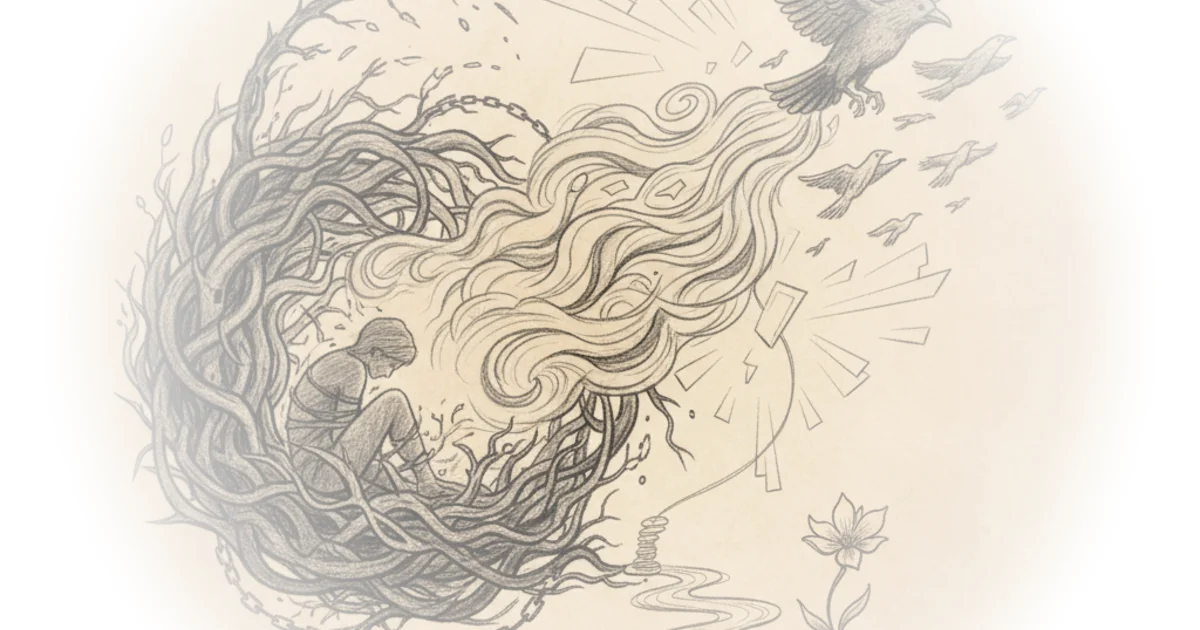
This is where diaries become invaluable. They capture the raw process before it is polished into something legible and therefore misleading. Popova writes, "All creative work is at bottom a means of self-liberation and a coping mechanism — for the loneliness, the despair, the chaos and contradiction within." The diary strips away the performance and leaves only the struggle.
Kafka's diaries, spanning 1910 to 1923, reveal a mind trying to write itself into existence while working a day job at an insurance office, battling tuberculosis, and drowning in unanswered correspondence. "Wrote nothing," he records, again and again. The diary becomes both accusation and lifeline.
Time-Anxiety
Kafka's first great hindrance is the conviction that he lacks the time and quiet to realize his talent — an excuse he himself recognizes as hollow. Popova writes, "During a rare respite from his ordinary time-lament — that his day job at the insurance company is taking too much energy away from writing — he finds himself not using the windfall gain to write." He wastes the free hours sleeping. He stretches on the bed and tells himself he has been writing.
The bi-polar nature of time-anxiety is this: the feeling of not having enough time paired with the paralysis of procrastination. As Popova notes, "Such fear of writing always expresses itself by my occasionally making up, away from my desk, initial sentences for what I am to write, which immediately prove unusable, dry, broken off long before their end." The gifted person does not simply run out of hours. They dilate the hours they have into nothing.
Kafka's insurance job — the bureaucratic machinery that consumed his daylight — would feel familiar to any working writer today. But the deeper truth Popova surfaces is that time is rarely the real problem. Fear is.
Only in this way can writing be done, only with such coherence, with such a complete opening out of the body and the soul.
World-Anxiety
To be an artist, Popova argues, is to feel life at maximum amplitude — including the terrors. Kafka writes as the First World War devours Europe. "The thoughts provoked in me by the war… devour me from every direction," he records. "I can't endure worry, and perhaps have been created expressly in order to die of it."
The writing stalls. His sorrow over military defeats, his anxiety for the future — it produces not prose but apathy, which returns like a chronic condition that must be beaten down daily. As Popova puts it, "There is time enough for sorrow when I am not writing." The diary absorbs the grief so the work can continue.
Kafka would die of tuberculosis before the war ended — a biographical detail that turns these entries from literary curiosity into something closer to a death watch. The tuberculosis deep dives in the companion material underscore how physical deterioration and creative output were braided together for him. Every page was written on borrowed time.
Self-Comparison
Few things destroy confidence like measuring yourself against someone greater. Popova identifies this as the third hindrance. Kafka reads a volume of Goethe's conversations and finds himself frozen. "This week I think I have been completely influenced by Goethe, have really exhausted the strength of this influence and therefore become useless," he writes. The paralysis lasts nearly a month.
The mechanism is precise: immersion in another's genius becomes a form of learned helplessness. Insecurity and envy twist together. The comparison does not inspire — it incapacitates.
Critics might note that Popova's treatment here flattens a genuine intellectual problem. Reading Goethe did not merely block Kafka; it absorbed his creative energy into a mode of study rather than production. That is not simply weakness — it is the cost of a mind that learns through total immersion. Whether that cost is avoidable is a question the essay leaves open.
Self-Doubt
The fourth hindrance is the most corrosive. "I cannot believe that I shall really write something good tomorrow," Kafka forebodes. He calls himself "an almost complete failure in writing." He writes a metaphor about standing between two holes in the ground, waiting for something to emerge from the right one while false things keep rising from the left — and then immediately demolishes the metaphor itself: "How weak this picture is."
Popova writes, "With his characteristic drama for metaphor, he writes in the winter of his twenty-eighth year: It is as if I were made of stone, as if I were my own tombstone, there is no loophole for doubt or for faith, for love or repugnance, for courage or anxiety." The doubt circles every word before the word even appears. "My doubts stand in a circle around every word, I see them before I see the word, but what then! I do not see the word at all, I invent it."
And yet — this is the consolation Popova returns to again and again — the remedy for writer's block is writing. Not planning. Not preparation. The act itself. Kafka's most powerful diary passage is also the simplest: "I will write in spite of everything, absolutely; it is my struggle for self-preservation."
The Verdict on Talent
Popova's final move is to reframe Kafka's relationship to writing not as art but as biological necessity. Writing did not serve his life. His life served writing. "When it became clear in my organism that writing was the most productive direction for his being to take, everything rushed in that direction and left empty all those abilities which were directed towards the joys of sex, eating, drinking, philosophical reflection, and above all music." All of his strengths pooled into one narrow channel. Everything else atrophied.
Critics might argue this is romanticization of a pathology — that Kafka's tuberculosis, his neurotic isolation, his inability to sustain relationships were not virtues but illnesses. Popova does not quite confront this tension. The essay presents self-destruction in service of art as a form of transcendence, when it might also be read as a tragedy.
But the essay's power does not depend on resolution. It depends on honesty. And Popova's excavation of Kafka's diaries delivers exactly that: an unvarnished record of what it costs a gifted person to keep writing, and what happens when they stop.
Bottom Line
The four hindrances Popova identifies — time-anxiety, world-anxiety, self-comparison, self-doubt — are not obstacles to be overcome. They are the medium through which serious work moves. Kafka wrote through all of them because writing was the only thing keeping him from collapsing into himself. The consolation, and the warning, is that this is not exceptional. It is the standard cost of doing the work.