Peter Gelderloos delivers a blistering, hyperbolic indictment of American driving culture that transcends mere road rage to expose a deeper crisis of social cohesion and spatial awareness. While the piece wears the mask of a holiday weekend rant, its core claim is startling: the chaos on US highways is not a result of bad vehicle design or infrastructure, but a fundamental failure of the American driver to recognize the humanity of others.
The Myth of the Machine
Gelderloos immediately dismantles the common defense that large vehicles are to blame. He writes, "The problem isn't the cars: it's the Americans." This is a provocative pivot. The author argues that while the preference for SUVs contributes to pedestrian fatalities, the root cause of accidents is a driver's inability to learn their vehicle's "delimitations and blind spots." He contrasts the typical American driver's panic in a parking lot with the competence of a professional truck driver, noting that even a massive box truck can be navigated safely if the operator respects its dimensions.
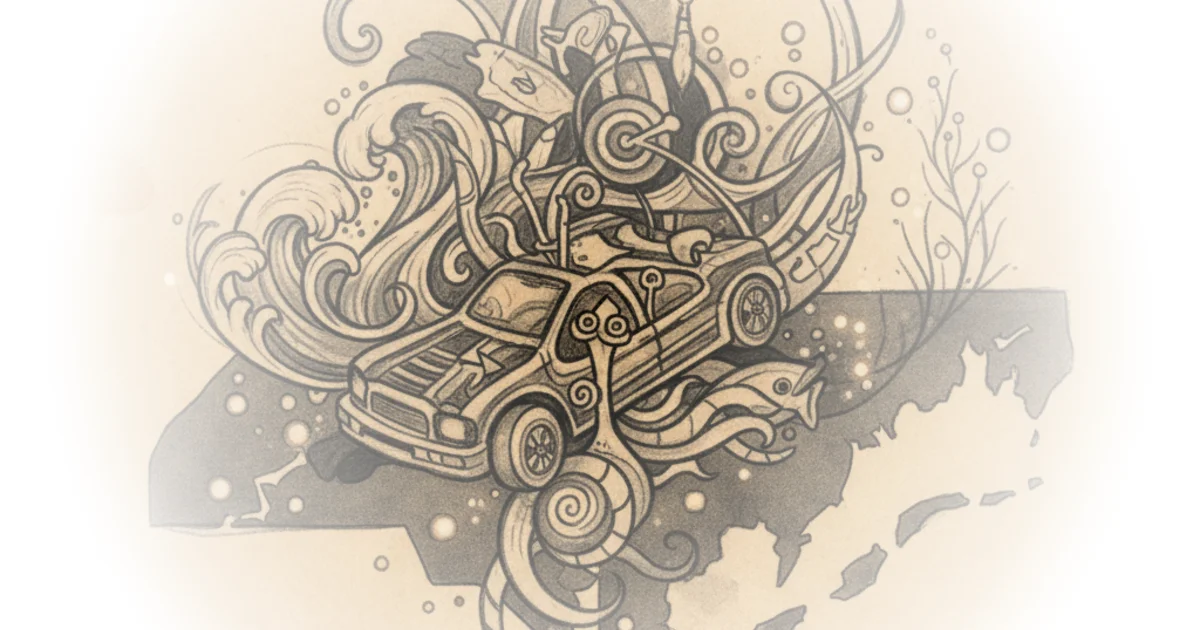
This framing is effective because it shifts the burden of safety from engineering to behavior. However, critics might note that this perspective underestimates how vehicle design—specifically the towering hoods of modern trucks—actively degrades visibility and creates genuine physical blind spots that no amount of "learning" can fully eliminate. Gelderloos acknowledges this tension but insists that the driver's refusal to adapt is the primary failure.
"It's like an American steps into a car and, no matter what kind of person they are before they get in there, they suddenly forget that there are other people in the world."
The author suggests that the car acts as a psychological container that strips away personhood, leading to "self-destructive and other-destructive behaviors in equal measure." This observation cuts to the heart of the issue: the isolation of the driver. By focusing on the loss of community, Gelderloos moves the conversation from traffic laws to social ethics.
A Geography of Incompetence
The piece then turns into a regional roast, mapping specific failures to specific geographies. Gelderloos writes, "Marylanders, I think, at 16 years old, are given a license, a key, no training, and instructions to go out and cause as much harm as possible." He contrasts this with the "derpy" obliviousness of Virginians and the aggressive, space-hogging habits of Ohioans. In New Jersey, he claims, the very concept of "traffic rules" is met with confusion.
This regional analysis serves as a metaphor for the fragmentation of American civic life. The author argues that these aren't just bad habits; they are distinct cultural norms that have calcified over decades. He notes that in the US, "two cars can cause a five mile long traffic jam on a double lane highway" simply because drivers refuse to let others pass, treating the left lane as a personal "comfort bubble." This behavior, he argues, is unique to the US and stands in stark contrast to the disciplined flow seen in Germany or the adaptive, fluid navigation of lower-infrastructure countries.
"The US is the only country in the world where two cars can cause a five mile long traffic jam on a double lane highway... They clearly don't know that the left lane is for passing."
Gelderloos uses this example to highlight a broader lack of spatial awareness and a selfishness that paralyzes the collective. He suggests that American drivers operate under a delusion that their personal comfort supersedes the flow of traffic, a mindset that mirrors broader political and social gridlock.
The Cost of the System
The commentary deepens when Gelderloos examines Los Angeles, describing it not as a city but as an "enclosed experiment in human tolerance for ecocide, totalitarianism, and pointless stupidity." He paints a grim picture of a system where millions are locked into cars, breathing toxic air, and paying exorbitant rents to survive a commute that offers no real value.
This section is the most sobering, moving beyond the rant to a structural critique. He asks what happens first in such a system: "mass escape; social revolution; homicidal mass nihilism; or infinite acceptance as highways grow and grow to 26 lanes and beyond." The implication is that the current trajectory leads only to collapse or total resignation. He contrasts this with the German tendency to obey signals even when no cars are present, which he views as a refusal to use one's own senses, and the Cleveland habit of running red lights, which he sees as a pragmatic but flawed adaptation.
"Lock several million people in a giant, open air laboratory where one of the highest concentrations of cultural capital in the world entices them to stay, force them to pay outrageous rents, to spend hours in traffic... and find out what happens first."
Here, the author's voice shifts from angry to mournful. He recognizes that while he would "abolish automobiles and highways today," we are currently "saddled with them." The tragedy, he argues, is that the system is not inevitable; it is a choice that has been made and reinforced, leading to a degradation of the human spirit.
Bottom Line
Gelderloos's strongest move is reframing traffic not as a logistical problem but as a moral failure of recognition, arguing that the American driver's inability to see others is the true cause of the chaos. The piece's biggest vulnerability is its reliance on anecdotal generalizations that may overlook the role of inadequate driver education and infrastructure design in shaping behavior. Ultimately, the reader is left with a stark warning: until we reclaim our sense of shared space and humanity, the highway will remain a place of isolation and danger.
"It's like an American steps into a car and, no matter what kind of person they are before they get in there, they suddenly forget that there are other people in the world."