John Campbell cuts through the panic surrounding the Nipah virus with a rare, dual-edged verdict: the threat is terrifyingly real, yet the immediate danger to the West is negligible. While many commentators rush to declare the next pandemic, Campbell anchors his analysis in the stark reality that this virus is currently geographically trapped in South and Southeast Asia, offering a grounded perspective for those tired of alarmist headlines. He argues that the true existential threat isn't natural evolution, but human arrogance in the laboratory, a distinction that reframes the entire conversation from "when" to "if" and "how."
The Geography of Fear
Campbell immediately dispels the notion that Nipah is an imminent global invader. He writes, "I don't think we're going to see cases of Nipah virus spreading person-to-person in the United States, Canada, Australia, United Kingdom." This assertion is backed by a clear mapping of outbreaks, which remain confined to Kerala in India, Bangladesh, and parts of Malaysia and the Philippines. By highlighting that no confirmed cases exist in Western nations, he provides a necessary reality check for anxious readers. The author's tone shifts briefly to critique modern hospital design, noting that "overcrowded and poorly ventilated environments" in the UK could facilitate transmission if the virus were present, a sharp observation on infrastructure that often gets lost in virology discussions. Critics might argue that dismissing the risk to the West entirely ignores the unpredictability of global travel, but Campbell counters this by emphasizing that the virus is not airborne in the way influenza or SARS-CoV-2 was.
"It is not going to be a rapid mode of transmission like it was with SARS Corona virus 2 for example."
This distinction is crucial. Campbell explains that while person-to-person spread occurs in close care settings, it relies on droplets from respiratory symptoms rather than aerosolized particles floating through a room. This limits the virus's ability to spark a rapid, uncontrollable chain reaction in the general population, provided basic infection control measures are in place.
The Laboratory Gamble
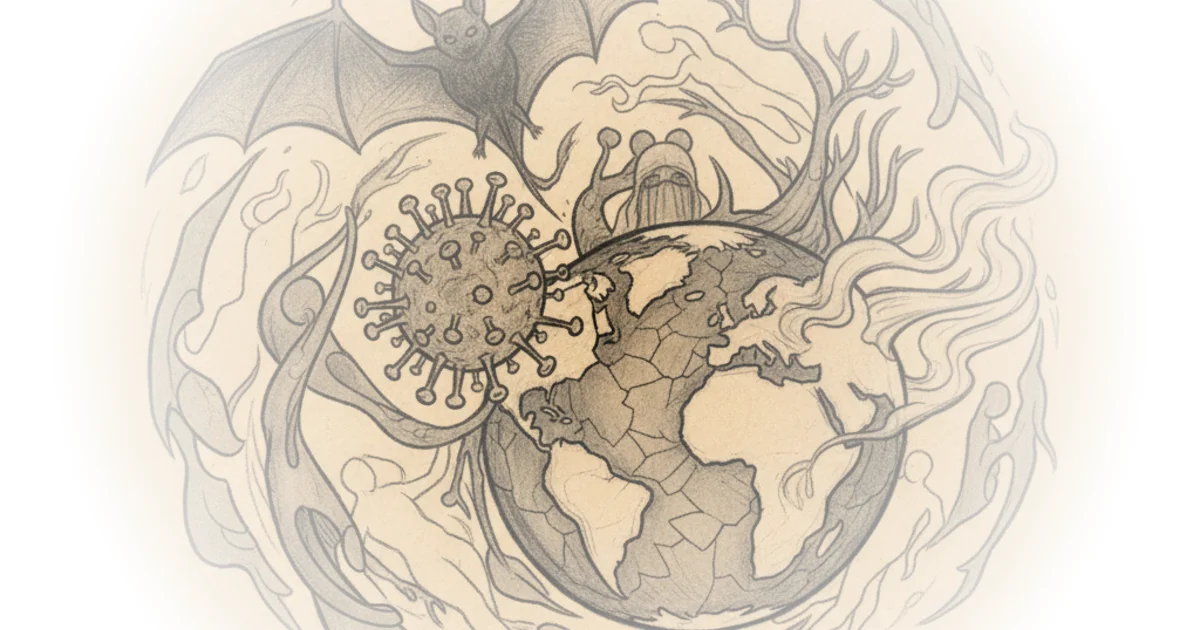
The most provocative element of Campbell's commentary is his pivot from natural transmission to the specter of human intervention. He posits that the virus's greatest danger lies not in the wild, but in the lab. "The reason I'm saying yes it is a potential risk is it could be weaponized it could be messed around within laboratories gain of function research could be carried out on it," he states. This argument introduces a layer of geopolitical and ethical risk that standard epidemiological models often overlook. Campbell suggests that if researchers were to increase the virus's transmissibility through gain-of-function experiments, the consequences would be catastrophic given the virus's lethality. He notes that the case fatality rate hovers around 57%, meaning "if you get this infection, your 57% chance you're going to die even if you're young and fit."
The author's skepticism toward the safety of such research is palpable. He warns that a leak from a lab where transmissibility had been enhanced could lead to "half the world's population dying." While this sounds like melodrama, Campbell frames it as a logical extrapolation of current scientific capabilities and the virus's inherent deadliness. A counterargument worth considering is that gain-of-function research is strictly regulated and that the risk of a leak is statistically low compared to natural spillover events. However, Campbell's point remains that the potential for human error or negligence creates a unique, high-stakes variable that natural evolution does not possess.
The Natural Reservoir and Prevention
Returning to the natural world, Campbell identifies the fruit bat, or "flying fox," as the primary reservoir. He describes the transmission route with vivid clarity: "If the bat or an infected animal has had a nibble of some fruit and then left the rest of it, it wouldn't be good if we ate the rest." This simple mechanism—contaminated fruit or raw date palm juice—explains why outbreaks are often localized to rural areas where humans and bats overlap. The author offers practical, actionable advice for prevention, such as boiling date palm juice and peeling fruit, grounding the high-level threat in daily habits. He also notes that while the virus can jump to pigs, horses, and dogs, the spillover to humans remains relatively rare despite the wide distribution of the bats themselves.
"There is no limit to the arrogance of human beings who think they contain it but then find it leaks."
This sentiment underscores the piece's central tension: nature is dangerous, but human hubris is potentially more so. Campbell's coverage effectively separates the manageable risk of natural outbreaks from the unmanageable risk of laboratory accidents, urging readers to focus their concern on the latter.
Bottom Line
John Campbell's analysis succeeds by refusing to indulge in baseless panic while acknowledging the genuine horror of the Nipah virus. His strongest argument is the distinction between the virus's current, contained natural spread and its hypothetical, lab-enhanced pandemic potential. The piece's biggest vulnerability is its reliance on the assumption that laboratory safety protocols will hold, a hope that history suggests may be fragile. Readers should watch for any reports of gain-of-function research on Nipah, as that is the single variable that could turn a regional threat into a global catastrophe.