The Sleeping Giant Awakens
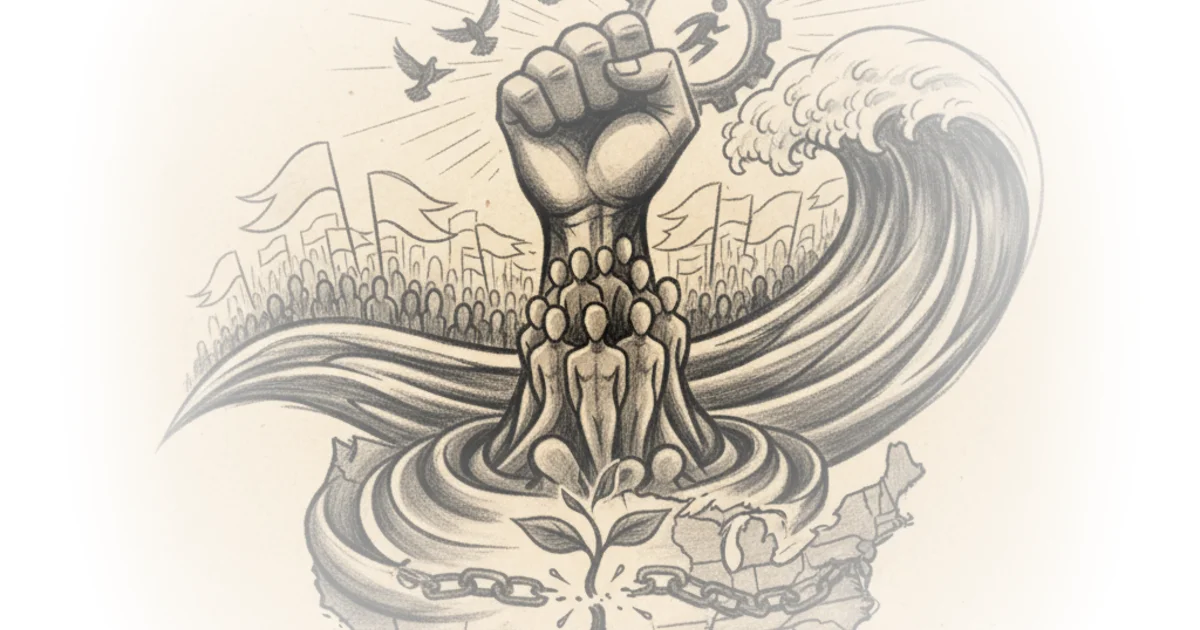
Eric Blanc's piece stands out because it treats history as a practical toolkit rather than nostalgia. The 2006 immigrant rights movement achieved something rare: it stopped a bill already passed by the House. Between 4 and 5 million people marched. Over a million walked off work on May 1 alone. Ports slowed. Restaurants closed. The Senate killed H.R. 4437 within weeks.
Youth as Catalyst
The spark jumped first to young people. Thousands of high school students walked out in late March 2006, before the national strike took shape. Blanc notes that over 51% of May Day participants were between 14 and 28 years old. Children of undocumented parents often have papers, speak English, and feel rooted enough to intervene politically.
Eric Blanc writes, "I told them how me and my friends are going to go and, if they go, it would be better 'cause at least if one more person [goes], that can make a difference." That Chicago high schooler convinced his parents to march. Their first political action.
Today's enforcement surges create higher fear levels. Undocumented parents may avoid leaving home for weeks. The political responsibility of their children becomes sharper. Blanc points to Minneapolis walkouts on January 14 as evidence this dynamic still operates.
"It gives me chills to be a part of it. Thirty years from now, I'll look back and say, 'I was there.'"
Critics might note that youth-led movements often lack institutional memory. Student leaders graduate. Momentum dissipates. The 2006 movement's strength came from anchoring youth energy in unions, churches, and community organizations that outlasted individual participants.
Winnable Demands Win
Inexperienced activists raise laundry lists. The 2006 movement centered one demand: stop the Sensenbrenner bill. Eric Blanc writes, "That bill, known as H.R.-4437, has been the main point of protest for most demonstrators." People without financial cushions or immigration papers take political risks only when victory seems possible.
The equivalent today requires clarity. "ICE Out of Cities." "Respect Our Votes." Not abolition or Medicare for All—policies appropriate for presidential platforms, not mass strikes. Blanc argues ordinary people strike for immediate-but-winnable demands.
Critics might note that narrow demands can foreclose deeper transformation. Stopping one bill does not end deportation regimes. The 2006 victory left enforcement infrastructure intact, which expanded in subsequent years.
The Air War
Spanish-language radio accelerated the 2006 movement. Two nationally syndicated DJs—Renán Almendárez Coello and Eduardo Sotelo—made immigration reform constant topics after organizers convinced them this was important. A Chicago survey found just over half of marchers heard about the rally on TV or radio.
Eric Blanc writes, "After organizers convinced the DJs that this was an important moment, immigration reform and the upcoming rally were constant topics on their shows."
Today's media environment fractures across feeds and algorithms. Spanish-language media, now controlled by finance capital, has grown hesitant to speak truth to power. Blanc argues replicating viral spread requires treating media strategy as core work and coordinating amplification rather than assuming organic spread.
Critics might note that corporate media alignment with enforcement regimes reflects material incentives, not merely cowardice. Organizing media itself—pressuring owners, building alternative channels—may be prerequisite to scaling.
Winning the Normies
Early 2006 protests in Denver featured Mexican flags and Spanish-language signs. Opponents painted protesters as lawbreaking criminals unwilling to assimilate. Organizers responded by sharpening a mainstream frame: family, work, belonging here. American flags drowned out Mexican flags across the nation.
Eric Blanc writes, "put away Mexican flags they had brought to the demonstration—predicting, correctly, that the flags would be shown on the news and that the demonstrators would be criticized as nationalists for other countries, not residents seeking rights at home."
Collective discipline mattered. Virtually no violence. Few arrests. Randy Shaw notes this differed from the 1999 anti-WTO protests and 2004 Republican National Convention demonstrations, where media footage portrayed protesters battling police even when most acts were peaceful.
The Catholic Church provided infrastructure and moral legitimacy. In Los Angeles, Cardinal Roger Mahony announced he would instruct priests and lay Catholics to break the law if H.R. 4437 became felony statute.
Eric Blanc writes, "if the Sensenbrenner bill was enacted and providing assistance to undocumented immigrants became a felony, he would instruct both priests and lay Catholics to break the law."
Church leadership and unions pushed for after-work rallies, minimizing job conflict. Debates were sharp. But scale requires navigating tensions with the bigger goal in mind.
Critics might note that patriotic performance and institutional approval can dilute radical demands. The frame that wins mainstream participation may foreclose more transformative visions of belonging and rights.
Union Leadership Lag
Blanc's final lesson cuts against waiting for union leaders to call strikes. The 2006 movement succeeded because it did not wait. Community organizations, student groups, and radicals anchored the action. Unions joined—but did not initiate.
Bottom Line
The 2006 strike proved immigrant workers could shut down cities and kill federal legislation. Blanc's argument rests on a hard claim: today's movements must replicate the discipline, clarity, and mainstream outreach that made that victory possible. The sleeping giant can wake again—but only if organizers learn from the last time it stood.