This piece cuts through the hype of "efficiency" to reveal a brutal economic reality: when artificial intelligence is deployed not to augment human talent but to replace it, the result is a race to the bottom where "good enough" becomes the new standard for human worth. Brian Merchant's reporting does not rely on abstract projections or executive forecasts; instead, it anchors the crisis in the visceral, personal testimonies of workers who watched their careers evaporate overnight, proving that the cost of automation is paid in human dignity, not just balance sheets.
The Illusion of Augmentation
Merchant begins by dismantling the comforting narrative that AI is merely a tool for workers to leverage. He introduces us to Jacques Reulet II, a former head of support operations who found his role inverted. "AI didn't quite kill my current job, but it does mean that most of my job is now training AI to do a job I would have previously trained humans to do," Reulet told Merchant. This is a critical distinction often missed in boardroom presentations: the shift from managing people to managing algorithms. The author notes that Reulet was eventually laid off the week before Thanksgiving, once the bots were deemed "good enough," illustrating a chilling pattern where human excellence is rendered obsolete by mediocre automation.
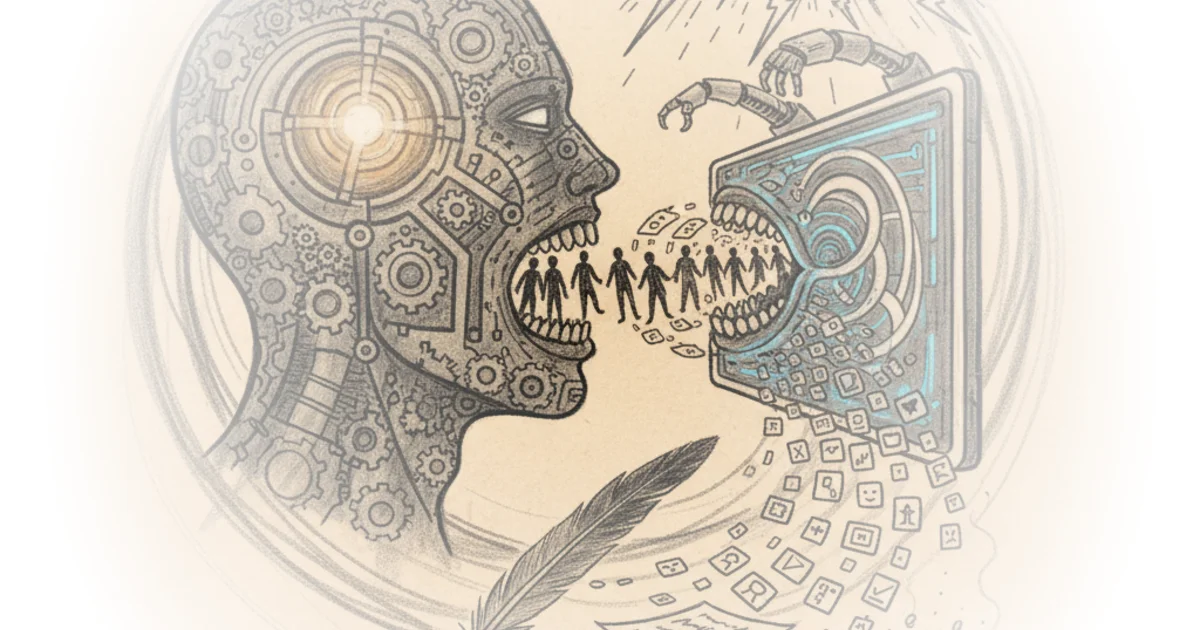
The framing here is devastatingly effective because it highlights the loss of the "apprenticeship" model. Reulet warned that "I have no idea how entry-level developers, support agents, or copywriters are supposed to become senior devs, support managers, or marketers when the experience required to ascend is no longer available." Merchant uses this to connect the current crisis to the historical concept of deskilling, where technology strips workers of the specialized knowledge that once guaranteed career progression. This isn't just a job loss; it is a structural collapse of the ladder that allowed people to climb from entry-level roles to leadership.
"I was actually let go the week before Thanksgiving now that the AI was good enough... We had a reputation for excellence that I'm sure will now blend in with the rest of the pack of chatbots."
The Human Cost of "Good Enough"
The article's most harrowing section moves from corporate strategy to individual survival. Merchant details the story of an anonymous social media copywriter who, after six years of excellence, was abruptly replaced by a "Mad Libs-style" template system. The author writes, "They didn't care that the quality of the posts would go down. They didn't care that AI can't actually get to know the client or their needs or what works with their customers." This indifference to quality in favor of cost-cutting is the engine of the current downturn.
The human toll described is severe. The writer reveals that they were "forced to get into online sex work," a stark admission that underscores the lack of safety nets for displaced creative workers. Merchant notes that this worker, who is disabled and required flexible hours, found that the gig economy offered no viable alternative to their former career. "What kind of jobs will be left? What kind of rights and benefits will we have to give up just because we're meant to feel grateful to have any sort of job at all?" they ask. This question cuts to the core of the "race to the bottom" dynamic, where the threat of AI replacement forces workers to accept worse conditions or exit the workforce entirely.
Critics might argue that the transition to AI is a natural market evolution that ultimately lowers costs for consumers and creates new, albeit different, types of jobs. However, Merchant's evidence suggests that for the specific demographic of mid-level creative professionals, the new jobs are not appearing at the same scale or quality as the ones being destroyed. The narrative of "creative destruction" rings hollow when the "creation" side of the equation is silent.
The Collapse of Small Business and Agency Models
The scope of the destruction extends beyond individual freelancers to entire small agencies. Merchant profiles a business copywriter whose agency, once employing eight people and generating $600,000 annually, saw revenue plummet to less than $10,000 in a single year. The author captures the emotional devastation of this collapse: "Being repeatedly told subconsciously if not directly that your expertise is not valued or needed anymore - that really dehumanizes you as a person." This testimony challenges the notion that AI is a neutral tool; instead, it acts as a force that actively erodes the value of human expertise.
The writer describes the psychological impact of being reduced from a strategic partner to an editor of AI drafts. "When you go from knowing you are valuable and valued... To being relegated to someone who edits AI drafts of copy at a steep discount because 'most of the work is already done'..." Merchant uses this to illustrate the concept of technological unemployment, where the demand for human labor drops precipitously even as the technology itself improves. The article suggests that the market is not simply shifting; it is contracting for human talent, leaving a vacuum that only the wealthiest institutions can navigate.
"It's getting dark out there, man."
Bottom Line
Brian Merchant's reporting succeeds by refusing to look away from the human wreckage of the AI boom, grounding high-tech trends in the stark reality of lost livelihoods and forced career pivots. While the piece focuses heavily on the negative impacts, it effectively argues that the current trajectory of AI adoption prioritizes short-term cost reduction over long-term ecosystem health, risking a permanent degradation of professional standards. The strongest takeaway is not that AI cannot write, but that the economic model built around it is actively dismantling the pathways for human growth and stability, leaving a generation of skilled workers with nowhere to turn.
"The work that client firms are settling for is not better when it's produced by AI, but it's cheaper, and deemed 'good enough.'"