Public Notice delivers a startling diagnosis of the Republican Party: it is not merely fracturing under the weight of its own contradictions, but actively cannibalizing its ideological foundations as the figurehead who unified its extremes begins to fade. The piece argues that the party's future is not a return to conservatism, but a collision between neo-fascist populists and a hollowed-out establishment, both of whom have lost the ability to govern or persuade the broader electorate.
The Fracture of the Cult
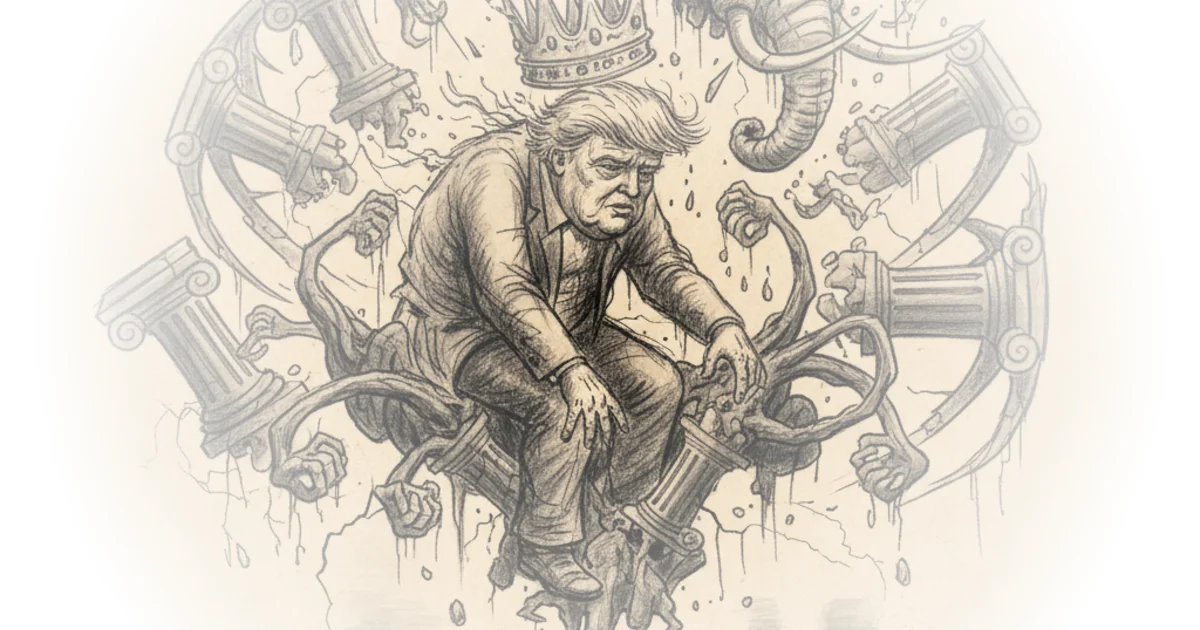
The core of Public Notice's argument rests on the idea that the Republican Party has traded long-held principles for a personality cult that is now failing. As the author notes, "Since 2016, the Republican Party has been under the thrall of Donald Trump's personality cult, having traded the party's 'principles' for power." This framing suggests that the current political chaos is not an anomaly but the inevitable result of a decade-long strategy that prioritized loyalty over policy coherence. The author posits that as the leader's influence wanes, the underlying incoherence of the party is being fully exposed.
Public Notice identifies Rep. Marjorie Taylor Greene as the primary case study for this disintegration. The author argues that Greene's rise was fueled by her ability to channel the darkest impulses of the base, noting she "did not 'moderate' her views to gain power. To the contrary, McCarthy valued Greene because of her 'seemingly innate understanding of the impulses' of the amalgam of racists, xenophobes, and conspiracists she represented." This observation is crucial; it reframes Greene not as an outlier, but as a logical product of a party that embraced extremism to win elections. The author draws a sharp parallel to the QAnon movement, which previously operated in the shadows, to illustrate how the party mainstreamed these fringe elements. Just as the Tea Party movement once reshaped the GOP's fiscal orthodoxy, the QAnon phenomenon reshaped its epistemological boundaries, accepting conspiracy theories as valid political discourse.
Greene apparently realized months ago that the Trump show was finally beginning to become old, even for previously diehard wackos, with the Epstein files debacle being an early indicator.
The author uses the Jeffrey Epstein scandal to mark a turning point. While QAnon followers had long fixated on Epstein as proof of a globalist cabal, the revelation of his ties to the former president shattered the narrative. Public Notice writes, "But the bubble burst on those claims when press reports, and Trump's self-incrimination, made it impossible for his cultists to ignore the fact that Trump himself was a longtime friend and associate of the notorious sex trafficker." This moment forced a reckoning within the base. Greene's subsequent pivot—breaking with the former president to champion the rights of Epstein's victims—is framed not as a moral awakening, but as a calculated business move to survive the inevitable collapse of the cult's credibility. Critics might note that Greene's sudden advocacy for victims feels opportunistic given her history of dismissing such issues, yet the author's point remains: the cult's internal logic is now so fractured that even its most loyal soldiers are forced to abandon the leader to save themselves.
The Hollow Establishment
While Greene represents the radical wing, the author turns to Sen. Bill Cassidy to illustrate the bankruptcy of the "traditional" Republican establishment. Public Notice describes Cassidy as a figure who has "repeatedly demeaned himself by betraying his principles in the almost certainly vain hope that Trump will support his reelection bid next year." The author highlights the absurdity of Cassidy's position: a medical professional who vocally opposes antivax conspiracies yet voted to confirm Robert F. Kennedy Jr. to lead health agencies simply to appease the executive branch.
The commentary suggests that this faction is attempting to reassert control over policy, specifically healthcare, but lacks any viable alternative. Public Notice writes, "The problem, however, is that there is no real Cassidy plan and almost certainly never will be. So far he's offered only warmed over versions of entirely unworkable ideas the GOP establishment has tinkered with since before the ACA was enacted in 2010." This is a damning assessment of the party's policy capacity. The author argues that the establishment's only success has been in doubling down on unpopular positions, such as cutting Medicaid or opposing the Affordable Care Act, despite the fact that these policies are deeply unpopular with the electorate.
Cassidy and his 'establishment' Republican crew sprang into action, demanding that Trump adhere to his longstanding opposition to the ACA.
The irony, as Public Notice points out, is that this rearguard action may lead to a political disaster that dwarfs recent election losses. The author notes that millions of Americans would be forced to choose between healthcare and bankruptcy if the administration follows through on these cuts. This section effectively argues that the "moderate" wing of the party is not a stabilizing force, but a group of opportunists whose policy prescriptions are so disconnected from reality that they threaten the party's very survival.
A Collision Course
The piece concludes by predicting a "raucous civil war" within the Republican Party as these two factions—Greene's neo-fascist populists and Cassidy's hollow establishment—clash for dominance. Public Notice argues that neither faction commands a majority of voters, and both repulse significant portions of the electorate. The author writes, "America would probably be far better off sending it into the dustbin of history." This is a stark, perhaps controversial, conclusion, but it flows logically from the evidence presented: a party that has abandoned its principles, embraced conspiracy theories, and failed to produce viable policy alternatives is unlikely to recover.
The author suggests that the emerging vision of the party is not a return to small-government conservatism, but a form of "fascist national socialism where 'big government' is accepted, as long as its beneficence flows only to white, Christian Americans." This reframing challenges the traditional left-right spectrum, suggesting that the future of the GOP is defined by identity-based exclusion rather than economic ideology. While some might argue that the party could eventually moderate, the author's evidence of Greene's continued antisemitism and Cassidy's policy failures suggests that the trajectory is toward further polarization and irrelevance.
The party has done untold damage to the nation over the past two and a half decades, particularly during its domination by Trump. America would probably be far better off sending it into the dustbin of history.
Bottom Line
Public Notice offers a compelling, if bleak, analysis of a party in terminal decline, arguing that the collapse of the personality cult has revealed a void where policy and principle used to be. The strongest part of the argument is the detailed breakdown of how both the radical and establishment wings are incapable of governing, leaving the party in a state of perpetual self-sabotage. Its biggest vulnerability is the assumption that the party will not find a new unifying figure or narrative to stabilize its fractured base, a risk that history suggests is always possible. Readers should watch for how the healthcare debate plays out, as it serves as the immediate flashpoint for this internal civil war.