Most analysis of Sri Lanka's collapse fixates on the immediate chaos of fuel lines and empty shelves, but PolyMatter argues the real story is a structural failure of the global financial system that could soon engulf much of the developing world. This piece stands out by reframing a national tragedy not as a unique political blunder, but as the first domino in a "perfect storm" driven by the convergence of pandemic shocks, geopolitical conflict, and the rigid mechanics of international debt. For a busy reader, the urgency lies in understanding that what is happening in Colombo is a preview of the coming global food crisis, not an isolated anomaly.
The Dollar Trap and the Illusion of Stability
PolyMatter begins by dismantling the common misconception that trade deficits are inherently catastrophic, noting that the United States and Japan run massive deficits without immediate collapse. The distinction, they argue, is the "privileged position" of the dollar. "The United States, for instance, has a huge deficit... but what's all too easy to forget is that the US and to a lesser extent Japan are weird countries." This framing is crucial because it isolates the specific vulnerability of nations like Sri Lanka, which must pay for essential imports in a currency they do not control.
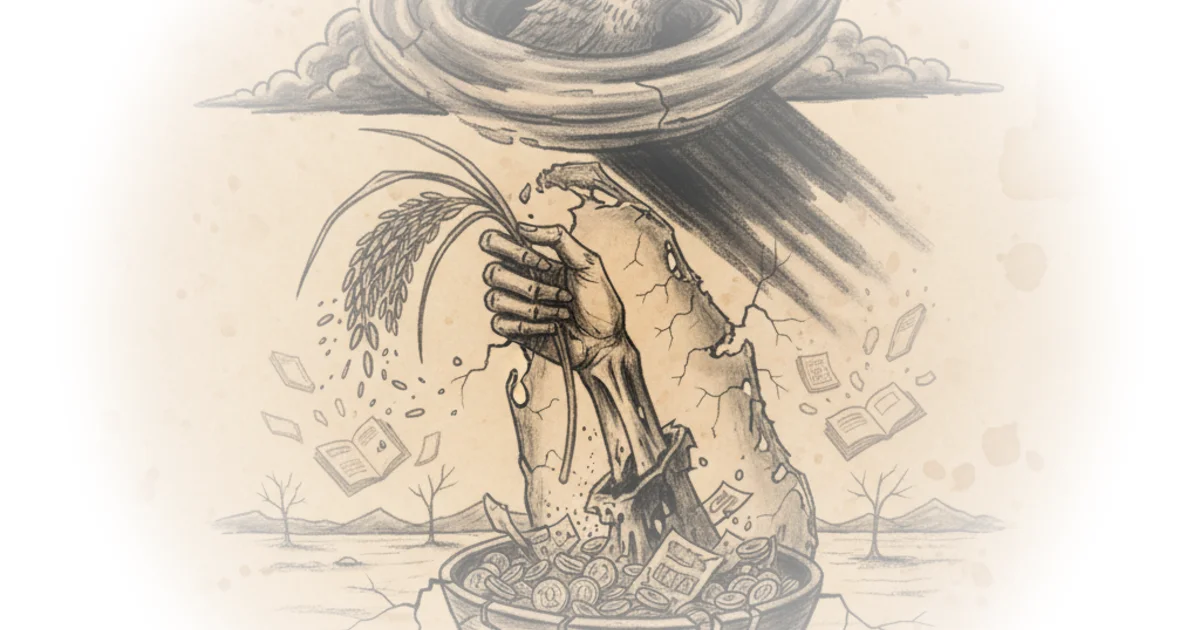
The commentary effectively traces how Sri Lanka's government, in a bid to maintain political stability, artificially propped up the value of the rupee. "Sri lanka is one of those places... if the central bank can convince everyone that no actually 150 rupees is the value of a us dollar well now that rice is effectively 25 percent cheaper." This policy created a false sense of security while draining the country's foreign reserves. The author points out that maintaining this artificial rate requires buying and selling foreign currency, a strategy that inevitably fails when reserves run dry. "When its real market value took over the government meanwhile was still pretending that one usd was worth for example 150 rupees when everyone else had decided it was worth 200."
Walk into a bank hand them one usd and they'll give you back 150 rupees walk on the other hand into a private shop hand them that same dollar bill and they'll give you say 200.
This breakdown of the dual exchange rate system is the piece's most lucid explanation of why the crisis spiraled so quickly. It highlights a critical failure of governance: the state was effectively running a scam on its own citizens by discouraging the deposit of foreign currency. "It doesn't take long before ward gets out don't deposit your foreign currency in the bank it's a scam." The result was a rapid depletion of the very assets needed to import food and fuel. Critics might argue that the focus on exchange rate manipulation overlooks the severity of the external shocks, but PolyMatter correctly identifies that without the internal policy failures, the country might have had the reserves to weather the storm.
The Trifecta of Shocks
The analysis shifts to the external pressures that exposed Sri Lanka's fragility. PolyMatter describes a "trifecta of shocks": the pandemic, the war in Ukraine, and the tightening of global financial conditions. The war, in particular, is framed as a commodity shock of historic proportions. "The conflict and the subsequent sanctions are currently causing the largest commodity shock in half a century." This is not just about higher prices; it is about the volatility of supply chains that many developing nations rely on for survival.
The piece connects the dots between the war and the specific plight of Sri Lanka, noting that Russia and Ukraine produce a significant portion of the world's wheat and fertilizer. "Ukrainian exports alone previously fed 400 million people." When these flows are disrupted, the impact is immediate for net importers. The author notes that the situation is compounded by the Federal Reserve raising interest rates, which makes servicing debt significantly more expensive for developing nations. "Some experts are pointing to pakistan whose currency is currently in rapid decline as a possible next domino to fall." This comparison serves as a stark warning that the crisis is not contained within one island nation.
What for the rich world will be an inconvenience high gas prices inefficient supply chains and possibly even recession will for the developing world mean the undoing of decades worth of progress in healthcare education and general prosperity.
This distinction between the experience of the developed and developing worlds is the emotional core of the argument. It moves the discussion from abstract economics to human survival. The author emphasizes that while the rich world faces inflation, the developing world faces the collapse of basic systems. "Millions of sri lankans went from living a fairly middle-class lifestyle cars college education and leisure to wondering whether they can eat dinner in a matter of weeks."
The Limits of International Aid
Finally, the commentary addresses the role of international institutions like the International Monetary Fund (IMF) and the World Bank. PolyMatter argues that the usual mechanisms for resolving sovereign debt crises are failing because the conditions for a bailout are impossible to meet in the current climate. "Bailouts you see are conditional on things like having a functional government and implementing economic policies which are often unpopular." The irony, as the author notes, is that the very unrest caused by the crisis makes it harder to secure the help needed to fix it.
The piece also pushes back against the popular narrative that Chinese loans were the primary culprit. "Only about 10 percent of sri lanka's debt is owned by china and its leaders have been pursuing disastrous policies for years before any of the recent events." This nuance is vital for a clear understanding of the crisis, shifting the blame from a single geopolitical actor to a broader pattern of poor governance and systemic vulnerability. The author concludes that the groundwork for the collapse was laid decades ago through a "pyramid scheme" of paying off old loans with new ones, a practice that left the country with no buffer against external shocks.
The groundwork for the current crisis can be traced back decades when sri lanka began paying off old loans with new ones in what the world bank has compared to a pyramid scheme.
Bottom Line
PolyMatter's strongest contribution is its ability to connect the specific mechanics of Sri Lanka's currency collapse to the broader, looming global food crisis, offering a clear warning that the developing world is uniquely vulnerable to the convergence of current geopolitical and economic shocks. The argument's greatest vulnerability is its relative silence on the specific political reforms needed to break the cycle of debt and mismanagement, focusing more on the inevitability of the collapse than the path to recovery. Readers should watch closely as the Federal Reserve continues to tighten policy, as the next domino is likely to fall in a nation with similar structural weaknesses.