The Architecture of Fearlessness
Maria Popova has a gift for unearthing the hidden corners of intellectual history and holding them to the light until they glow. Her treatment of Hannah Arendt's most overlooked work — a doctoral thesis written in 1929 that sat unpublished for decades — is one of those recoveries. It is also, perhaps, one of her most urgent. Popova reads Arendt reading Augustine reading the human heart, and what emerges is a meditation on why love terrifies us precisely because it is the only thing worth having.
The manuscript, titled Love and Saint Augustine, was Arendt's first book-length work and the last to be published in English, salvaged posthumously from her papers. Popova frames the irony with characteristic precision: the young woman who would become one of the twentieth century's sharpest analysts of political evil spent her twenties obsessively revising a text about the irrational force of the heart — all while composing fiery love letters to Martin Heidegger.
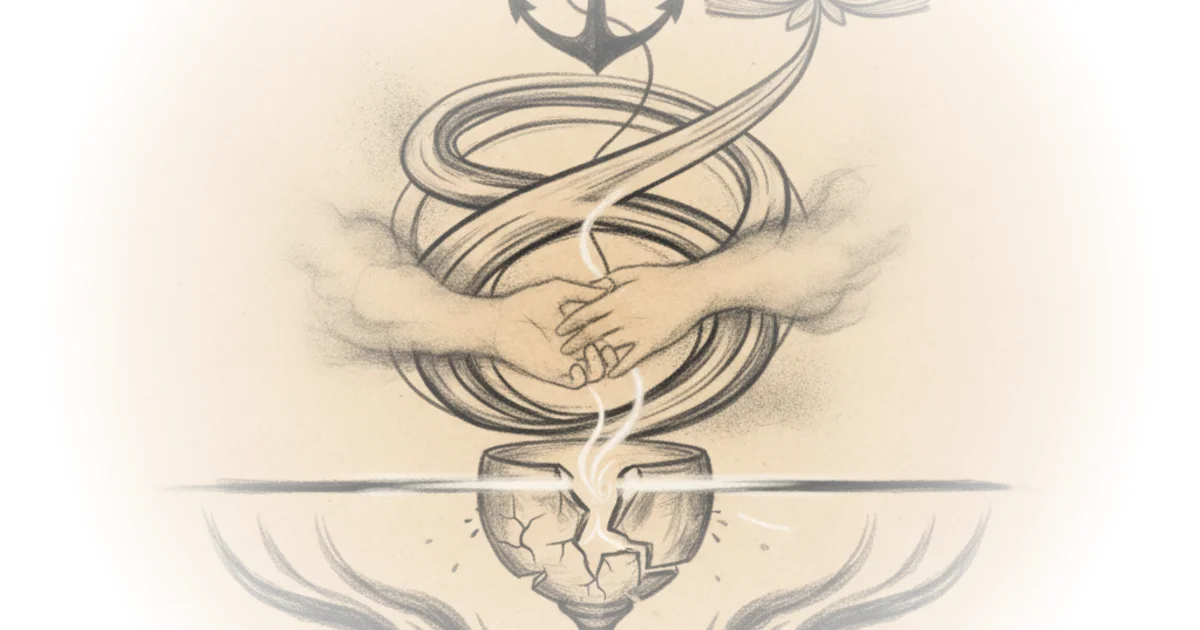
Love as Craving, Fear as the Shadow
Popova begins with Augustine's conception of love as appetitus — craving, appetite, a kind of motion toward something perceived as good. Maria Popova writes, "Every craving is tied to a definite object, and it takes this object to spark the craving itself, thus providing an aim for it." The argument is almost mechanical in its elegance: desire points at something already known, already judged good. We do not discover through loving; we reach for what we have already decided we want.
But here is where Arendt's reading turns darker, and Popova follows her faithfully. Once you possess the thing you desire, the desire does not end — it metastasizes into anxiety. As Popova writes, "Once we have the object our desire ends, unless we are threatened with its loss. In that case the desire to have turns into a fear of losing."
The logic is inescapable. Every attachment is a hostage situation.
Popova channels Arendt's diagnosis with devastating clarity: "So long as we desire temporal things, we are constantly under this threat, and our fear of losing always corresponds to our desire to have." The more you love, the more you have to lose. The equation balances itself in dread. And so the future — that endless parade of things that might go wrong — colonizes the present. We stop living in the now and start living in anticipation of the loss that is coming. Critics might note that this framing risks rendering all human attachment pathological, a view more aligned with Stoic detachment than with the messy reality of how most people actually survive loving.
The Only Valid Tense Is the Now
Against this architecture of dread, Popova locates Arendt's counterargument — one borrowed from Augustine and refined across decades. Maria Popova writes, "Fearlessness is what love seeks. Love as craving is determined by its goal, and this goal is freedom from fear."
Not safety. Not permanence. Fearlessness.
The distinction matters enormously. Safety is an illusion; nothing temporal is safe. Fearlessness is something else entirely — the calm that arrives when you stop bracing for the future and inhabit the present so completely that the future loses its grip on you. Popova quotes Arendt: "Such fearlessness exists only in the complete calm that can no longer be shaken by events expected of the future."
"The future destroys the present."
It is one of the starkest sentences Popova surfaces, and it lands with the weight of a verdict. The mechanism is invisible until named: we ruin the only moment we actually have by living in a moment that does not yet exist. Anxiety is, in Arendt's formulation, a kind of living death. Popova does not soften this. She lets it stand.
Memory as the Storehouse of Time
Popova then turns to Augustine's most inventive contribution — his theory of time as something that exists only in the present, cached in memory. As Maria Popova puts it, "It is only by calling past and future into the present of remembrance and expectation that time exists at all." The past is not behind us; it lives in memory. The future is not ahead; it lives in anticipation. Both are present-tense phenomena.
The implication is staggering. Time does not flow through us. We hold time.
Popova traces this idea to Arendt's later Gifford Lectures, where the notion of the "Now" — that point where past and future briefly coincide — became the centerpiece of The Life of the Mind. The intellectual lineage is continuous: from a doctoral thesis on Augustine's theology of love to a philosophical architecture of consciousness itself.
Critics might observe that Popova's treatment skims over the theological machinery Augustine uses to support these claims. The concept of eternal life, divine grace, and the soul's orientation toward God are not incidental to Augustine's argument — they are its foundation. Arendt secularizes Augustine by stripping away the theology, and Popova follows her without noting what has been lost in translation.
Desire as the Definition of Being
The most philosophically audacious move Popova highlights is Arendt's claim that desire defines human essence. Maria Popova writes, "Strictly speaking, he who does not love and desire at all is a nobody." The argument flips the Stoic script entirely. Where the Stoics saw self-sufficiency as the highest good, Arendt — channeling Augustine — insists that our defining characteristic is our lack of self-sufficiency. We are the creatures who reach outward. To stop reaching is to stop being.
Popova connects this to Arendt's later work on totalitarianism with a single, devastating sentence: totalitarianism is not only the denial of love but an assault on the essence of human beings. The tyrant's weapon is isolation. Love's antidote is connection. The politics of the heart and the politics of the state are not separate domains — they are the same fight conducted on different terrain.
The Transcendence of Transience
Popova closes by returning to the question that animates the entire piece: if love is necessarily finite, how do we live with that fact? She does not offer an answer. She offers something better — a reframing. The courage of love lies not in its permanence but in the integrity with which we inhabit its duration and the grace with which we release it.
As Maria Popova writes, quoting Augustine's own reaching toward the ineffable: "Who will hold [the heart], and fix it so that it may stand still for a little while and catch for a moment the splendor of eternity which stands still forever."
The piece ends without resolution. It is meant to.
Bottom Line
Popova's recovery of Arendt's early work on love is not merely an intellectual curiosity — it is a mirror held up to the most common human malady, the one that disguises itself as rationality and calls itself planning for the future. The piece argues, with philosophical rigor and emotional precision, that the only way to love without being destroyed by fear is to stop treating the present as a waiting room for what comes next. That is a harder task than it sounds, and Popova does not pretend otherwise.