Most music theory lectures treat form as a rigid architectural blueprint, but Yale University reframes it as a living, rhetorical conversation where every note serves a specific psychological purpose. This isn't just about identifying patterns; it's about learning to hear the difference between a melody you can hum and the complex counterpoint that drives a piece forward. The lecture's most distinctive claim is that understanding these functional types transforms a listener from a passive observer into an active critic capable of dissecting a symphony's internal logic.
The Rhetoric of Classical Music
Yale University opens by contrasting the repetitive nature of popular music with the structural complexity of the classical era. They note that while verse-chorus forms rely on "the same musical material coming back again and again," the sonata-allegro form is "something constructed in the 18th century" by figures like Joseph Haydn and Wolfgang Amadeus Mozart. This distinction is crucial because it sets the stage for a more demanding listening experience. The author argues that this specific form is not merely a container for notes but a sophisticated narrative device. "Music in the classical period is what we would call rhetorical music," Yale University states, "it's doing something at every moment." This framing is effective because it shifts the listener's focus from passive enjoyment to active analysis, asking the audience to consider the intent behind every musical gesture.
To make this abstract concept tangible, the lecture breaks the sonata-allegro form down into four distinct functional types: thematic, transitional, developmental, and cadential. Yale University explains that the thematic function presents a melody you can "sing that we can remember," while the transitional function serves to "move from point A to point B." This categorization provides a practical toolkit for listeners. Instead of getting lost in the complexity of a symphony, a listener can now ask: "Is this a theme, or is it a transition?" The lecture emphasizes that the developmental section is where the composer "take[s] the material and play[s] with it," often creating a sound that is "the most polyphonic, the most contrapuntal." This specific vocabulary allows for a much more educated response to music, moving beyond vague impressions of disorganization to precise critiques of counterpoint and imitative entries.
"In the development section... it seemed disorganized because the counterpoint was not clear because the imitative entries of the parts was not clearly articulated."
The lecture uses student interactions to demonstrate how these concepts play out in real-time listening. When a student identifies a passage as "transitional," the instructor points out the "lots of movement" and the eventual "sense of arrival." Conversely, when identifying a "cadential" passage, the focus shifts to the "monotonous harmonic pattern" that psychologically signals the end. This pedagogical approach highlights that the difference between these sections isn't just theoretical; it's audible. The cadential section, for instance, is described as the composer throwing on "heavy simple harmonic motion to slow the music down psychologically." This insight reveals that musical form is as much about manipulating the listener's perception of time and tension as it is about melody.
Theme and Variations as a Series of Box Cars
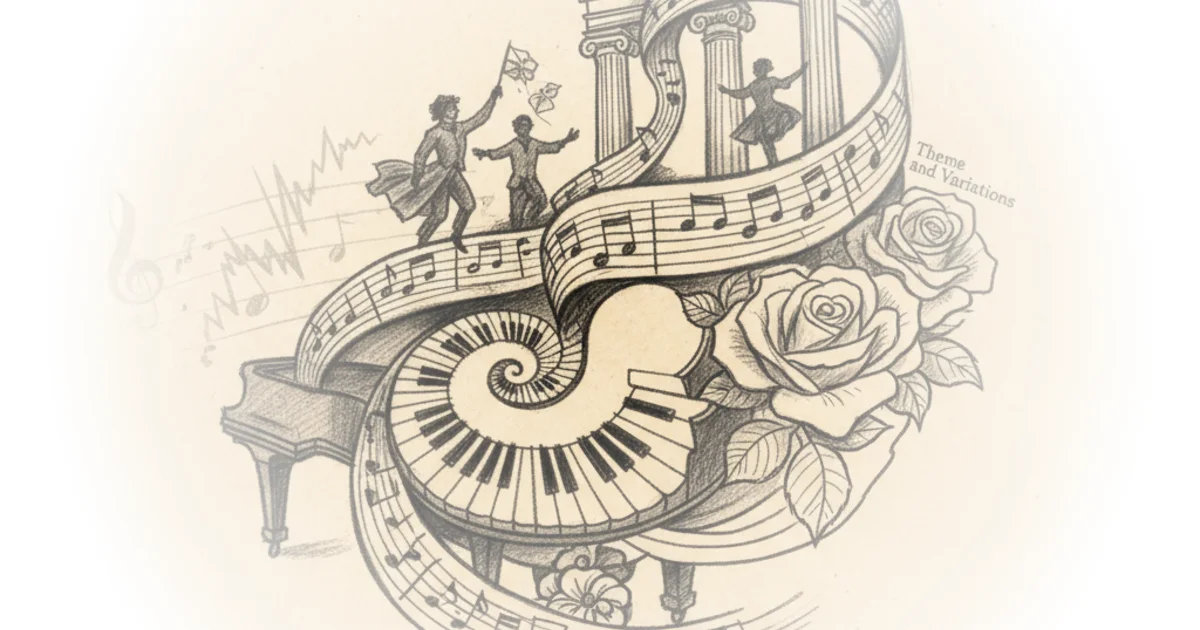
After dissecting the sonata-allegro form, Yale University pivots to theme and variations, describing it as a structure that "goes all the way back to the Middle Ages." The lecture uses a vivid analogy to explain this form: "think of this as a kind of series of box cars on a railroad train." In this model, the units are "more or less the same size," but each car looks different due to "a little different logo on it, a little bit of different ornamental material." This metaphor is a stroke of genius for a busy audience, instantly clarifying a complex musical structure without requiring deep theoretical knowledge. It suggests that the beauty of this form lies in the subtle alterations of a familiar idea, rather than the introduction of entirely new material.
The lecture reinforces the historical depth of these forms, noting that one could find "an early 15th century English carol that's in verse and chorus form" or an instrumental piece in theme and variation from the same era. This historical context grounds the lecture, showing that these structures are not arbitrary inventions but enduring solutions to the problem of musical organization. However, a counterargument worth considering is that by focusing so heavily on the structural mechanics, the lecture might inadvertently downplay the emotional or expressive content that makes these pieces resonate with modern audiences. The focus on "functional types" risks reducing the music to a mechanical puzzle, though the instructor's emphasis on the "rhetorical" nature of the music attempts to mitigate this by restoring the element of human intent.
Bottom Line
The strongest part of this lecture is its practical application of theory to listening, providing a clear vocabulary that transforms how one hears a symphony. Its biggest vulnerability is the potential for over-intellectualization, where the listener becomes so focused on identifying "transitional" or "developmental" sections that they miss the emotional arc of the piece. For the busy professional, the takeaway is clear: the next time you attend a concert, listen not just for the melody, but for the rhetorical function of every moment, turning a passive evening out into an active intellectual engagement.