Ryan Grim & Jeremy Scahill deliver a harrowing dispatch that strips away the diplomatic veneer to reveal the raw, ongoing machinery of displacement and detention. While the administration frames recent moves as strategic pivots, the authors expose a reality where "limited" openings of borders are merely new choke points for control, and where the human cost is measured in emaciated doctors and shattered car windows. This is not a story of policy adjustments; it is a chronicle of a system designed to maximize pressure on the vulnerable while shielding the powerful from accountability.
The Illusion of Access
The piece opens with a stark contradiction: Israel's announcement of a "limited" reopening of the Rafah crossing. Grim & Scahill note that while the Coordinator of Government Activities in the Territories (COGAT) claims this allows for "limited movement of people only," the mechanism remains one of total surveillance. The authors highlight the bureaucratic strangulation inherent in the plan: "Exit from and entry into the Gaza Strip via the Rafah Crossing will be permitted in coordination with Egypt, following prior security clearance of individuals by Israel, and under the supervision of the European Union mission, similar to the mechanism implemented in January 2025."
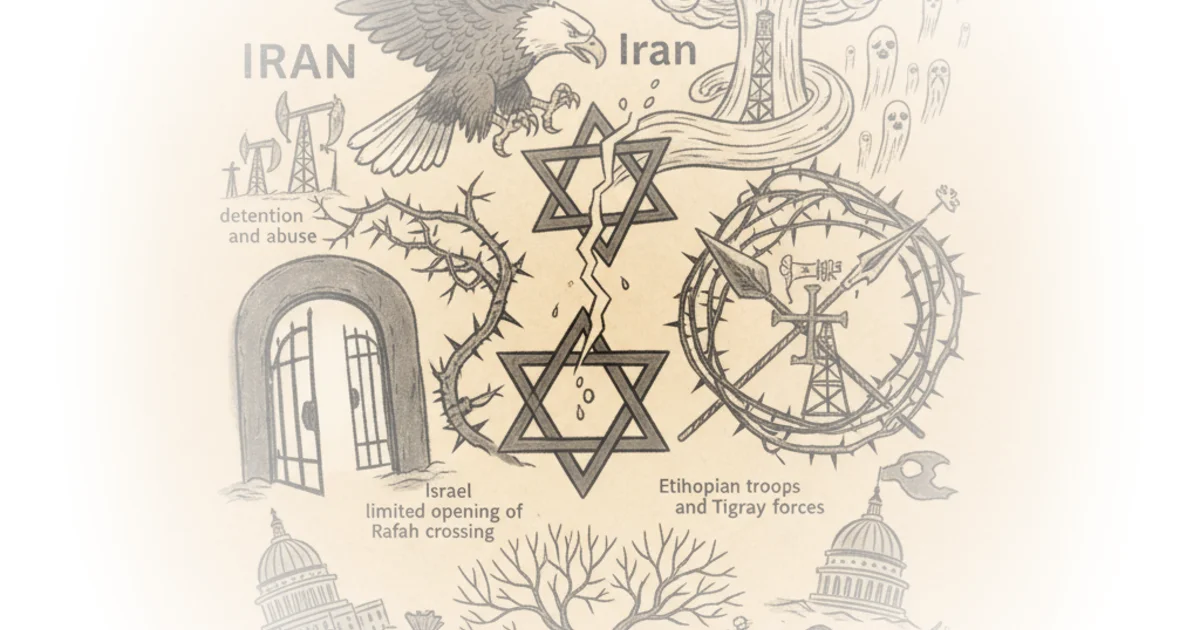
This framing is crucial. By invoking the January 2025 precedent, the authors remind us that this is not a new humanitarian gesture, but a continuation of a failed model. The European Union Border Assistance Mission to Rafah, once a symbol of international oversight, is now reduced to a supervisor of Israeli security clearance. The authors argue that the crossing, once the main gateway for Palestinians, has been effectively seized and held since May 2024, turning a lifeline into a gate that opens only when the state deems it convenient. Critics might argue that any opening is better than total closure, but the text suggests that "limited" access is a tool of psychological warfare, offering hope only to snatch it away with the next security clearance denial.
"Exit from and entry into the Gaza Strip via the Rafah Crossing will be permitted in coordination with Egypt, following prior security clearance of individuals by Israel, and under the supervision of the European Union mission, similar to the mechanism implemented in January 2025."
The Human Toll of "Security"
The commentary shifts with brutal clarity to the human beings caught in the crossfire. Grim & Scahill do not hide behind casualty statistics; they center the narrative on Tasnim al-Hams, a nurse whose father, Dr. Marwan al-Hams, was detained during a raid. The authors describe a scene of profound cruelty: "She described her father as gravely ill and emaciated, having lost nearly 24 kilograms (53 pounds), and said interrogators sought information about the remains of Israeli soldier Hadar Goldin, whose body has since been transferred to Israel."
This detail is not incidental. It underscores the systematic nature of the abuse, where medical professionals are targeted and their families used as leverage. The authors juxtapose this with the ongoing violence, noting that Israeli forces killed at least three Palestinians in southern Gaza and two in central Gaza, including a 19-year-old near the "yellow line." The administration's claim that these strikes target "imminent" threats is met with the reality of the dead: Ahmed Ramzi Saeed Barab, Muhammad Osama Imran, and Anwar Fawzi al-Satari. The authors' choice to name the victims is a deliberate act of rehumanization, forcing the reader to confront the individuals behind the headlines.
The narrative also touches on the broader regional instability, weaving in the conflict between Ethiopian troops and Tigray forces. This context is vital, reminding the reader that the Middle East and Horn of Africa are not isolated theaters but interconnected zones of conflict where peace agreements, like the Stockholm accords, are fragile and often ignored. The authors imply that the administration's focus on "disarming" groups like Hamas ignores the complex web of regional alliances and grievances that fuel these conflicts.
The Domestic Front: Detention and Denial
The piece pivots to the United States, where the administration's hardline stance on immigration is mirrored by escalating trade disputes and domestic violence. Grim & Scahill detail the arrest of Hassane Barry, an asylum seeker in Portland, Maine, where "armed federal agents arrested Hassane Barry... after boxing in his car with unmarked vehicles, shattering the driver's side window, and pulling him away while his wife and one-month-old baby remained inside amid broken glass."
This is not an isolated incident. The authors connect this to the broader strategy of the Department of Homeland Security, noting the administration's move to "convert warehouses into immigration jails in what could be the largest expansion of detention capacity in U.S. history." The human cost is further illustrated in Texas, where police fired chemical agents at protesters outside a family residential center in Dilley. The authors quote an attorney describing conditions as "absolutely abysmal," citing "putrid water used to mix baby formula, food with bugs, verbal abuse by guards, and medical neglect."
The administration's rhetoric is starkly contrasted with these realities. While the President claims that "Hamas will have no guns," the authors point out that "Hamas has said no negotiations have taken place." This disconnect between official optimism and on-the-ground denial is a recurring theme. The authors also highlight the political maneuvering in New York, where a legal challenge by DAWN against Israel Bonds exposes a rift between Mayor Zohran Mamdani and Comptroller Mark Levine. The authors note that "Former City Comptroller Brad Lander divested the city's holding in Israel Bonds in 2024, citing these legal and financial risks," while the current comptroller promises to reinvest. This suggests a growing awareness of the legal and ethical liabilities of funding military operations, even as the administration doubles down.
"Armed federal agents arrested Hassane Barry... after boxing in his car with unmarked vehicles, shattering the driver's side window, and pulling him away while his wife and one-month-old baby remained inside amid broken glass."
The Erosion of Accountability
Perhaps the most damning section of the commentary is the focus on the erosion of accountability within the U.S. justice system. Grim & Scahill cite a CNN analysis that confirms their own video investigation: "at least one federal agent fired a 'flurry of rounds'—at least four shots—at Pretti's body after he had been disarmed and was a..." The sentence cuts off, but the implication is clear: the use of lethal force continues even when the threat is neutralized.
The authors also touch on the political fallout, noting that Senator Rick Scott rejected a funding motion for the Department of Homeland Security, calling it "crazy," while Senator John Fetterman backed Israel despite ceasefire violations. The authors ask a pointed question: "Drop Site's Julian Andreone approached Senator John Fetterman and asked him whether he was concerned about Israel breaking the Gaza ceasefire established in October 2025 thousands of times, killing nearly 500 civilians and injuring more than 1,300; Fetterman ultimately replied, 'I support it.'"
This exchange highlights the political cost of dissent. The authors also note the repeated, unchallenged claims by Governor J.B. Pritzker regarding sexual violence on October 7, despite a lack of independent verification. The authors write, "No independent international investigation body, including the UN Commission of Inquiry, or major human rights organizations such as Amnesty International and Human Rights Watch, has found that a single incident of rape definitively occurred on October 7." This suggests a willingness to propagate unverified narratives to justify military action, a dangerous precedent for democratic discourse.
Bottom Line
Ryan Grim & Jeremy Scahill have constructed a narrative that refuses to let the reader look away from the human consequences of policy. Their strongest argument is that the administration's focus on "security" and "disarmament" is a smokescreen for a broader strategy of control and dehumanization. The piece's greatest vulnerability is its sheer density of tragedy; it risks overwhelming the reader with the sheer scale of suffering. However, this is precisely the point: the scale is the story. The reader should watch for the next move in the Rafah crossing negotiations and the outcome of the DAWN legal challenge, as these will be the first real tests of whether the administration's rhetoric can withstand the weight of reality.
"The administration's focus on 'security' and 'disarmament' is a smokescreen for a broader strategy of control and dehumanization."
The authors' work serves as a necessary corrective to the sanitized language of official statements. By centering the voices of the detained, the dead, and the displaced, they force a reckoning with the true cost of the current geopolitical landscape. This is not just news; it is a warning.