Most urban planning debates fixate on the binary of cars versus bikes, but Jason Slaughter cuts through that noise to argue for a third, superior option that fundamentally reshapes the city itself. He posits that trams are not merely a mode of transit but a tool for creating better, more walkable human environments, a claim backed by a deep dive into the mechanics of European infrastructure. For the busy professional looking to understand the future of urban efficiency, this is the missing link between transportation and quality of life.
The Mechanics of Convenience
Slaughter begins by dismantling the idea that transportation choices are driven by ideology. "I've learned over the years that there really aren't that many car people, bike people, or train people. The vast majority of people just want to get from point A to point B conveniently and efficiently." This observation is crucial because it shifts the debate from moralizing about driving to optimizing for utility. The author argues that when cities prioritize the most efficient methods, they naturally create better living spaces.
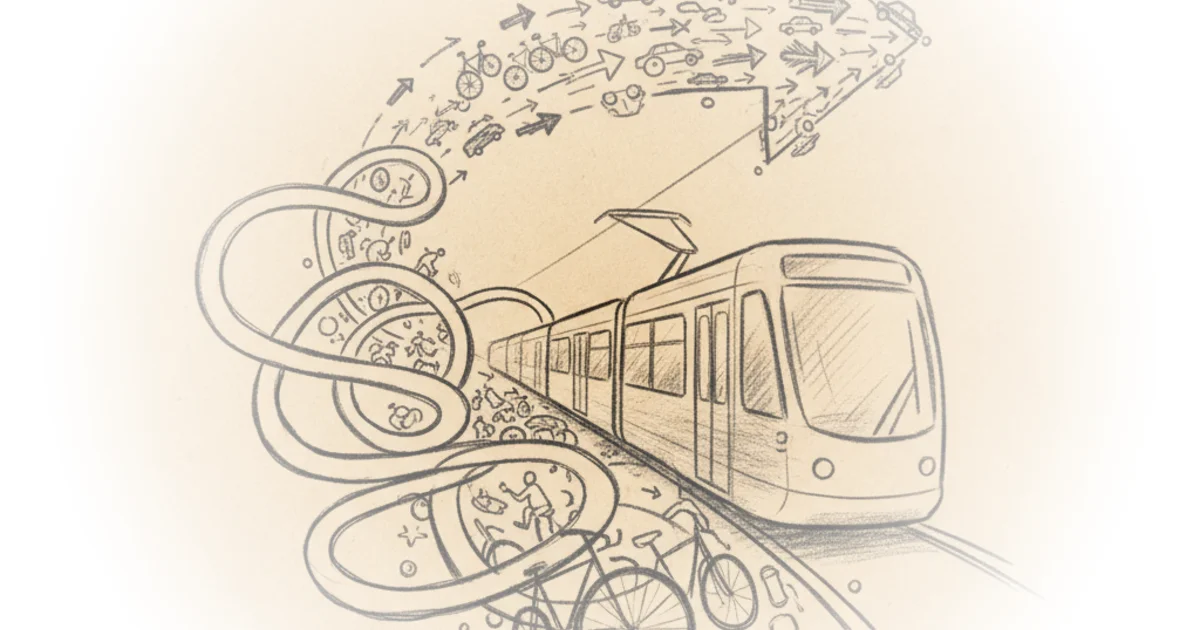
He illustrates this with the specific advantages of the tram network in Amsterdam, noting that "the absolute best part is that all of the traffic lights have transit signal priority. So, as soon as the tram gets close to the signal, it turns green to let us go through." This technical detail is not trivial; it represents a systemic commitment to public transit that eliminates the friction of waiting. Slaughter notes that because of dedicated lanes and signal priority, "while there might be a traffic jam for cars, the tram sails right past them." This reliability is what makes the system viable for the average commuter, not just the enthusiast.
Trams should be thought of as a walking accelerator. They're a way to go from one mixeduse walkable neighborhood to another mixeduse walkable neighborhood faster than you could go by walking.
Designing for the Human Scale
The core of Slaughter's argument is that trams integrate seamlessly into the urban fabric in a way buses and cars cannot. He describes the ideal city street as an "outdoor room" and argues that trams are the only motorized transport compatible with this vision. "Trams run at ground level, and this is a major benefit. With level boarding, it's easy to walk up to the tram stop, get on, and have it take you to your destination." This accessibility is a key differentiator; it removes the barriers of stairs and high curbs that often exclude parents with strollers or those with mobility issues.
Furthermore, the permanence of tram infrastructure drives economic development in a way temporary bus lines do not. Slaughter points out that "when a tram line is built somewhere, it increases the value of that land because having a rapid transit line nearby makes an area more desirable." He contrasts this with North American planning, where neighborhoods are often built for cars first, forcing transit to be an afterthought. In contrast, cities like Amsterdam build the transit first, ensuring that "when people moved in, they already had highquality public transit service available." Critics might note that this approach requires significant upfront capital and long-term political will, which can be difficult to secure in regions with fragmented governance. However, the long-term return on investment in land value and reduced congestion often justifies the initial outlay.
The Catalyst for Better Streets
Slaughter takes a hard look at how different transit modes affect the pedestrian experience. He contrasts the chaos of buses in pedestrian zones with the predictability of trams. "Tram run on rails and so they're really predictable. Everybody knows where the tram is going to go, so they wait a moment for it to pass and then continue walking." This predictability allows for pedestrianized squares to remain vibrant and safe, whereas bus routes often force the creation of curbs and asphalt that break the flow of the street.
He cites the example of Groningen, where a redesign to remove buses from a central square improved the walkability but inadvertently made public transit access harder. "If Groningen had a tram network, it could run the trams through the city center with minimal disruption, which would allow it to maintain good connectivity by public transit while also preserving the highquality walkability of the area." This highlights a critical flaw in many modern urban renewal projects: they often treat transit as a problem to be removed rather than a feature to be integrated.
There is literally no other form of transportation that is more accessible than a ground level tram stop with level boarding. It doesn't matter if you're pushing a stroller or a suitcase or carrying something heavy or even using a wheelchair. There is no vehicle easier to get into than a well-designed tram.
Bottom Line
Slaughter's most compelling contribution is reframing trams not as a nostalgic throwback but as the essential infrastructure for the modern, walkable city. The argument's greatest strength lies in its focus on the synergy between transit and urban design, proving that you can have high-capacity movement without sacrificing the human scale of the street. The biggest vulnerability remains the political and financial hurdle of implementing such systems in car-centric regions, but the evidence from European cities suggests the payoff is worth the struggle.