In an era saturated with health influencers and polarized public health debates, Rohin Francis identifies a specific, dangerous mental trap that transcends political divides: the "mechanistic bias." This is the seductive belief that if a treatment sounds scientifically plausible, it must be effective, regardless of whether the evidence actually supports it. Francis argues that this cognitive error is not limited to fringe wellness gurus but is a fundamental flaw in how modern society, including credentialed professionals, evaluates medical truth.
The Demarcation Problem
Francis begins by grounding the discussion in the philosophy of science, specifically the "demarcation problem": how do we distinguish science from non-science? He invokes the work of 20th-century philosopher Karl Popper to explain that science is defined not by what can be proven true, but by what can be proven false. "Popper proposed that science isn't about what you can prove because many things can have supporting evidence without being science," Francis writes. He illustrates this with the classic example of swans: one can observe a thousand white swans, but a single black swan disproves the theory that all swans are white. This falsifiability is the engine of scientific progress.
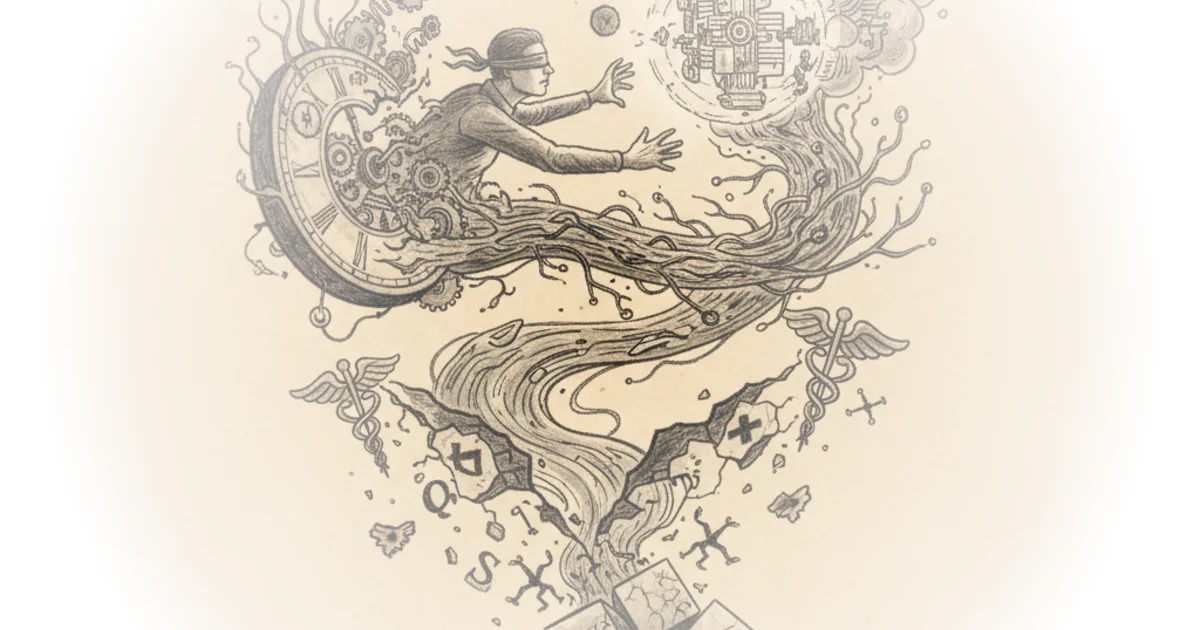
However, Francis notes that this clear line blurs in the public imagination. He argues that pseudoscience thrives in the gray area between obvious magic and rigorous physics. These fields "are dressed up like science in order to borrow its respectability and cachet." They use scientific language, publish in sciency-looking journals, and propose mechanisms that sound logical to the layperson. The danger lies in the fact that these fields do not ask for blind faith in spirits; they ask for belief in a logical framework that is, in reality, flawed. Francis points out that even highly educated individuals fall for this because "they are fooled by these more legitimate looking Fields" that mimic the trappings of clinical medicine.
Pseudoscience fields use scientific language, they may perform experiments using apparently scientific equipment, they may publish those results in sciency looking journals, have mechanisms or pathways that may appear plausible.
This framing is particularly effective because it shifts the blame from the intelligence of the believer to the sophistication of the deception. It explains why a person who would instantly reject a psychic might still trust a chiropractor or a homeopath. The latter offers a narrative of cause and effect that feels rational, even if the underlying mechanism is nonsense.
The Trap of Bioplausibility
The core of Francis's argument targets a specific cognitive shortcut: bioplausibility. He defines this as the assumption that if a treatment makes biological sense on paper, it will work in practice. "Bioplausibility is a fairly self-explanatory neurologism to describe if something is biologically plausible," he explains. For instance, it is biologically plausible that an antibiotic kills bacteria, or that ice reduces inflammation. But Francis warns that this is merely the starting point for research, not the conclusion.
He critiques the tendency to mistake a plausible mechanism for a proven cure. "Time and time again people mistake the first step for the end of the journey," Francis writes. He draws a sharp distinction between interventions that are biologically plausible and those that are not, such as homeopathy, where a solution is diluted to the point where no original chemical remains. "If you ingest a solution that has been diluted so many times that there is no trace of the original chemical present it is not biologically plausible that this will do anything," he asserts. Yet, the human brain struggles to accept that a logically constructed argument can lead to a false conclusion.
Francis extends this critique to the wellness industry, where the desire for control and the comfort of human interaction are often masked as medical efficacy. He suggests that many alternative therapies work because they provide "tender human contact" and a sense of being cared for, rather than through any active pharmacological mechanism. "It's okay to say that these things have real value and feel nice without resourcing to seeing them through the lens of science," he argues. The problem arises when practitioners invent "vague concept[s] of scientific holistic Wellness" to justify these effects, leading patients to view them as superior to proven therapies.
The problems arise when you start trying to give some quack explanation as to why these things have an effect by inventing this vague concept of scientific holistic Wellness or a hodgepodge of metaphysical and medical terms which can lead to people viewing them as inherently active cures.
Critics might note that Francis's dismissal of alternative therapies risks undervaluing the placebo effect, which is a real and powerful physiological response. If a patient feels better because they believe a treatment works, the outcome is genuine, even if the mechanism is not. However, Francis's point remains valid: attributing that improvement to a fake mechanism can lead to the abandonment of life-saving treatments.
The Universal Blind Spot
Perhaps the most striking aspect of Francis's commentary is his observation that this bias is not partisan. He notes that the mechanistic bias "flies under the radar" and is demonstrated by "both sides of the gaping Chasm that has opened up in society" during the pandemic. Whether it is the "carnivore ice bath testosterone crew" or the group demanding "booster shots in perpetuity," both sides make the same mental mistake. They assume that because their preferred narrative has a plausible mechanism, it must be the whole truth.
Francis uses a Star Wars analogy to illustrate how reducing a complex, magical concept to a simplistic biological metric can strip it of its value and lead to misunderstanding. He compares the "midichlorian" explanation in the prequels to the modern obsession with microbiome testing. "George Lucas clearly took a leaf out of the alternative medicine apologists Playbook when he was making the prequels and took all the magic out of the force by boiling it down to some blood test," Francis writes. This reductionism, while seemingly scientific, often fails to capture the complexity of human health.
I believe that shining infrared light at my scrotum increases my testosterone level and there's this very compelling study in the Journal of infrared scrotal studies demonstrating this Cutting Edge science yes I am aware that there are multiple studies contradicting this but frankly a lot of them had funding from the visible light spectrum industry and big UV.
This satirical example underscores the absurdity of confirmation bias when paired with a plausible-sounding mechanism. Francis argues that the solution is not to reject science, but to demand that claims be falsifiable and supported by evidence, not just by a story that sounds good.
Bottom Line
Rohin Francis delivers a compelling critique of how the human mind prioritizes narrative coherence over empirical evidence, a flaw he terms the "mechanistic bias." The piece's greatest strength is its ability to unify disparate groups under a single cognitive failure, showing that the desire for a plausible story is a universal vulnerability. However, the argument's reliance on strict falsifiability may overlook the nuanced reality of the placebo effect and the value of patient-centered care that doesn't always fit the rigid mold of randomized trials. Readers should watch for how this bias influences their own acceptance of new health trends, especially those that sound too logical to be false.
Time and time again people mistake the first step for the end of the journey.