BobbyBroccoli transforms a history of nuclear physics into a gripping narrative about the perilous line between scientific discovery and catastrophic error. The piece's most striking claim is not that Enrico Fermi discovered new elements, but that his celebrated "mistake"—failing to recognize he had split the atom—unintentionally ignited the nuclear age. This reframing turns a standard biography into a cautionary tale about the limits of human perception in the face of the unknown.
The Pope of Rome and the Missing Row
BobbyBroccoli sets the scene with vivid imagery of 1930s Italy, where scientific ambition outpaced resources. "Fermi is Italy's top physicist at the age of just 24... unlike the pope though he was broke." The author highlights the makeshift nature of the research, noting that when protection from radiation was needed, scientists would "Sprint back and forth down his lab if it meant extending his lifespan by a few years." This framing effectively humanizes the high-stakes environment, stripping away the sterile image of modern laboratories to reveal the physical danger inherent in early nuclear physics.
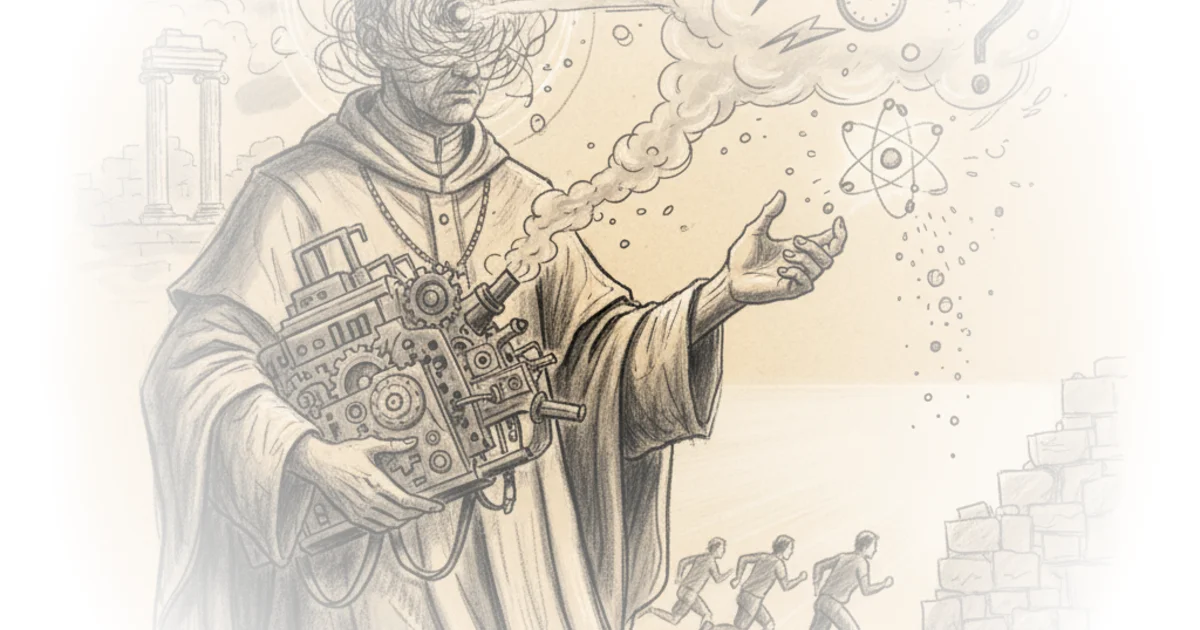
The core of the argument rests on Fermi's methodology. He aimed to create elements 93 and 94 by bombarding uranium with neutrons, expecting a process called beta decay. "Fermi's idea was to go to the furthest edge of the periodic table uranium element 92 fire neutrons at it to try and artificially induce beta Decay." When the results didn't match known elements, Fermi concluded he had created new ones. BobbyBroccoli notes that "Fermi and his team had to rule things out by verifying which elements they hadn't created," a process that ultimately led to a false positive. This highlights a critical vulnerability in scientific inference: the danger of assuming a new discovery simply because an old one doesn't fit. Critics might note that Fermi's error was understandable given the lack of tools to detect fission fragments, but the narrative choice to emphasize his confidence makes the eventual reversal more dramatic.
"Fermi had falsely claimed the discovery of two new elements and half a century later one man would make a similar false claim but entirely on purpose."
The stakes of this error were geopolitical as well as scientific. With the rise of fascism, Fermi faced immense pressure to name the hypothetical elements after Roman symbols. "Fermi did not follow this suggestion," BobbyBroccoli writes, pointing out the irony that the symbol of fascism had taken on a "terrifying meaning." The timing of Fermi's Nobel Prize win, coinciding with anti-Semitic laws in Italy, forced his family to flee. The author captures the urgency: "Fermi his wife and his children packed their bags and immediately traveled to Sweden they did not return to Italy." This section masterfully weaves personal history with the broader political climate, showing how the pursuit of knowledge is inextricably linked to the safety of the seeker.
The Sea of Radioactivity
The commentary shifts to a more abstract visualization of nuclear stability, using a chart of nuclides to explain the forces at play. BobbyBroccoli describes the chart as a "topological map of our journey through the periodic table," where stable nuclei form "tall pillars" surrounded by a "raging sea of radioactivity." This metaphor is powerful, turning complex physics into a navigable landscape. "The sea even has Tides," the author explains, describing alpha and beta decay as currents that push unstable atoms back toward stability.
The narrative then introduces the true discoverers of element 93, neptunium, and element 94, plutonium. The credit goes to Edwin McMillan and Phil Abelson at Berkeley, who faced a unique dilemma. "Their publication was met with Silence from the academic community no one dared acknowledge the Breakthrough lesta give the Germans any inspiration." This detail underscores the shadow of war that hung over scientific progress. The story then introduces Glenn Seaborg, whose family name was altered by an immigration officer, a small bureaucratic error that would echo through history. "This Customs officer had no idea that his half-assed spelling attempt would one day make it on to the periodic table," BobbyBroccoli quips, adding a touch of levity to the heavy subject matter.
Seaborg's work on plutonium is described as a delicate balancing act. "It really is like an absurdly delicate game of Jenga," the author writes, illustrating the precision required to isolate the element. The stakes were incredibly high, as plutonium proved to be a superior fuel for atomic weapons. The narrative touches on the hazards of this work, recounting an incident where a lead brick broke a beaker and "25 of the world's entire plutonium Supply was soaked into a copy of the Chicago times." This anecdote serves as a stark reminder of the fragility of the materials that would soon reshape the world.
"Fermi had split an atom in two a process that releases an absurd amount of energy in reality Fermi had discovered nuclear fission a discovery that would go on to fundamentally reshape the upcoming war that he had just fled from."
Bottom Line
BobbyBroccoli's strongest move is reframing Fermi's "failure" not as a blunder, but as the accidental ignition of the nuclear age, a discovery that would dictate global power struggles for decades. The piece's greatest vulnerability lies in its simplification of the complex chemistry of fission, which may leave some readers wanting more technical detail on why the Berlin group identified krypton and barium. Ultimately, the commentary succeeds in showing that the path to scientific truth is often paved with false starts and unintended consequences.
The story of Fermi, Seaborg, and the periodic table is a testament to the fact that in the race to understand the universe, the most profound discoveries often arrive when we are looking in the wrong direction.