The Poet Who Outgrew Her Platform
Rupi Kaur's conversation on the Tetragrammaton podcast arrives at an inflection point in her career. She is 33 years old, on a self-imposed sabbatical, disconnected from the social media apparatus that made her famous, and wrestling with a question that has haunted artists for centuries: how do you create authentically after early, massive success? Her answers are revealing not just for what they say about poetry in the Instagram age, but for what they expose about the machinery of creative fame itself.
The basic biography is now well-known. Born in Punjab, immigrated to Montreal as a toddler, started performing spoken word in high school, began posting poems on Tumblr and then Instagram, and self-published "Milk and Honey" in her early twenties. The book spent a hundred weeks on the New York Times bestseller list and sold millions of copies. What is less discussed -- and what this conversation excavates with unusual candor -- is what happened to the creative process after the machine took over.
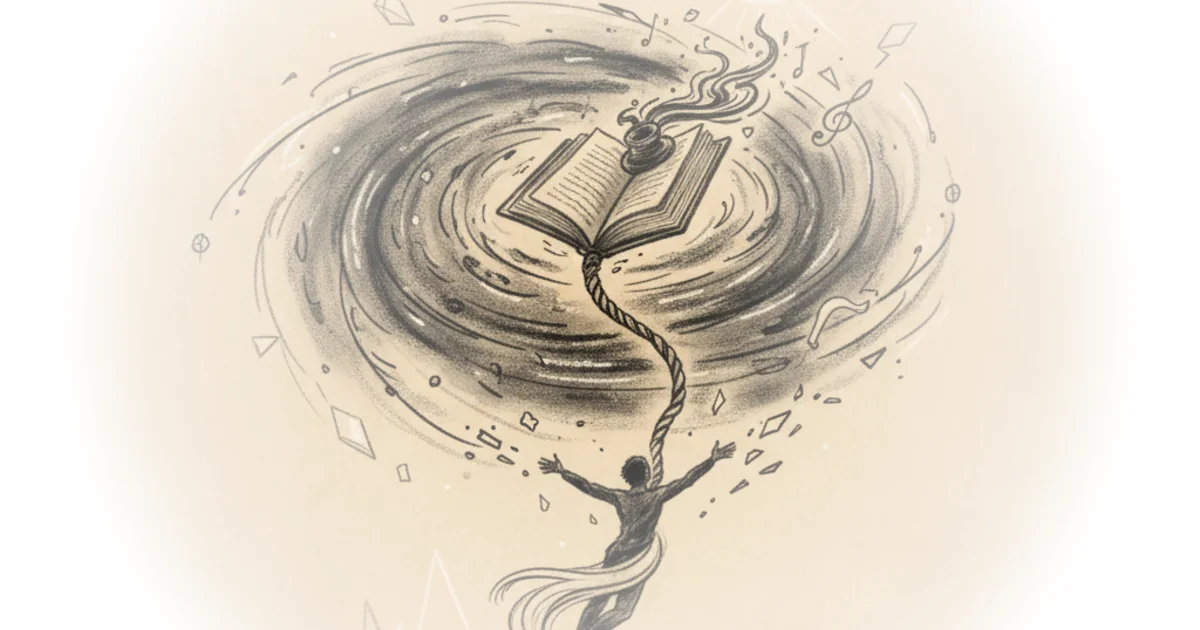
The Body Keeps the Score
Kaur describes her second book as a near-traumatic experience. Her publisher gave her roughly two months to deliver a manuscript. She tried to reverse-engineer the magic of the first book using discipline and output targets, borrowing advice from writers like Stephen King about daily word counts and regimented schedules. The result was physical collapse.
Writing became such a punishing act and my body became so sick and I would go through these 72-hour migraine spells. I couldn't digest food. It was just pain all the time.
This is a familiar pattern in creative industries -- the sophomore effort produced under contractual pressure, stripped of the conditions that made the debut possible. What makes Kaur's account distinctive is her frank admission that she never fully understood how the first book happened in the first place. She arrived at the blank page for book two "having no idea how I even did it the first time." The organic process of writing poems for live performance, posting them casually, and letting an audience accumulate over years had been compressed into a deadline-driven production cycle.
A counterpoint is worth raising here. Many prolific artists -- from Dickens serializing novels on deadline to Dolly Parton writing thousands of songs on schedule -- have produced their finest work under external pressure. The romantic notion that creativity requires total freedom from constraint is historically dubious. What Kaur may actually be describing is not a universal truth about art, but a specific mismatch between her particular creative temperament and the publishing industry's timelines.
Instagram Poet Is Not a Self-Description
One of the conversation's most interesting threads is Kaur's relationship with the label "Instagram poet," which she firmly rejects. Her origin story is stage performance, not social media. She performed at open mic nights for years before posting anything online, and the move to Instagram in 2012 was almost accidental -- she asked a friend if sharing a poem about alcoholism and domestic violence on a photo-sharing platform was "super weird."
The transition from stage to screen required a genuine artistic innovation. Kaur discovered that the long-form spoken word pieces that killed in live venues fell flat online. She developed what she calls "peach pits" -- poems stripped down to their concentrated core.
I'll write a first draft and then it's about peeling back the skin and the flesh and just presenting the core of the idea so that it's the most concentrated form and it hits you hard and fast, like a shot of vodka or something.
This is a legitimate formal contribution, whatever one thinks of the resulting poems. Kaur essentially created a new format: the micro-poem optimized for visual consumption on a feed, paired with a simple line drawing. That this format was then imitated by thousands of accounts and became its own genre -- often dismissed by literary critics as shallow -- does not diminish the innovation itself. The Beatles did not invent rock and roll, but they shaped the form that millions then followed.
The Sabbatical and the Social Media Question
The most candid portion of the interview concerns Kaur's decision to step away from posting entirely. She describes advisers who told her she could shut down every other operation, but urged her never to stop posting. The implication was clear: her value in the marketplace was inseparable from her follower count.
So much of how I define myself doesn't include social media at all. But so much of how people define me or why they find me valuable is my social media platform because of the followers I have.
This is the central tension of creator-economy fame. The platform giveth and the platform taketh away. Kaur built an audience of millions on Instagram, but the platform changed around her. She describes feeling unable to express anything meaningful in the format anymore, noting that even a "little nugget" of what she wants to say will be "vastly misunderstood." She has gravitated toward long-form options -- newsletters, podcasts -- while also "trying not to create more work for myself."
The irony is thick. The poet who became famous for radical brevity now finds the short form insufficient. Whether this reflects genuine artistic evolution or the natural restlessness of someone who has exhausted a format's possibilities is an open question.
Process as Performance
Host Rick Rubin -- characteristically understated throughout -- steers the conversation toward creative process, and Kaur's answers reveal a poet who thinks about her craft in primarily somatic terms. She describes the genesis of a poem not as an idea or a set of words but as a physical sensation.
What forms inside is a feeling and the feeling is the feeling I want to have when I read the thing and how I think writing that thing is going to free me and how it'll feel in my body.
She recounts one of her most recognized poems nagging at her like "an annoying song" for three months before she finally wrote it down, dismissing it as preachy the entire time. The poem -- which begins "I want to apologize to all the women I've called pretty" -- turned out to be among her most circulated works. The lesson she draws is about getting out of her own way, about the intellect as obstacle rather than instrument.
Rubin reinforces this framework repeatedly, offering what amounts to a creative philosophy session. His advice -- lower the stakes, write bad poems on purpose, treat everything as "free play" until you decide it is a book -- is essentially permission to stop performing productivity. He even proposes a homework assignment: one poem a day for fifty days, with no expectation of quality.
I don't care what it says. And knowing no one will ever read these. They serve no purpose other than practice in turning on the machinery. I'm doing my poet workout. I'm not making art. I'm not sharing it with the world. This is something else. I'm just doing my reps.
The Uncracked Poem
Perhaps the most compelling moment in the conversation is Kaur's description of a poem she has been unable to finish for months. It concerns a woman who wakes each morning resolved to leave a relationship -- metaphorized as an island -- but loses her nerve at the shore every time, turning back when her partner's confident voice overpowers her own uncertainty.
His voice says, "You can't live without me." His voice sounds so confident that she's never been that confident about anything. And so then she confuses that confidence for truth.
Kaur knows the poem's ending -- one morning the woman simply dives in without waiting for the fear to pass -- but cannot find the words for what changes on that particular morning. Both she and Rubin acknowledge that this unfinished poem mirrors Kaur's own creative situation: the fear of leaving a known identity, the confidence of external voices telling her what she can and cannot do, the inability to articulate why one day the leap becomes possible.
It is the kind of artistic problem that cannot be solved by effort alone, and Kaur seems to know it. The poem will either arrive or it will not. The woman will either swim or she will not. And the poet who sold millions of books by distilling emotion into its smallest possible container is now trying to find words for the one experience that resists compression.
Cultural Bridges
A quieter but significant thread runs through the conversation about Kaur's Sikh heritage and its relationship to her art. She describes Sikh scripture as written in "poetic verse" and "musical compositions" -- short, concise verses that a community could discuss for hours. The parallel to her own formal choices is obvious, though she does not belabor the point. Her decision to write in all lowercase, she explains, was partly inspired by Punjabi script, which has no uppercase letters and no punctuation.
In Punjabi we don't have any upper case. There's just one case and it's all quite symmetrical and there's no punctuation.
She also describes performing in India for the first time in 2018 and feeling, for the first time, that she did not need to explain herself. The audience simply understood. This is a telling detail. For all the millions of followers and bestseller lists, the deepest artistic recognition Kaur describes came not from the global internet but from a live audience in the country she left as a three-year-old.
Bottom Line
Rupi Kaur's conversation with Rick Rubin is the portrait of an artist at a genuine crossroads -- not the manufactured kind designed to generate sympathy, but the real kind where the old methods no longer work and the new ones have not yet emerged. She is honest about the emptiness that followed early success, the physical toll of forced creativity, and the gap between the confident performer on stage and the uncertain person who steps off it. The most interesting question the conversation raises is whether the Instagram poetry format Kaur pioneered was a genuine art form that she has outgrown, or a viral phenomenon that happened to attach itself to a talented performer. Her next book -- if it arrives on its own terms rather than a publisher's deadline -- may answer that question. In the meantime, the unfinished poem about the woman and the island says more about where Kaur is than any finished work could.