In a year defined by rapid scientific headlines, Matt O'Dowd's year-end reflection on PBS Space Time stands out not for a single discovery, but for a radical reframing of how we perceive the act of observation itself. He argues that the universe isn't just a stage where physics plays out, but a self-contained informational structure where the "flow" of time is merely a byproduct of how internal patterns process data. This is not a standard recap; it is a meta-commentary on the very nature of scientific inquiry, suggesting that the next frontier isn't just new particles, but understanding the observer's role in the cosmic equation.
The Needle in the Record
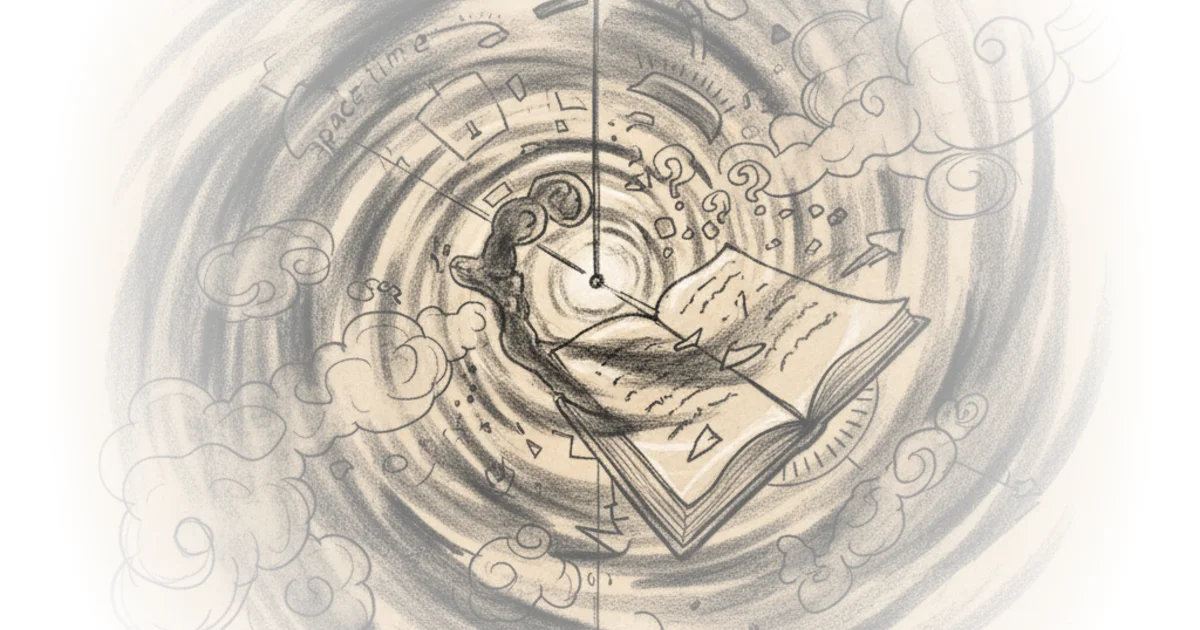
O'Dowd tackles the counterintuitive concept of "block time," where past, present, and future exist simultaneously in a four-dimensional block. He dismantles the common analogy that compares this to a music record with a needle playing it. "To answer this we need to pick apart what an observer is," O'Dowd writes, noting that an observer is not an external entity but a localized pattern within the block itself. He argues that the feeling of time passing is not caused by an external force moving through the universe, but by the internal evolution of information within a conscious system. "In order to in the first place develop this self-awareness and then to reflect and tell yourself this a story of your self-awareness the data structure needs to evolve," he explains. This framing is compelling because it removes the mystical "now" and replaces it with a mechanical necessity: consciousness requires a sequence of data processing to exist at all. Critics might note that this reduces the subjective experience of "now" to a computational artifact, potentially sidestepping the hard problem of consciousness, but the logical consistency of the argument holds firm within the bounds of information theory.
"Really there is no needle there are just different frames of reference defined by the world lines of informational patterns inside the block and some of those frames of reference are telling an internal story to themselves if read in the right direction."
The Illusion of Shine and the Reality of Black Holes
Shifting from the abstract to the tangible, O'Dowd addresses the nature of light and the paradoxes of black holes with characteristic clarity. He challenges the intuitive notion that photons themselves possess the quality of "shine." "Photons don't shine per se," he states, clarifying that "what shines is our perception of the endpoints of photons when they dump their energy uh on the retinas of our eyes." This distinction is vital for understanding that many physical properties are relational, not intrinsic. He applies similar rigor to black holes, addressing why they appear black even though light from the event horizon is technically "frozen" there. The answer lies in redshift: the light is stretched to such low energies it becomes undetectable. "The light from the stuff on the Event Horizon is infinitely redshifted so its wavelength has been stretched to the point but we could never detect it," O'Dowd notes. This explanation effectively bridges the gap between the theoretical ideal of a black hole and the observational reality captured by the Event Horizon Telescope.
The Holographic Universe and Dualities
The most profound section of the commentary addresses the possibility that our universe is a hologram, specifically through the lens of the AdS/CFT correspondence. O'Dowd explores the idea that the universe could be described equally well as a three-dimensional volume or as a two-dimensional surface. He warns against the common misinterpretation that the interior is merely an illusion. "It has been I think uh often vary incorrectly described that the interior of our universe is actually an illusion and that we really use this on the boundary and that is not what the holographic principle is saying," he corrects. Instead, he emphasizes that these are dual descriptions: "one is not more fundamental than the other." This is a crucial nuance often lost in popular science coverage. The existence of such dualities suggests that our current theories are merely different maps of the same territory, hinting that a deeper, unified theory lies beneath both. A counterargument worth considering is that the AdS/CFT correspondence applies to a specific type of universe that differs from our own, making its direct application to our reality speculative. However, O'Dowd uses this limitation not to dismiss the theory, but to highlight the power of duality as a tool for understanding.
"Dualities in general are such a strange feature of our universe we see them uh throughout a lot of our more specular theories like the holographic principle and string theory but we also see it in regular physics um dual descriptions of the same phenomena different stories that lead to the same observables."
Bottom Line
Matt O'Dowd's commentary succeeds by shifting the focus from "what we found" to "how we know," offering a sophisticated look at the structural foundations of physics. The strongest part of the argument is the reframing of time and consciousness as internal data processes rather than external flows, a perspective that aligns with modern information-theoretic physics. Its biggest vulnerability lies in the speculative nature of applying holographic principles to our specific universe, yet O'Dowd handles this with appropriate caution. For the busy thinker, the takeaway is clear: the next great leap in physics may not be a new particle, but a new way of understanding the relationship between the observer and the observed.
"The universe is a very meta place."
The Future of the Inquiry
Looking ahead, O'Dowd promises that the show will move toward even more "meta" questions, exploring the philosophy of science and the physics of the mind. He acknowledges the difficulty of these topics, admitting that some areas, like the nature of the mind, are "hairy stuff." Yet, the commitment to asking "what is the project of science really" signals a maturation of the discourse. This approach respects the intelligence of the audience, treating them not as passive consumers of facts but as active participants in the grand inquiry of existence. As O'Dowd puts it, "we'll try to keep asking some very big questions and our questions have been are going to become more and more meta." This is the promise of the coming year: a deeper dive into the architecture of reality itself.